
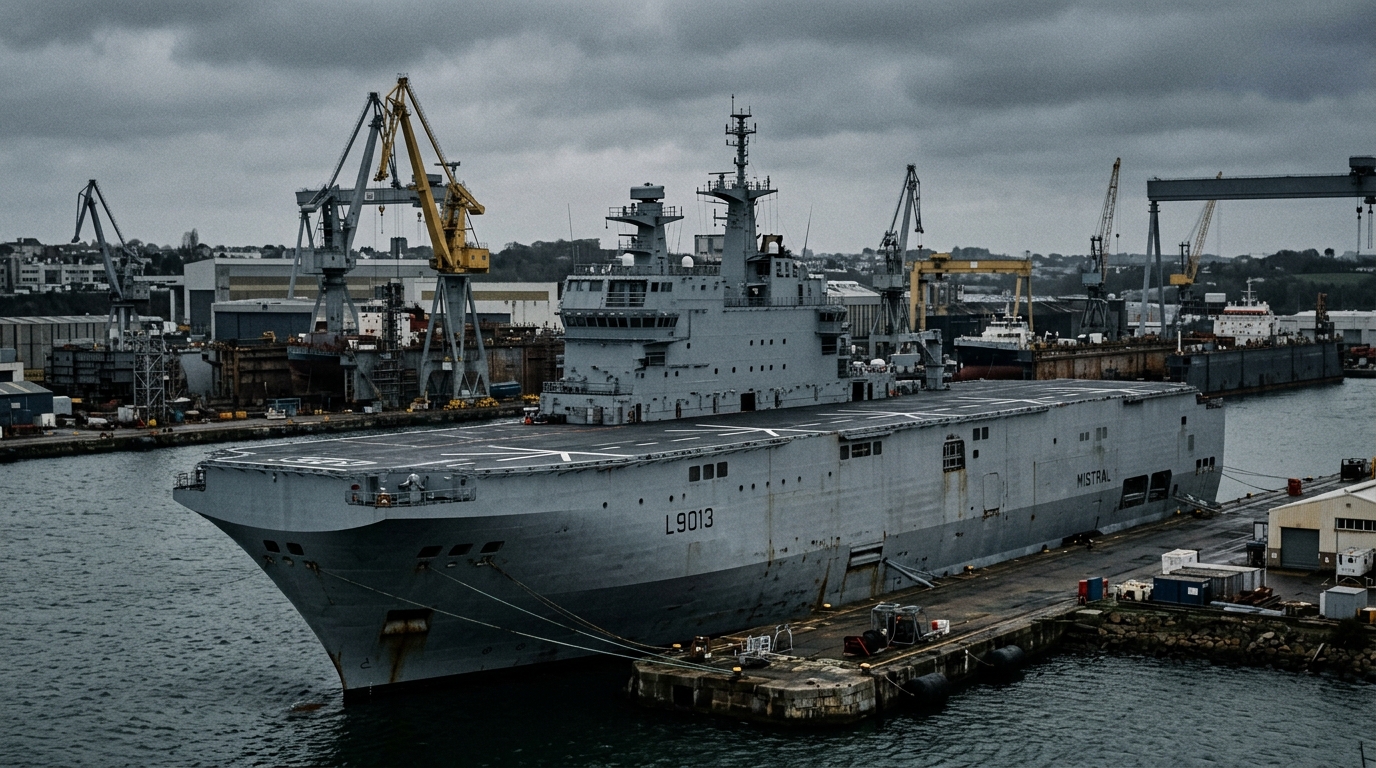
Imagine having to repay the full mortgage on a property you will never inhabit, and to make things worse, the seller charges you for the travel to visit the site. This is essentially what happened to France in the Mistral ships affair, the helicopter-carrying warships built in Saint-Nazaire but never handed over to Russia. The spark was Russia’s annexation of Crimea in 2014, which abruptly altered the geopolitical landscape and transformed a weapons contract into a diplomatic and financial headache. Almost €950 million ultimately left the French treasury to settle the affair, a sum that, when examined more closely, hides intriguing details about how Moscow managed to defend its interests down to the last cent.
- France paid about €950 million to Russia after the cancellation of the Mistral contract, including €893 million to reimburse the advances already received.
- The bill includes €56.7 million covering the maintenance and training costs for the 400 Russian sailors who stayed in France awaiting a delivery that never occurred.
- Sold to Egypt for a comparable amount, the two ships would have, in fact, cost France an additional €200–€250 million according to the Sénat.
- When Paris has to pay for ships it will never deliver
- €893 million: the price of a contract canceled amid the Ukrainian crisis
- The hidden bill: Russia makes France cover even the waiting costs of its sailors
- Mistral, Vladivostok: two hulls without a flag that will remain in diplomatic history
When Paris has to pay for ships it will never deliver
The scenario could almost pass for bureaucratic absurdity: build two sophisticated warships, test them at sea, train crews from abroad to operate them, then be forced to cancel everything under international pressure. That is precisely what France experienced with the two Mistral, the helicopter-carrying carriers originally destined for the Russian navy. The contract, signed years earlier, called for the delivery of ships capable of transporting helicopters, armored vehicles, and troops. But the Ukrainian crisis upended the situation, and Paris was pressed by Western allies not to supply military equipment to a country under sanctions.
Result: an agreement was signed on 5 August 2015 between France and Russia to formally cancel the sale outright. Yet canceling a major arms deal does not come without concessions. The question that French lawmakers faced seemed simple on the surface but was dangerously complex in terms of budgetary implications: how much would renouncing the deal cost French taxpayers?
€893 million: the price of a contract canceled amid the Ukrainian crisis
The bill presented at the time by the foreign minister Laurent Fabius set a figure whose precision was almost comical given its scale: €949,754,849. This number is not random; it is the sum of several expense items. A large portion, amounting to €893 million, simply represents the reimbursement of advances paid by Russia when the order was placed. Moscow had already financed the construction of the ships, plus the development of port infrastructure in Vladivostok and the technical adaptation of Russian helicopters intended to operate from the Mistrals.
In other words, France did not pay a punitive penalty in the traditional sense: it largely returned the money it had already received. It is a logically tidy accounting move, but it becomes dizzying when viewed against the total cost of the operation, a figure that long fed a variety of speculations in the press and in the National Assembly.
The hidden bill: Russia makes France cover even the waiting costs of its sailors
This is where the story takes a rather almost-savory turn. In addition to the €893 million in advances reimbursed, Moscow tacked on a further line of €56.7 million. This sum did not correspond to equipment or infrastructure; it was the reimbursement of the costs incurred to train 400 Russian sailors who had come to France to wait for a delivery that, in the end, never occurred. In short, Russia made France pay for the sailors’ accommodation, meals, and training—despite the ships remaining idle on French soil.
The French government of the time sought to minimize the budgetary shock, insisting that the real extra cost to the state was only these €56.7 million, the rest being a return of already received funds. But this official presentation did not convince everyone. Le Canard enchaîné spoke of a total bill that could climb to as much as €2 billion when accounting for ancillary costs, such as the guarding of the ships. Opposition deputy Thierry Mariani put forward a range of between €1.5 and €1.6 billion, considering the cost of what he called the “derussification” of the ships—essentially removing all Russian military equipment already installed on board.
That dismantling continued for months after the agreement was signed, with guarding costs estimated at no less than €2 million per day. A stark contrast to the official narrative of a dismantling-free, low-cost resolution.
Mistral, Vladivostok: two hulls without a flag that will remain in diplomatic history
What to do with two brand-new helicopter carriers, stripped of their Russian technology, and without a buyer? France eventually found a solution by selling the two ships to Egypt, for a price close to €950 million, including training for the Egyptian crews. The operation was presented at the time as financially neutral for the state, since it theoretically compensated the money paid to Moscow.
Yet, once again, the budgetary reality proved more nuanced. According to the Senate Finance Committee, this sale to Egypt was, in fact, expected to cost between €200 and €250 million more to the French budget, contradicting earlier promises of a zero-sum transaction. The two Mistrals, briefly named Vladivostok and Sebastopol in reference to their original Russian destination, thus became a symbol of a defense contract caught between geopolitics and arithmetic, two hulls without a flag that ultimately cost far more than anticipated, no matter which angle you choose to read the bill from.
In the end, this affair vividly illustrates how a dossier presented as purely technical can conceal layers of negotiations worthy of an economic espionage novel. Between the reimbursement of advances, the waiting costs for Russian sailors, and the hidden expense of the Egyptian resale, the French taxpayer paid the price of a geopolitical decision taken far beyond France’s borders. One question remains: how many other international arms contracts conceal similarly surprising lines of charges?
