
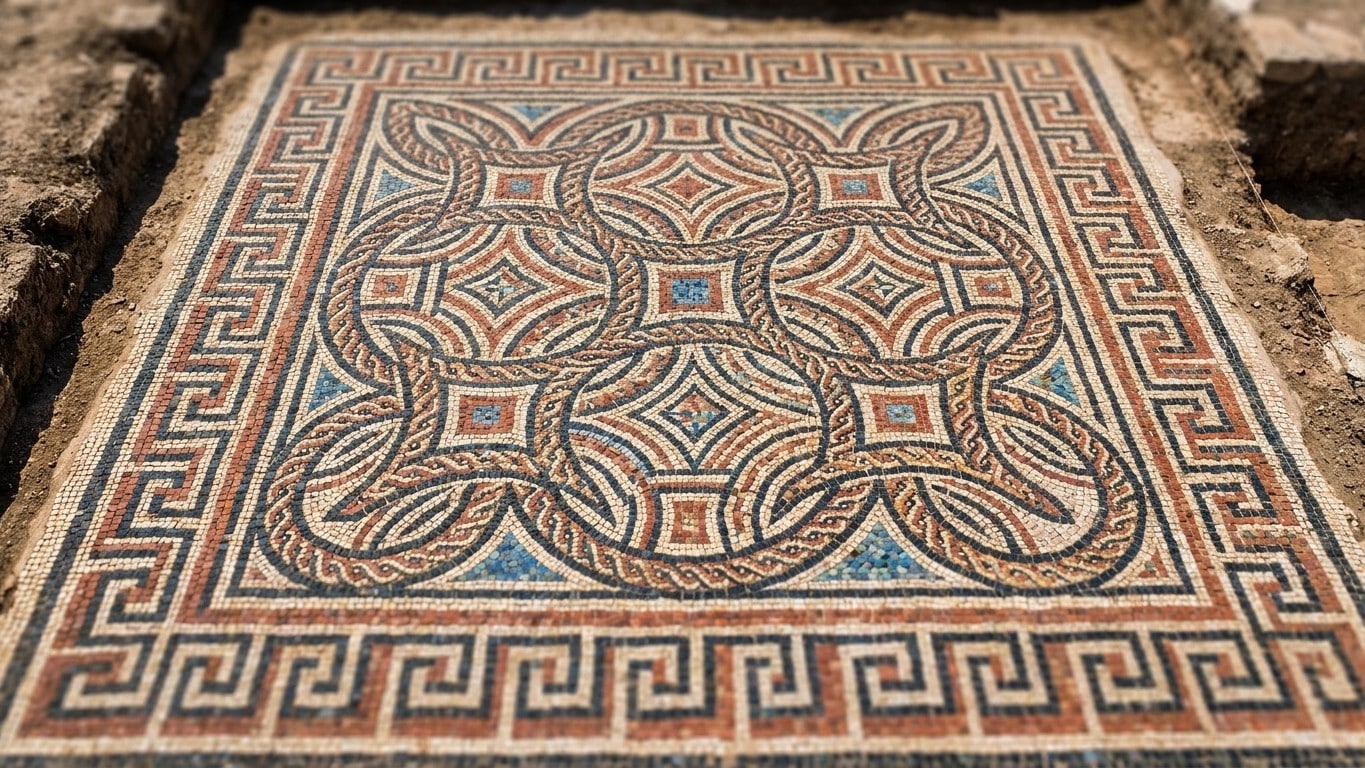
June 2026, Eauze, Gers. Excavations at the major site of the ancient city of Elusa have unearthed a vast, remarkably preserved IVth-century polychrome mosaic in the Domus de Cieutat. Not a single tessera has shifted in seventeen centuries. Beneath only a few tens of centimeters of Gascon soil, a Roman floor waited, intact, colorful, silent, since the legions had abandoned the Aquitaine region.
Key takeaways
- A 4th-century polychrome mosaic surfaces after seventeen centuries underground
- How could an ancient artwork escape destruction for more than a thousand years?
- Elusa, forgotten capital, yields its secrets to 21st-century archaeologists
A Room That Never Forgot Its Colors
The mosaic displays black, red, white, and blue. The tesserae are made from a variety of materials, mostly calcareous stones but also marble. This chromatic mix, laid stone by stone by Roman artisans in the IVe century, has weathered the collapse of an empire, the incursions of the barbarians, the entire Middle Ages, and the industrial era without losing its radiance. To place the period in context: when this floor was laid, Constantine had just legalized Christianity, and the Western Roman Empire still had a century before its end.
Laurent Callegarin, a professor at the University of Pau and head of the archaeological operations, explains: “We have recovered a threshold composed of marble slabs and numerous fragments of high-quality materials. Everything indicates we are in a prestigious room belonging to a wealthy dwelling.” A reception hall, most likely. The kind of space where guests were impressed by floors that cost a fortune, the equivalent of a Parisian apartment, on the scale of Antiquity.
The mosaic is expected to be fully uncovered and documented within a few days. Specialists in ancient mosaics were on site to study this exceptional discovery. The work of a Roman artisan from the IVe century, examined by experts of the XXIe. A dialogue that is almost impossible to imagine in time.
Elusa, a Forgotten Capital Beneath the Gers’ Vines
Who knows Elusa? Almost no one, outside the circles of archaeology. And yet, Elusa is the name of the ancient city of Eauze. In the 3rd century AD, the city became the capital of the Roman province of Novempopulania and radiated across today’s Gascony. As a provincial capital, it functioned as a major regional prefecture within the Empire’s hierarchy. A city of power, commerce, and culture.
The Domus de Cieutat, spanning 2,700 square meters in the IVth century AD, was the site of display and reception for a local notable. To give scale: 2,700 m² equals the footprint of a Haussmann-era Parisian building. A single owner, in a provincial Roman city. The mosaic that has just been uncovered adorned this miniature palace, in the heart of an aristocratic district where local elites rivaled in refinement.
After a first third was uncovered in 2012, the remaining two-thirds have just been revealed, offering now an almost complete view of this exceptional ancient decoration. Fourteen years of waiting between the two revelations. Archaeologists are not always in a hurry, and that delay is often a blessing for what they seek.
How Did 42 m² of Floor Survive Seventeen Centuries?
The question deserves attention. Nearly twenty hectares around the Elusa site are preserved from urban development, a protection that partly explains why this floor was never pierced by a construction pick. But geology also plays a role: successive layers of silt, humus, and backfill create a natural mat that isolates the relics from moisture and shocks. In Turkey, another recent example illustrates this well: a collapsed wooden roof over a mosaic from the same period helped seal it beneath a protective layer.
The phenomenon occurs more often than one might think beneath French towns. INRAP conducts more than 450 preventive excavations annually, according to the Ministry of Culture. Each construction project undertaken in a zone with archaeological potential can theoretically yield such discoveries. In the event of an incidental discovery, works must be halted immediately and the site manager must notify the prefecture’s archaeological services. A well-established protocol, but it cannot prevent the awe when the bucket strikes something beautiful.
In Alès, in 2025, INRAP archaeologists experienced something similar. The mosaic uncovered at this Gallo-Roman site featured a center made of white, black, and red tesserae arranged in interlaced geometric patterns, surrounded by a plain white band and a black rectangle speckled with white crosses, probably marking a doorway threshold. Two mosaics, two contexts, but the same astonishment from the field teams.
What the Earth Keeps Better Than Our Archives
The excavations’ lead reveals that “this site did see medieval occupation, but we are still trying to understand where inhabitants settled between the 5th and 11th centuries. We now believe the town gradually retreated onto the Cieutat plateau. Future campaigns will focus on this transition between Antiquity and the Middle Ages.” The Eauze mosaic, therefore, is not merely a feat of conservation; it is also a gateway to centuries of darker local history, those generations of transition between Rome and the barbarian kingdoms about which little is known.
The École d’Aquitaine designates a stylistic current of itinerant mosaic workshops whose regional center was in Gallia Aquitania from the 4th century onward. This school is characterized by a grid that defines squares containing a stylized plant motif, or more rarely a hollowed solid on a black background that creates a sense of volume. Eauze’s tesserae may well belong to this regional tradition, in which case they are as much a work of art as a testimony to the reach of a Aquitanian craft, exporting its know-how across the Southwest. A locally rooted mosaic, yet with a Mediterranean ambition.
Sources: grandsudinsolite.fr | mairie-eauze.fr
