
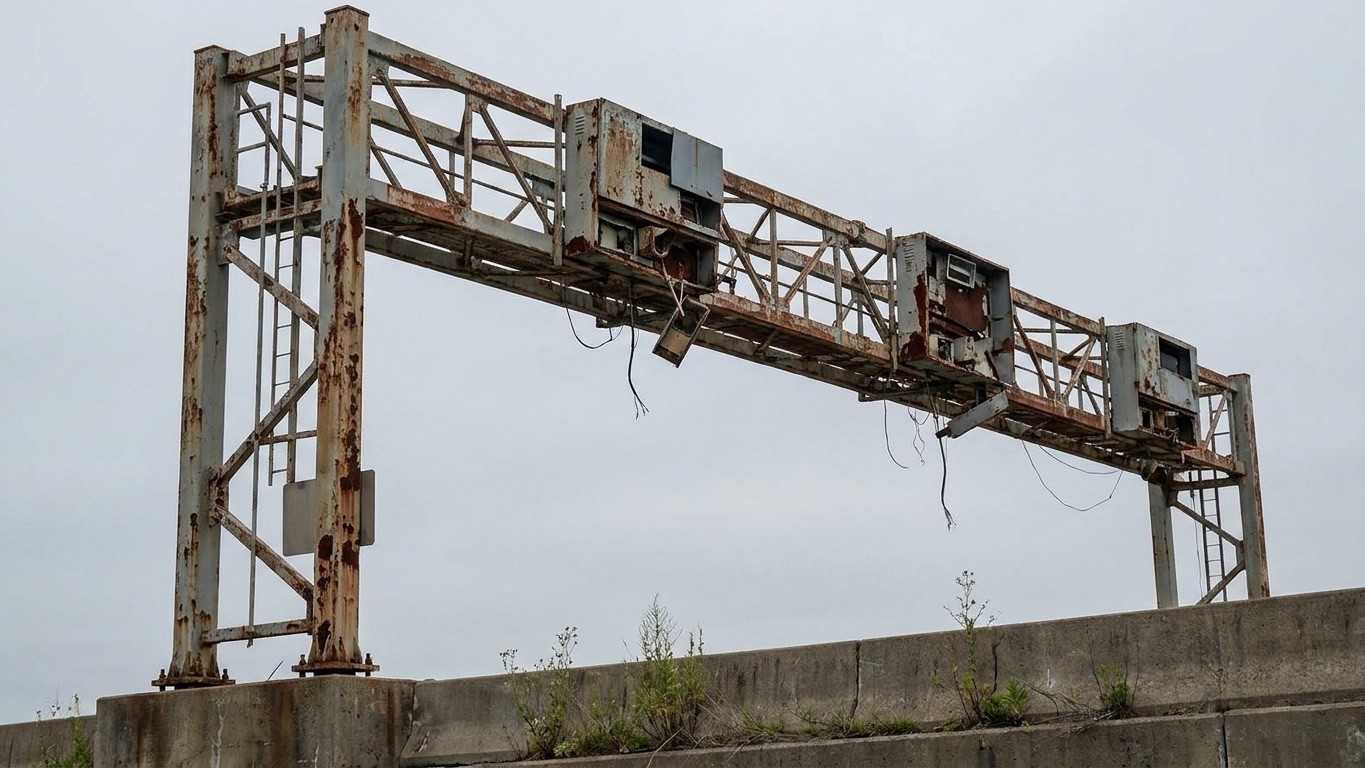
A tax that has never yielded a single euro, yet costs the state dearly every year. The Court of Auditors estimated that revenue losses from lowering the axle tax reached 795 million euros per year, a measure introduced in 2009 to pave the way for a heavy goods vehicle ecotax that, in turn, never came to fruition. Twelve years after the project was abandoned, the reduction of this alternative tax, meant to be only temporary, has still not been corrected.
Back in 2009. The Environmental Round Table had just given birth to an ambitious project: to charge heavy goods vehicles by the kilometer traveled on the French road network, via a system of tolling gantries and GPS devices entrusted to the company Ecomouv’. To win acceptance of this future ecotax among road hauliers, the State chose a goodwill gesture: to lower the axle tax, the levy in place since 1968 on heavy vehicles, down to the minimum allowed by European rules. The idea is simple: avoid stacking two taxes on the same vehicles at the same time. A report from the Court of Auditors makes it explicit in black and white: this reduction of the axle tax rate, to the minimum level permitted by the community rules, represents a revenue loss of 53 million euros per year, a measure taken in 2009 to foster acceptance of the implementation of the heavy goods ecotax among road transport organizations.
Key takeaways
- A temporary 2009 decision turned into a permanent budget drain of 795 million euros per year
- The promised heavy goods ecotax never operated, but its compensatory counterpart was never repealed
- French motorists ultimately paid the bill for a project that did not concern them directly
A decision suspended, never canceled
The problem is that the promised ecotax never worked. Faced with the Bonnet rouge protests in Brittany, the government of Jean-Marc Ayrault suspended the scheme at the end of October 2013, before Ségolène Royal definitively buried it in October 2014. Result: France paid to install a revenue-collection system that it never activated. The compensatory measure supposed to balance this abandonment, namely the axle tax cut, remained in force. An reduction intended to be temporary thus transformed into a permanent revenue shortfall, year after year, without any finance law restoring order.
This budgeting anomaly did not escape the Cambon Street magistrates. In its public annual report published on February 8, 2017, the Court of Auditors coldly details the tally: between 2009 and 2024, and in the absence of revising the axle tax rate by then, the cumulative revenue loss would reach 795 million euros for the state budget, in constant euros. An amount calculated over fifteen years, which, to give an idea, is roughly equal to the annual operating budget of a mid-sized prefecture. But this is money that never enters the coffers, year after year, with no visible offset for road users.
9.8 billion euros wiped out in total
The axle tax is only the visible tip of the iceberg. The ecotax itself, the one that would have replaced this shortfall, was never collected either. According to the Court’s calculations, the abandonment of the heavy goods ecotax is the source of potential net revenue losses to public administrations of 9,833.09 million euros over the contract’s execution period. Nearly 9.8 billion euros, equal to the annual budget the State dedicates to the ecology and transport mission as a whole.
In addition to this double revenue loss, there were real expenditures. The State had to compensate the Ecomouv consortium for terminating the contract, with indemnities that rise to 957.58 million euros, i.e., 180.79 million for the “suspension” and 776.79 million for the termination indemnity, to which 70 million euros of costs for steering, operational deployment and unwinding the contract are added. The gantries installed along the roads were scrapped or sold for a fraction of their value. The Court notes that these devices, initially valued at 652 million euros, were sold for amounts between 2% and 30% of their initial value, bringing in only 2.19 million euros for the State.
The bill paid by motorists, not by foreign heavy trucks
To plug this budget hole, the executive chose a discreet solution: raising the fuel tax. The Court of Auditors regards this choice as ineffective in terms of fairness among carriers, since the original aim was precisely to make foreign trucks pay when traveling on French soil. The report is unequivocal on this point: the indirect objective of rebalancing the relative competitiveness between French and foreign carriers in France, which the heavy goods ecotax was meant to address, failed because foreign heavy goods vehicles refuel little in France. In plain terms, it is mainly French motorists behind the wheel of their own cars who ended up footing the bill for a project that did not concern them directly at first.
The Court’s overall judgment remains severe, almost nine years after this initial finding: “Costly for public finances and damaging to the coherence of transport policy and its funding, the abandonment of the heavy goods ecotax constitutes a waste.” The axle tax, for its part, continues to be collected at the floor rate fixed in 2009, with no successive government deeming it appropriate to revise its stance. A budget blind spot that endures fifteen years after a decision that was supposed to be only temporary, and which resurfaces today in the debate on a new per-kilometer tax, this time considered for electric vehicles, as the ecotax experience remains a deterrent in the minds of public decision-makers.
Sources: actu-environnement.com | questions.assemblee-nationale.fr | lemoniteur.fr
