
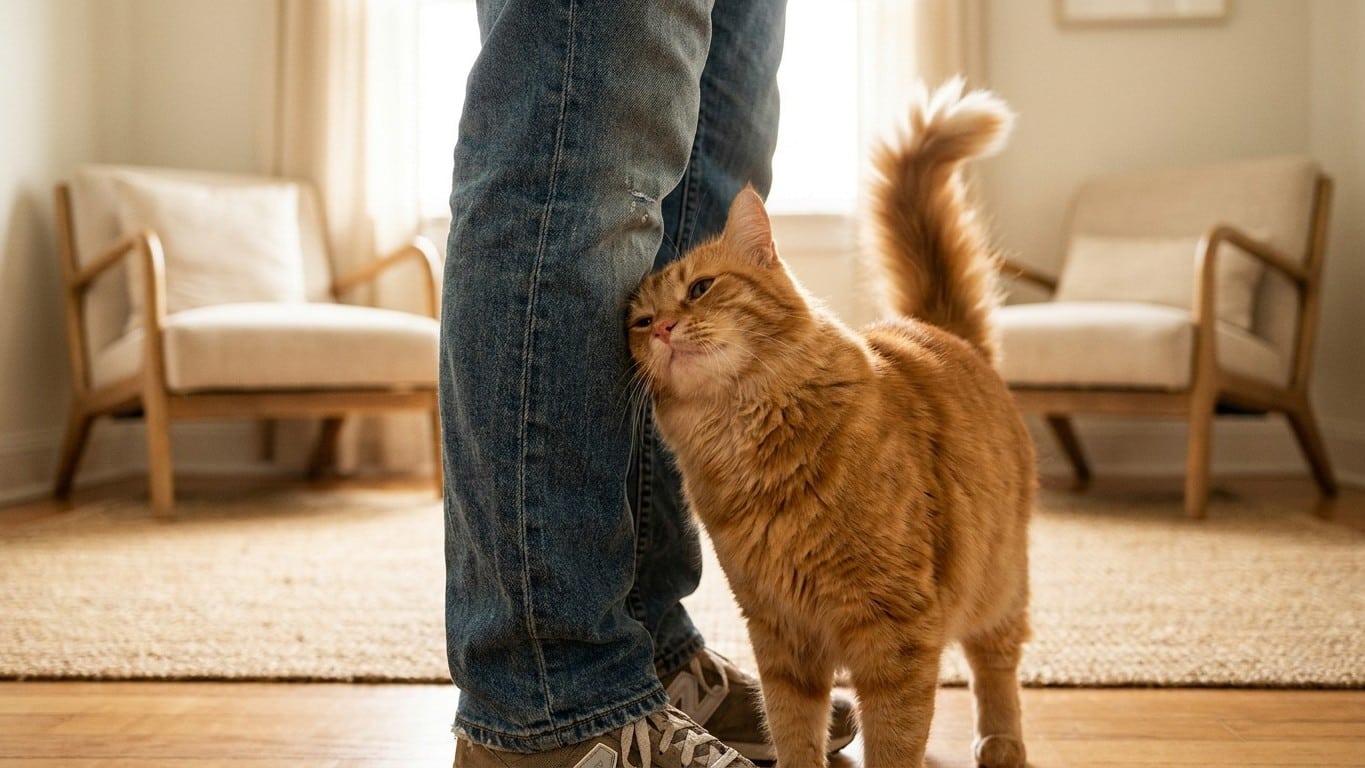
Your cat does not see you as its owner. Nor as a human friend in the true sense. According to British anthrozoologist John Bradshaw, a specialist in feline ethology at the University of Bristol, cats perceive us as other cats — bigger, clumsier, but belonging to the same social group as them. That sums up a conclusion that challenges conventional wisdom: after 10,000 years of cohabitation, you probably do not hold the status you think you do in your feline’s mind.
Key takeaways
- Cats apply to you exactly the same body language they use with one another
- Your cat probably understands your words, but deliberately chooses not to obey
- You fall into a very specific category: a large maternal substitute
Researchers have explored the cat’s cognitive world
After years in which scientists had largely ignored cats’ social intelligence, feline cognition laboratories have sprung up around the globe, and a growing number of studies show that cats rival dogs in many tests of social competence. The contrast with dogs is striking. Science long focused on dogs, capable of memorizing an average of 89 words. Cats have long been underestimated in cognition, simply because they do not reveal their understanding in a servile manner like canines.
Result: for decades, it was believed feline indifference stemmed from a lack of understanding. It was a misread. This nuance explains why a cat may seem to ignore its owner. According to Saho Takagi, a researcher at Azabu University in Japan, the animal may understand a large portion of human speech without choosing to respond. The cat processes the information, classifies it, but sovereignly decides not to display obedience or reaction. Your cat understands. It chooses not to obey. The nuance matters.
You are not their master; you are a large conspecific
Feline behavior expert John Bradshaw has frequently discussed his research into what cats think of humans. Cats display exactly the same body language and behaviors toward us as toward other cats. By contrast, dogs interact in a completely different way with humans and with their conspecifics. That is the fundamental distinction. The dog has integrated humans into a special category. The cat, on the other hand, has not bothered to do so.
Bradshaw argues that, judging by certain behaviors, cats see their humans as feline peers. He highlights three kinds of interactions in particular: a raised-tail headbutt, mutual grooming, and resting in contact with us. These gestures are not marks of affection “in the human sense”; they are feline social protocols applied to a different species. When your cat rubs its head against your leg, it acts exactly as if it were meeting another cat in its colony.
The category you fall into is not flattering
From an ethological standpoint, the human caretaker of a cat functions as a maternal substitute. Adult cats live in a kind of extended infancy, a form of behavioral neoteny. Here’s the picture: you are not his social equal. You are not his boss. You are, with a certain biological precision, a kind of substitute grandmother, a nurturing and protective role, but not a prestigious one.
Domestication has transformed other aspects of feline behavior. Our modern cats tolerate our presence better, are more sociable, and retain kitten-like behaviors even as adults, a phenomenon known as neoteny. Neoteny refers to the retention of juvenile physical or behavioral traits into adulthood. It is likely these characteristics help cats socialize with humans and other felines or pets in the home. In short, the domestic cat has solved the problem of cohabitation with humans by remaining emotionally a perpetual kitten. It’s an elegant, somewhat disarming solution for the human ego.
The ethologist John Bradshaw reminds us that the cat does not view humans as a pack leader the way a dog does, but rather as a social partner. There is no strict hierarchy here: the relationship is chosen, nuanced, and contextual. The cat–human attachment thus does not mirror the canine model; it expresses itself through feline-specific codes. Perhaps the most counterintuitive aspect is that a cat that has ignored you from the back of the sofa does not despise you. It places you in the category of “trustworthy conspecific,” and as such, does not feel the need to monitor you constantly.
What science reveals about their ability to know you
Cats do more than tolerate your presence; they actively analyze you. All tested felines spent more time sniffing unfamiliar odor samples than those from their owners. This reaction shows that cats quickly assimilate the familiar scent of their humans, treating it as “habituated.” By contrast, when faced with a new odor, they take the time to inspect it carefully to gather more information. You are identified, recognized, memorized. Not ignored.
Cats can follow human gaze cues and discern human emotional expressions. They also recognize their owners by voice, as well as by the voice–face combination, and form attachments bordering on closeness. This cross-modal recognition—olfactory, auditory, and visual—indicates a mental representation of you that is far more precise than the reputation of feline indifference would suggest.
The most unsettling aspect comes from a recent Japanese study published in Scientific Reports. Adult cats are able to form associations between images and words about four times faster than human babies. This research upends a comforting assumption: the ability to connect words to the real world is not the exclusive province of primates. The cat now joins a small group of animals able to pair sounds with symbols, alongside great apes and African grey parrots. What this means in practical terms is that your cat probably remembers a large number of your common words and simply chooses not to respond.
The category you fall into within feline classification, therefore, is this: a large familiar conspecific, nurturing, predictable, whose scent is known and whose voice is recognized, but whose authority is not automatically accepted. Not flattering, indeed. But in a sense, more honest than the total submission relationship a dog maintains with its human. A surprising number of owners report moderate to severe behavioral issues in their cat when separated from their owner. Gone are the theories that cats aren’t really interested in their owners and are merely here for the food; these cats appear to suffer from the absence of their human companions. It isn’t indifference. It’s a form of attachment to the feline architecture: discreet, conditional, and entirely real.
Sources: lecoindeschats.fr | top-animaux.info
