
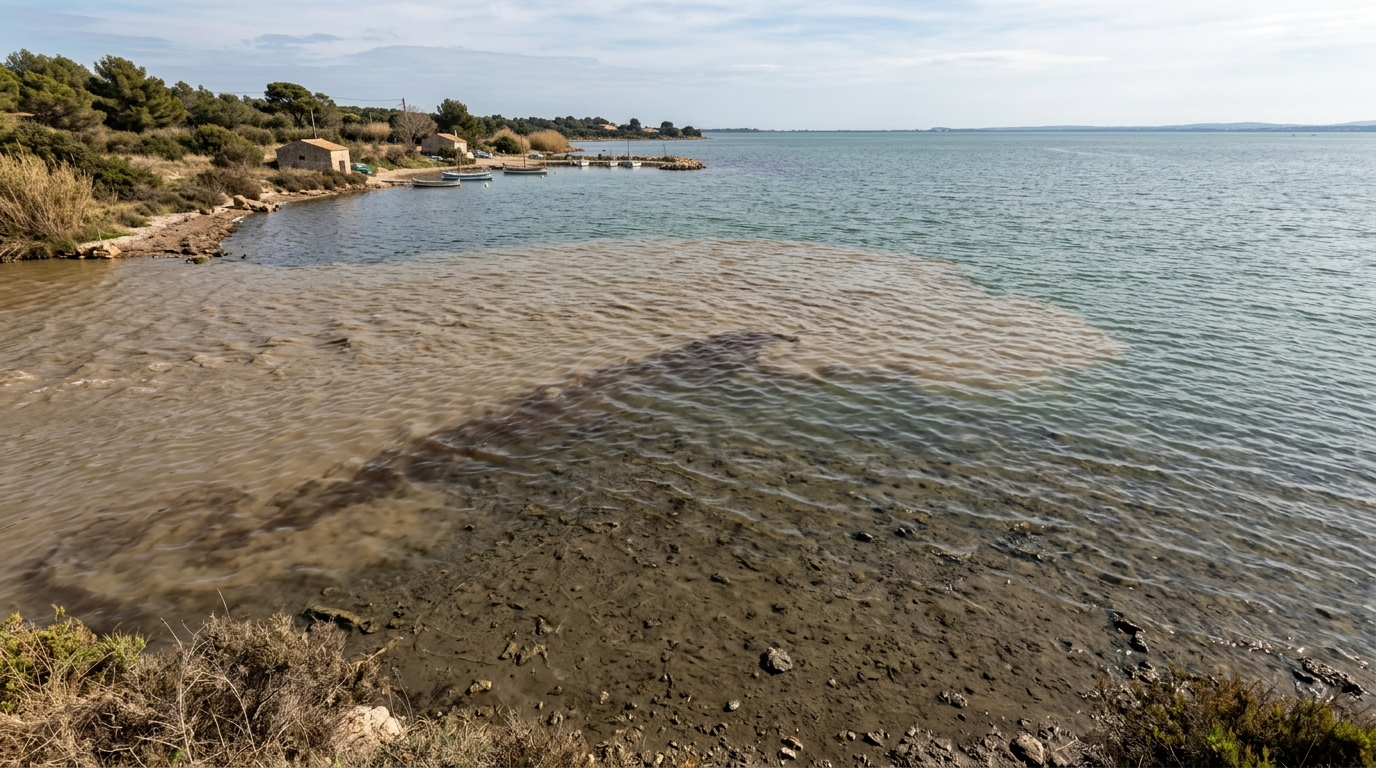
Imagine a salt lake as vast as Paris proper, where underwater meadows once housed thousands of fish and shellfish. Today, almost nothing remains. For six decades, an industrial decision has quietly transformed the Étang de Berre into an unrecognizable ecosystem, and the story of this metamorphosis deserves attention.
Key takeaways
- The Saint-Chamas hydroelectric plant, commissioned in 1966, releases water diverted from the Durance into the Étang de Berre, upending its natural salinity
- Deprived of stable salinity and light because of sediment, the zostères disappeared across about 6,000 hectares, triggering the collapse of fish breeding zones and mollusk populations
- Since the early 2000s, the reduction of freshwater volumes discharged has yielded some encouraging signs, but full restoration of the ecosystem remains slow and uncertain
- A plant, a diverted river, a sacrificed lagoon
- The freshwater that killed the zostères
- 6,000 hectares of seagrass beds wiped off the map
- Berre, after Berre: what remains to be saved
A plant, a diverted river, a sacrificed lagoon
It all starts with a structure that few French people know, despite its scale: the Saint-Chamas hydroelectric plant. Commissioned in 1966, this facility was designed to harness the power of the Durance by diverting it for several tens of kilometers before releasing it directly into the Étang de Berre, the large saltwater lagoon located between Marseille and Martigues. The objective was highly strategic at the time: to generate electricity for a growing region while taking advantage of a favorable natural drop in altitude.
The problem is that this engineering feat introduced an imbalance that no one had truly anticipated at the scale where it would unfold. The Étang de Berre is indeed a brackish lagoon, a setting where seawater and freshwater mix naturally, but in very precise proportions. By discharging every year substantial volumes of freshwater from the Durance, this fragile balance was disrupted, with consequences that would prove far deeper than anyone anticipated.
The freshwater that killed the zostères
At the bottom of the Étang de Berre once grew vast meadows of zostères, these flowering aquatic plants often likened to sea grasses. They perform a vital role: they oxygenate the water, stabilize sediments, and provide shelter for a multitude of species, from fish juveniles to small crustaceans. They are commonly regarded as the lungs of lagoon environments.
But zostères require a stable salinity. Yet, by continually receiving freshwater at an entirely artificial pace, the lagoon’s salinity plummeted abruptly and durably. Added to this was another insidious phenomenon: the massive inputs of sediments carried by the Durance gradually clouded the water, depriving the zostères of the light necessary for photosynthesis. As a result, these plants simply could not survive in such a radically altered environment.
6,000 hectares of seagrass beds wiped off the map
The figure is dizzying: it is estimated that nearly 6,000 hectares of zostère seagrass beds have disappeared from the Étang de Berre since the plant began operation. To picture this area, imagine the equivalent of several thousand football fields submerged, not by urbanization or concrete, but by a simple change in the water’s composition.
This disappearance did not come without cascading consequences. Without the zostères to shelter them, many fish species saw their spawning grounds collapse. The populations of shellfish, once abundant in this corner of Provence, also paid a heavy price. The lagoon, which had once sustained a thriving artisanal fishing activity, lost a large portion of its biological richness in just a few decades, an incredibly rapid pace by the standards of marine ecosystems.
Berre after Berre: what remains to be saved
In response to this reality, actions began to move, though the path remains long. Since the 2000s, the volumes of freshwater discharged by the Saint-Chamas plant have been reduced, in the hope that the lagoon could gradually regain a salinity closer to its natural state. This limitation of discharges has, moreover, allowed some encouraging signs, with a timid return of certain marine species in the least-affected areas.
But restoring an ecosystem of such magnitude does not happen overnight. The zostères grow slowly, and their recolonization depends on numerous factors, from water quality to sediment type and the presence of viable seeds in the still-preserved zones. The Étang de Berre thus remains a particularly telling symbol of the tension that can exist between energy development and preservation of natural habitats, a tension that France has learned the hard way on this very site.
What this story mainly reveals is how a single infrastructure choice made at a given moment can have ecological repercussions that extend across generations. The Étang de Berre continues today to seek a new balance, between ongoing energy needs and the urgency to restore a biodiversity that has been deeply tested. It remains to be seen whether, in the coming decades, the efforts undertaken will be enough to revive those underwater meadows that once constituted the very wealth of this Provençal lagoon.
