
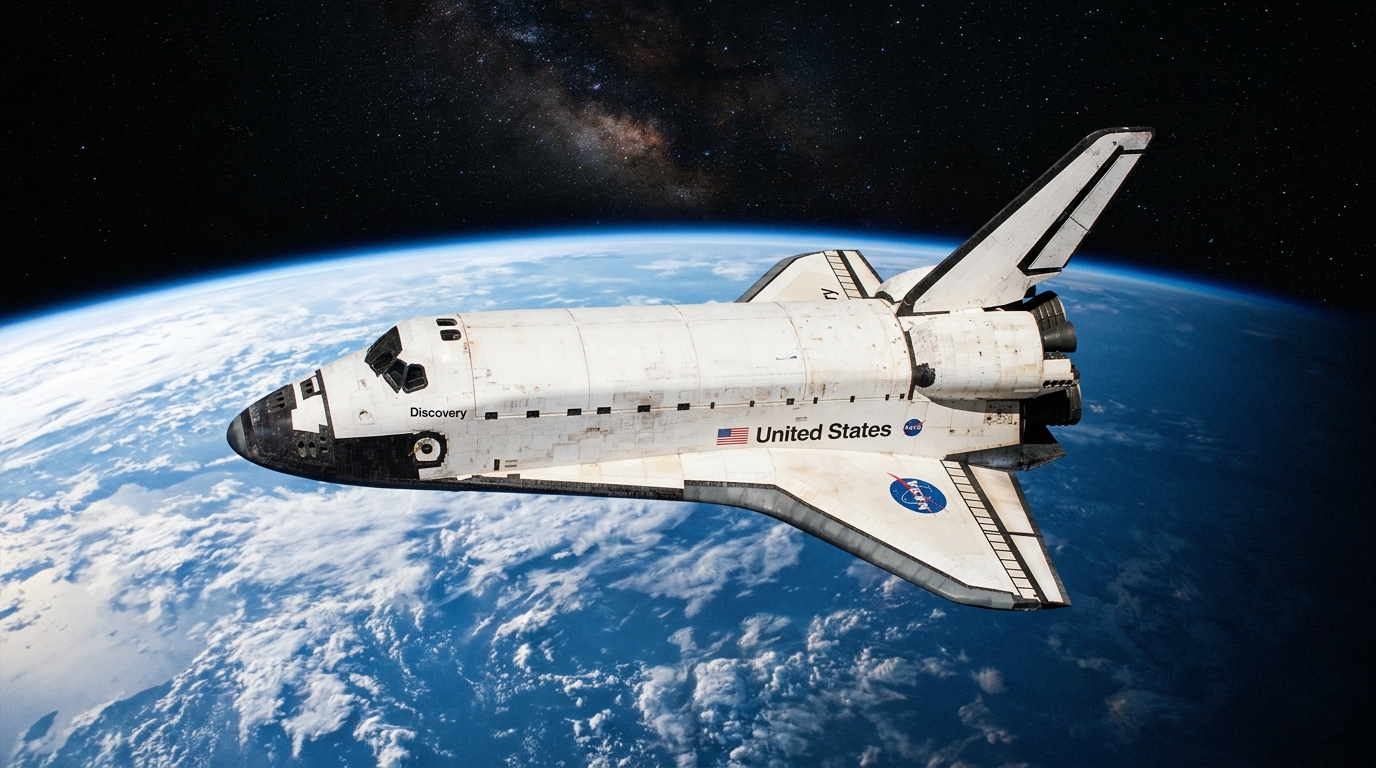
What would you feel if, while in Earth orbit, a sudden flash of light struck your spacecraft without the slightest warning? This is precisely what the Discovery crew experienced during STS-51-G in 1985. No alarm blaring, no radio message announcing danger—just this intense light that flashed through the portholes and seized the crew. For years, the episode remained relatively quiet, almost anecdotal compared with the era’s grand feats of spaceflight. Yet it tells a far larger story: the scientific, technological, and military tensions that threaded through space exploration during the Cold War. Not a secret weapon, nor a spacecraft malfunction, the true explanation is almost more fascinating than any scenario one might imagine.
Key takeaways
- In 1985, the Discovery crew were struck by an unexplained flash of light aboard without any alert triggering.
- This light originated from a laser-reflection experiment conducted from a Hawaii observatory, aimed at testing optical tracking of objects in orbit.
- A miscalculation of altitude directed the laser beam straight at Discovery, turning a harmless scientific test into a notable incident for the crew.
- An Unexplained Flash at 350 Kilometres Altitude
- Hawaii, a Secret Laboratory Pointed Skyward
- When a Miscalculation Turns a Test into an Incident
- What This Glare Reveals About Cold War Space Ambitions
An Unexplained Flash at 350 Kilometres Altitude
Put yourself for a moment in the shoes of the Discovery crew, speeding around the Earth at more than 28,000 kilometres per hour. Everything seems under control: instruments are functioning normally, communications with the ground are steady. And then, abruptly, a bright and brief light strikes the vessel, visible from inside the cabin. No alert system triggers, no technical data signals a mechanical or electrical anomaly. The event lasts only a few seconds, but it is enough to intrigue the crew deeply.
In the context of the era, when rivalry among the major space powers was omnipresent, the hypothesis of an attack or a weapon test was not far-fetched. There was a ferment around space-defense projects, and the notion that a beam could be directed toward a manned spacecraft was not completely dismissed by some observers. Yet the reality, once revealed, turned out to be quite different: it was neither a weapon nor a failure of the spacecraft itself.
Hawaii, a Secret Laboratory Pointed Skyward
The key to this puzzle lies thousands of miles away, on the volcanic peaks of Hawaii. It is from this archipelago, renowned for the clarity of its skies and the altitude of some of its observatories, that a laser-reflection experiment was conducted toward space. The test’s objective was not militaristic: it aimed to evaluate the ability to project and track a light beam to an object in orbit, a technique that interested both scientific research and defense programs of the time.
Such manipulation, now well documented in the field of space optics, required astonishing precision. It demanded exact calculations of the spacecraft’s position, its velocity, and above all its exact altitude at the moment of firing. The slightest deviation could transform a perfectly harmless test into a far more striking, even destabilizing, experience for those in the line of sight.
When a Miscalculation Turns a Test into an Incident
That is precisely what happened. During this laser-reflection test, a miscalibration of altitude caused the beam to be directed straight at Discovery, even though the experiment was not meant to strike the crew head-on. This technical detail, seemingly minor on paper, was enough to produce the sudden dazzle that the astronauts perceived as lights striking their vessel.
Here lies the fragility of this kind of experimentation: an error of a few hundred meters in trajectory calculation, a slightly incorrect estimate of the orbital position, and the whole scenario can tip. Where the ground teams expected a discreet test, almost invisible to those unaware of it, they unwittingly produced a dramatic scene hundreds of kilometers above. There was neither malice nor ship malfunction—only a calibration error that transformed a discreet scientific exercise into a moment of uncertainty for the crew.
What This Glare Reveals About Cold War Space Ambitions
Beyond the anecdote, this episode says a great deal about the atmosphere that reigned in the space domain at the time. The 1980s were a period when major powers boosted laser technology research, both for scientific applications and for potentially strategic purposes. Tests like this, conducted from isolated sites such as Hawaii, fit into a technological race in which each advance could serve civil research as well as military interests.
What the story ultimately shows is the permeability between these two worlds. An experiment designed to refine optical tracking could, by a simple miscalculation, transform into an event significant enough to be reported by an orbital crew. It demonstrates how the space race of that era sometimes advanced along a knife-edge, between legitimate scientific progress and gray strategic zones where the slightest technical error could be interpreted as more alarming than it actually was.
This story, long kept at the margins of the great narratives of space exploration, deserves to be told for what it truly reveals: not a dramatic incident, but tangible proof that science, even at its most rigorous, remains susceptible to human imperfection. A single altitude misadjustment, and a simple optical test can leave a lasting imprint on an entire crew’s memory. At a moment when laser technologies continue to evolve for increasingly varied uses, this 1985 episode invites us to wonder how many other discreet experiments, conducted from Earth, may have grazed other ships lost in the stillness of orbit without our ever knowing it.
