

GLP-1 medicines like Ozempic have transformed the treatment of obesity and diabetes. But a new molecule targets three hormonal pathways simultaneously rather than just one — and the results from a phase III trial have just been published in The Lancet. Nearly nine out of ten patients achieved satisfactory glycemic control. Some saw their blood sugar return to the normal range typical of non-diabetic individuals.
What you will learn
- What sets retatrutide apart from existing GLP-1 drugs and why targeting three receptors changes everything
- The precise results of the 40-week phase III trial in 537 adults with type 2 diabetes
- Why this molecule could become a first-line therapy for early-stage type 2 diabetes
Ozempic and its successors: an incomplete revolution
In recent years, GLP-1 analogs — with Ozempic and Wegovy among the best-known representatives — have transformed the management of type 2 diabetes and obesity. By mimicking a natural gut hormone, these drugs regulate blood glucose, slow digestion, and reduce appetite. Millions of patients have benefited.
But they come with a notable limitation: their weight-loss effectiveness is considerably lower in patients with diabetes than in non-diabetic individuals. And for a substantial number of patients, glycemic control remains insufficient despite treatment.
This is precisely the therapeutic floor that retatrutide seeks to surpass.
Three receptors instead of one
Retatrutide belongs to a new pharmacological class: triple agonists of the receptors for GIP, GLP-1, and glucagon. Whereas current drugs activate only a single hormonal pathway — GLP-1 — retatrutide targets three simultaneously.
The first is GLP-1, already targeted by existing therapies: it stimulates insulin secretion and reduces appetite. The second is GIP — glucose-dependent insulinotropic peptide — which improves how cells metabolize sugar and strengthens the insulin response. The third is glucagon, which nudges the body to burn more energy and mobilize fat stores more efficiently.
By activating these three pathways in a single weekly injection, retatrutide is designed to treat simultaneously the two central metabolic problems of type 2 diabetes: hyperglycemia and excess weight.
The results of the phase III clinical trial
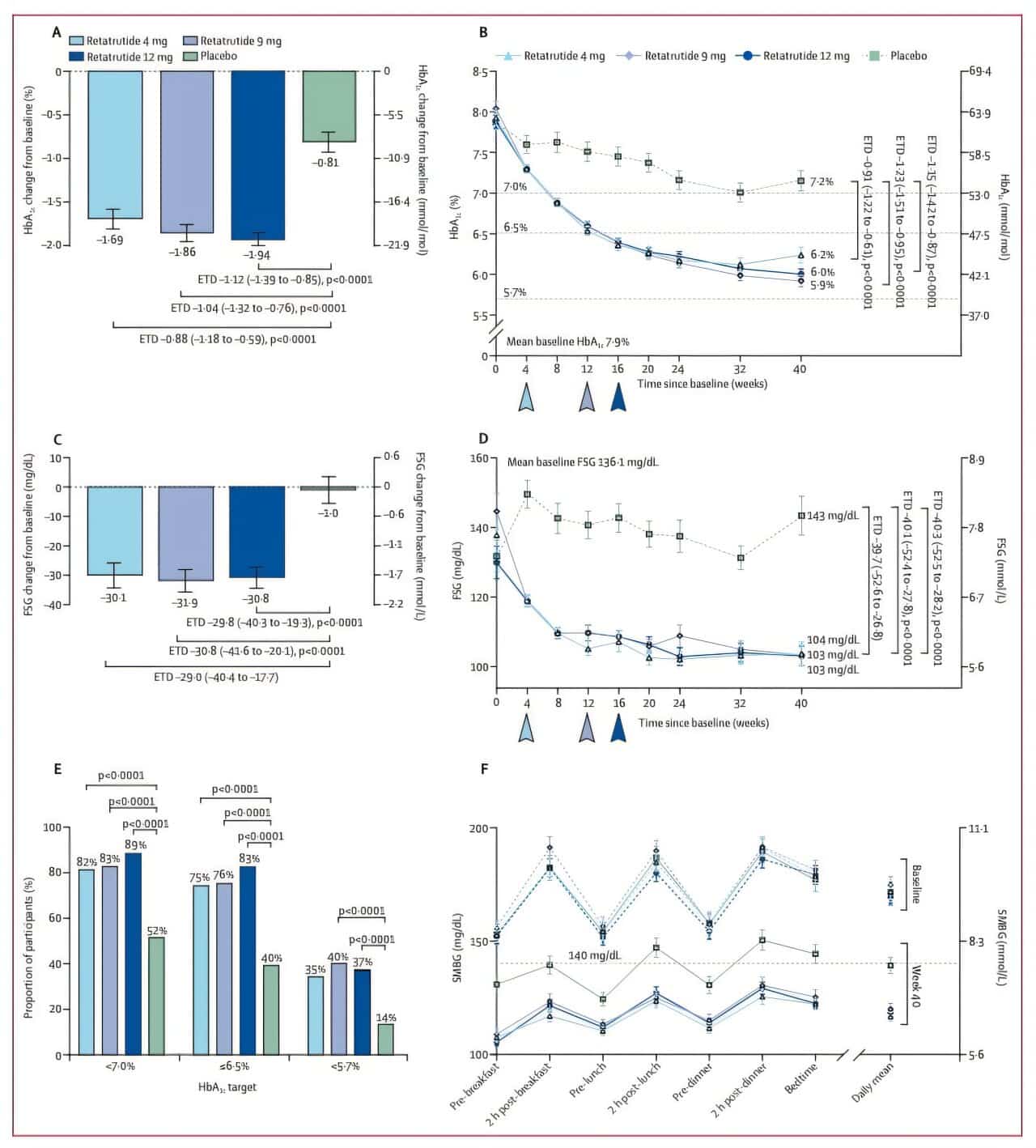
The TRANSCEND-T2D-1 trial enrolled 537 adults with type 2 diabetes inadequately controlled by diet and exercise alone, across 48 sites in the United States, Mexico, and India. Participants received either retatrutide at different doses — 4, 9, or 12 milligrams — or a placebo, via weekly injections for 40 weeks.
The results published in The Lancet are substantial. Nearly nine participants out of ten treated with retatrutide achieved HbA1c below 7.0% — the threshold considered a good level of diabetic control. Even more striking: up to 40% of participants on the highest dose saw their HbA1c drop below 5.7% — i.e., within the normal range for a non-diabetic.
A significant weight loss in parallel
Glycemia is not the only marker that improved. The weight loss observed was substantial and directly proportional to the dose. Participants on the 4 mg dose lost an average of 11.5% of their body weight. Those on the maximum 12 mg dose lost an average of 15.3% — versus just 2.6% in the placebo group.
By the end of 40 weeks, the weight-loss curves continued downward, suggesting that the plateau had not yet been reached. Reductions in waist circumference were also measured, indicating a decrease in visceral fat — the fat stored around internal organs and directly linked to cardiovascular risk.
About 64% of participants achieved the composite endpoint set by medical guidelines: a HbA1c of 6.5% and a simultaneous loss of at least 10% of body weight. This is the double benefit that current treatments struggle to achieve in diabetic patients.
An acceptable safety profile
In terms of safety, no participant developed severe hypoglycemia — one of the feared risks with insulin-acting medications. Reported side effects were mainly gastrointestinal: nausea, diarrhea, and vomiting, ranging from mild to moderate in severity, a profile similar to that observed with existing GLP-1 therapies.
Towards a first-line therapy
The authors of the study envisage that retatrutide could eventually become a first-line therapy for patients with type 2 diabetes in its early phase, even before turning to current standard treatments.
But longer studies, involving larger and more diverse populations, will be necessary to evaluate its long-term efficacy and safety. The current trial covers only 40 weeks, and the effects of chronic treatment over years remain to be documented.
What TRANSCEND-T2D-1 demonstrates is that a single molecule can act on the two most challenging dimensions of type 2 diabetes — with results that surpass current therapeutic standards.
Article prepared with the help of AI · Our method
