
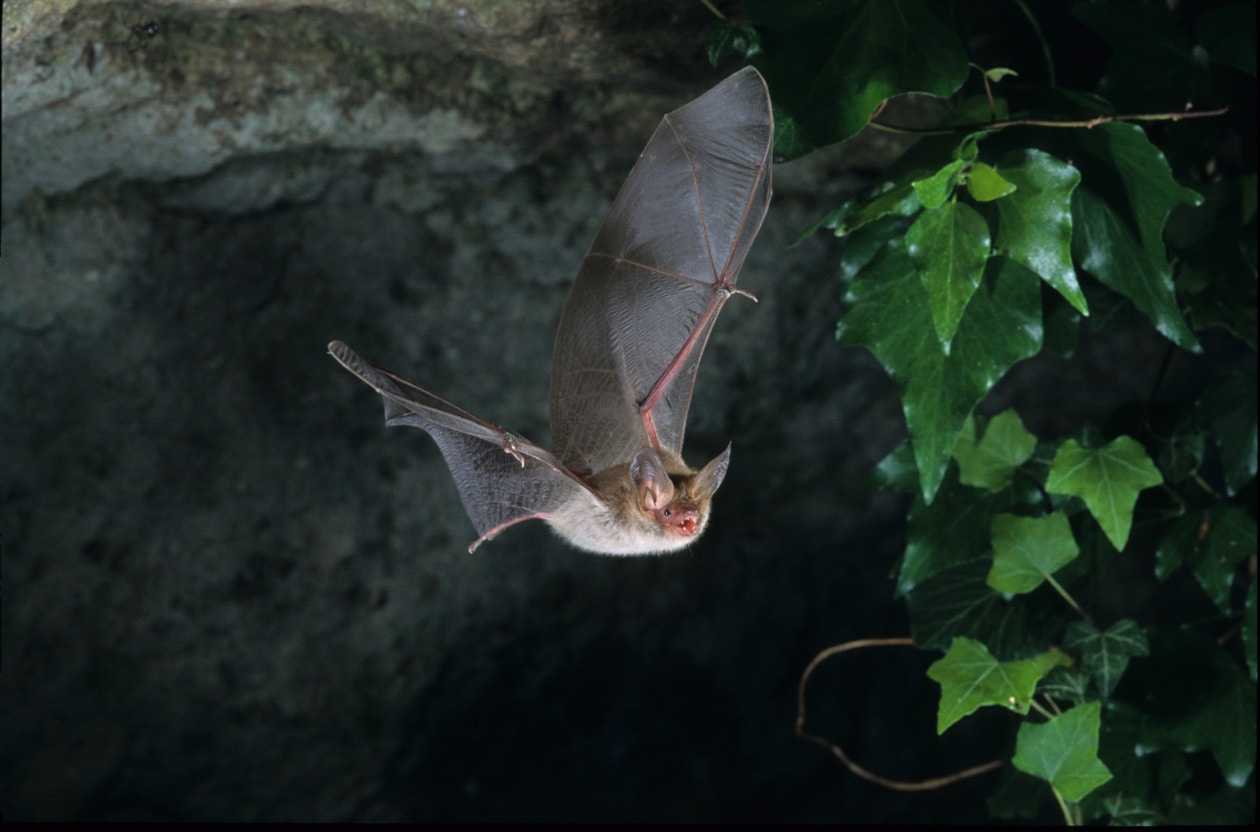
The serotine bats are the first mammals documented to practice non-penetrative sexual relations. This feat is explained by their male genitalia being seven times longer and wider than the female genital tracts.
A Fascinating Discovery
Sexual behaviors play a crucial role in sexual selection, but remain enigmatic for many species. Because of their nocturnal and elusive lifestyle, the copulatory behaviors of bats have often been neglected.
The reproduction of these mammals indeed features several unique characteristics such as prolonged sperm storage and delayed development. A study today reveals that in some of them, the penis is used as a “copulatory arm” rather than as an organ of insertion, thereby introducing a new copulatory behavior among mammals.
An Abnormally Large Penis
The penis of male serotine bats (Eptesicus serotinus) is seven times longer and wider than the vagina of their female counterparts. Specialists had already observed that these mammals possessed disproportionately long organs, but they still wondered why.
As part of these studies, Nicolas Fasel and his team at the University of Lausanne examined footage from cameras placed on a structure accessible to bats, allowing visualization of the genitalia during mating. The researchers more precisely documented 97 mating sessions in the attic of a church in the Netherlands and in a bat rehabilitation center in Ukraine. It emerged from their observations that none of these interactions seemed to involve penetration.
Instead, the footage captured the males grabbing the females by the nape and moving their hips until their erect penis was firmly pressed against the female’s vulva. The males would then remain completely immobile in this position for an average of 53 minutes. However, the longest sequence reportedly extended over more than 12 hours.
The researchers observed that the penises were enlarged before any contact with the vulva, ruling out the possibility of early penetration, a characteristic observed particularly in dogs.
A ‘Contact Mating’
The team also stimulated the males to induce erections under anesthesia. They then observed a heart-shaped swelling at the end of the penis.
“The terminal swelling, adorned with a few short hairs, is composed of two large erectile tissues,” explain the researchers in their study. “We hypothesize that the hairs on this swelling act as sensors to help locate the vulva.” After mating, the female bats’ abdominal fur also appeared damp, suggesting semen presence. However, samples will be necessary to confirm whether the males ejaculate during the lengthy embrace.
This discovery represents the first documented evidence of non-penetrative sex, also called “contact mating”, in mammals. Although this behavior had previously been observed in birds, it involves males and females pressing openings called cloacae together, performing “cloacal kisses” that enable sperm transfer.
These bats may have evolved with oversized genital organs to bypass a membrane that covers the female’s genitalia. According to the team, these animals indeed use their tail membranes to fly or to hunt prey.
To better understand this unique behavior in bats, the researchers are considering building an observation facility similar to an aquarium, equipped with cameras to document these interactions in more detail.
The study’s details are published in Current Biology.
