
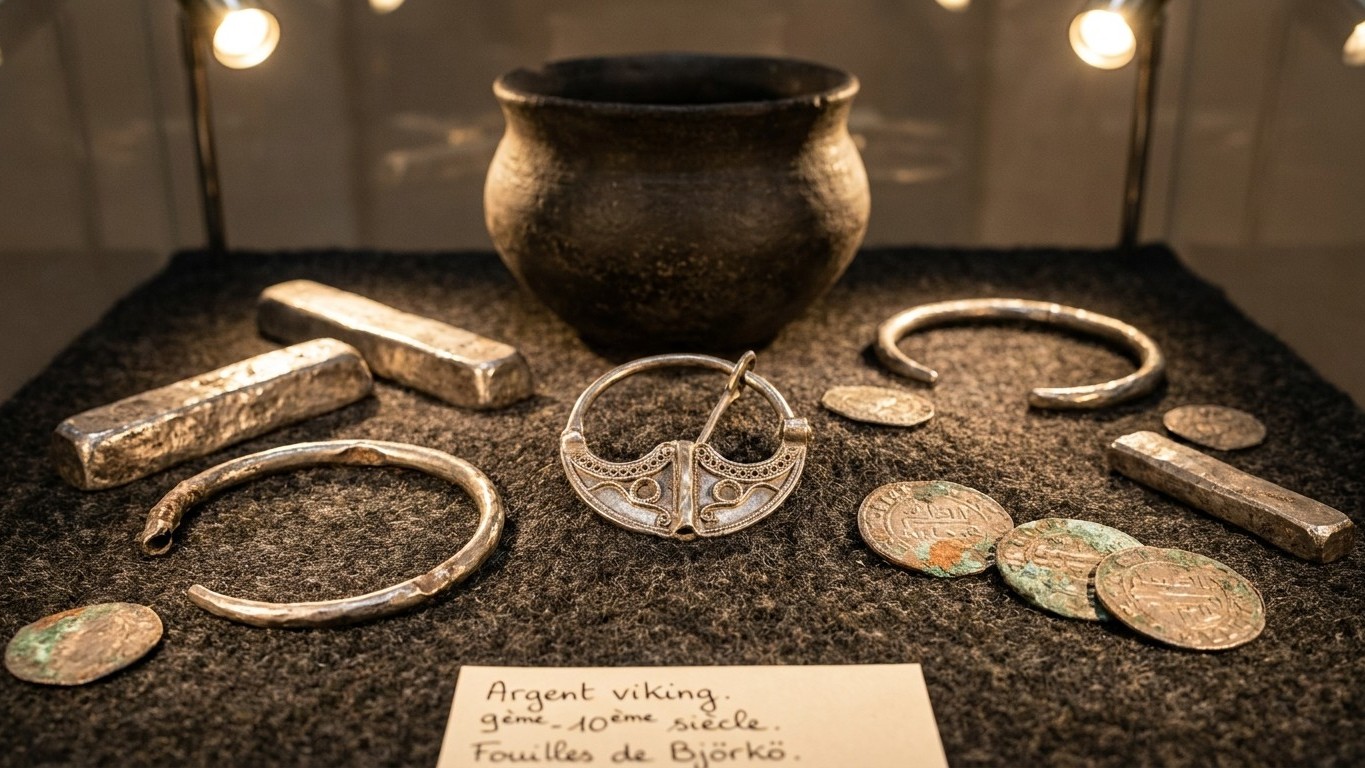
A garden in Bramslev, near Hobro, in northern Jutland. A homeowner preparing the ground for a terrace. And beneath his tools, a dull thud that has nothing to do with stone or a rusted pipe. In a matter of tens of minutes of improvised digging, this man uncovers the largest Viking treasure ever found in Denmark: 18.5 kilograms of silver spread across nearly 700 objects, buried for more than a thousand years in a clay vase.
Key takeaways
- A gardener unexpectedly uncovers what could be the largest Viking treasure ever found
- The crucial dating element isn’t what you’d expect: it’s fragments of cut coins
- Archaeologists reconstruct an ancient monetary system where silver was weighed and fragmented rather than spent as full coins
A discovery three times heavier than the previous record
The previous Danish record, the famous Terslevskat, weighed about 6.5 kilograms. The Bramslev treasure weighs 18.5 kilograms, almost three times the weight of the previous largest Viking-age silver hoard in Denmark, the Terslevskat, which weighed roughly 6.5 kilograms, according to Nordjyske Museer. In other words, Bramslev’s garden has just reset the playing field for Scandinavian archaeology, in a country already accustomed to Viking discoveries.
The account of the anonymous discoverer reads like a scene that starts off almost ordinary and suddenly tilts into extraordinary. “After about half an hour of digging, my find struck something that produced a strange sound,” the man recalled. “At first I thought it was old iron or fencing wire and pottery shards, but when I began to dig with my bare hands, I suddenly pulled out one metallic object after another.” A project that was meant to last a few hours of terrace work turned into a multi-day archaeological dig, under the supervision of Nordjyske Museer (the museums of northern Jutland).
Part of the treasure remained intact inside its original container. About 320 objects, weighing 6.4 kilograms, lay inside the original vase, while the rest was scattered around in the surrounding soil. This intentionally buried ceramic vase tells a story in itself: a deliberate attempt to secure or conceal a substantial fortune for the era.
Ingots, bracelets, Thor’s hammer: the anatomy of a Viking fortune
The Bramslev hoard is not merely a collection of jewelry. Archaeologists identified around 700 objects and fragments, including numerous silver ingots, arm rings, 47 complete coins and cut fragments, shards of cut silver, and a small Thor’s hammer pendant. The hammer pendant—a symbol of the god Thor—reminds us that traditional Norse religion coexisted broadly with the early Christian influences arriving from the south.
What strikes scholars most is the distribution. The predominance of ingots, jewelry, and cut or melted silver rather than whole coins suggests that the silver itself functioned as money, its value largely determined by weight. Coins could be cut, divided, or melted to settle the amount needed for a transaction. In the Viking era, people did not pay with bank notes or even always with intact round coins. Silver was weighed, cut as needed—somewhat like how one would cut a gold bar today to pay a precise fraction.
Torben Sarauw, an archaeologist and head of cultural heritage at Nordjyske Museer, did not hide his enthusiasm for the scope of the discovery. “This is a finding of great importance for our understanding of the Viking Age in Denmark. Not only because of its size, but also because the treasure clearly shows how silver functioned as wealth and as a means of payment during the Viking era. It’s like finding a Viking-age safe,” he said. An apt image: this buried vase played exactly the role we would assign today to a bank vault.
What really allowed dating the treasure: not the bracelets, but the cut coins
One might think that dating such a treasure would rely on the style of bracelets or the shape of ingots. That is not the case. The most solid evidence comes from the coins themselves, particularly their fragmented state. Two Anglo-Saxon pennies, minted during the reign of King Edward the Elder, who ruled from 899 to 924, prove decisive for dating the treasure. Since such a hoard could not have been buried before those coins were struck, its dating cannot predate the early 10th century.
Arabs’ silver dirhams also provide a corroborating piece of the puzzle. These silver coins—dirhams—from the Islamic world bear inscriptions that can be tied to specific places and mint years. In this discovery, the dirhams had been cut into small pieces and used as a means of payment, their value tied to the weight and purity of the silver. This is the Bramslev treasure’s apparent paradox: it is not the carved bracelets or the heavy ingots that yield a precise date, but pieces of metal cut with a knife, nearly worn away, whose monetary inscriptions reveal a mint year. The chopped state of most coins is not a preservation accident; it directly reflects how money circulated in the 10th century—weighed and fragmented according to exchange needs rather than spent as fully minted coins, like modern currency.
One detail still puzzles researchers: a single ingot bears a runic inscription. Runes are etched on one of the silver bars, the inscription being readable as “hutu,” which could be a name, a mark of ownership, or another meaningful sign. A minor mystery, yet it adds a human touch to this metal mass: someone, more than a thousand years ago, felt the need to engrave his name or mark on what may have been his entire fortune.
Heading to the National Museum, and perhaps an exhibition at Fyrkat
Under Danish law, this type of discovery falls under the status of danefæ, a framework that automatically assigns ownership of historic treasures unearthed on the territory to the state. The treasure is classified as danefæ, meaning it belongs to the state and will be evaluated by the National Museum of Denmark. The finder will receive a reward based on the material value of the silver, along with an additional finder’s fee. The garden owner will therefore not walk away empty-handed, even though the treasure joins public collections.
Nordjyske Museer already envisions an exhibition that extends beyond the Bramslev case. The museum hopes this extraordinary treasure might one day be displayed at Fyrkat’s Viking museum, alongside the recently discovered gold hoard from Rold, placing both discoveries within the broader Viking Age narrative in northern Jutland. Two hoards, two metals, in the same region: northern Jutland continues to confirm, hole after hole, that it was one of the busiest economic centers of the Viking world, connected to the caliphates of the Middle East as well as to Anglo-Saxon kingdoms.
