
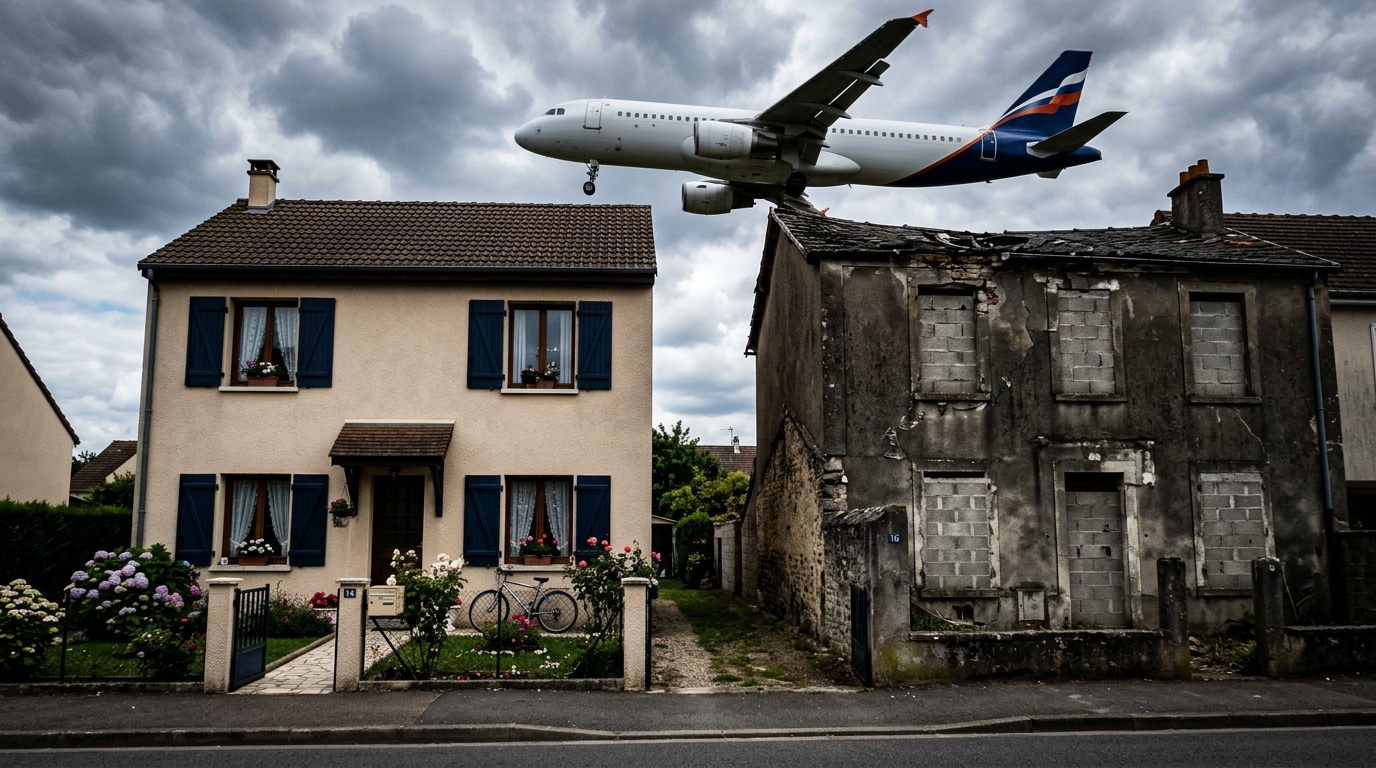
An abandoned kindergarten, rusted metal shutters banging in the gusts, and every five minutes a low rumble rising from the sky that makes the still-intact windows tremble. Welcome to Goussainville-Vieux Pays, in Val-d’Oise, a district where time seems to have paused somewhere in the 1970s, wedged between the runways of Roissy-Charles de Gaulle and a religious heritage that refuses to yield. Here, roughly 300 residents continue to live their daily lives, surrounded by more than 70 houses walled up, empty yet standing, as if frozen in an administrative waiting period that has lasted half a century.
- Since the opening of Roissy-CDG in 1974, about 300 residents of Goussainville-Vieux Pays continue to live under the flight path, with a plane every five to ten minutes.
- More than 70 houses bought by ADP have been walled up because they cannot be demolished, protected by the 500-meter perimeter around the church classified as Saint-Pierre-Saint-Paul, nor rehabilitated due to aircraft nuisance.
- In 2008, around 80 houses and corresponding plots were ceded for a symbolic euro to the town hall without resolving this blockage, while a school and a bookstore sustain local life.
- The turning point that transformed a village into a ghost town
- Why these 70 walled houses cannot be demolished or rebuilt
- Living with 300 inhabitants under the constant roar of Airbus
- Goussainville-Vieux Pays, symbol of fifty years of administrative stalemate
The turning point that transformed a village into a ghost town
Before the 1970s, Goussainville-Vieux Pays was a peaceful hamlet, organized around its church and the lanes typical of rural Île-de-France. Nothing suggested it would become, a few years later, one of the most singular cases of French urban planning. Everything changed with the start-up in 1974 of the Roissy-Charles de Gaulle airport. The chosen layout for one of the takeoff runways literally placed the village in the direct axis of aircraft, turning what had been a quiet living environment into a permanent air corridor.
The shock was immediate for the residents. Of roughly 1,000 people living in the Old Town at that time, a large majority chose to leave, often after their house was bought by Aéroports de Paris (ADP). The exodus happened gradually, as the flights intensified over the years. Yet, around 300 inhabitants made a different choice: to stay, despite the noise, despite the uncertainty, out of attachment to the place or a refusal to give up what they consider home.
Why these 70 walled houses cannot be demolished or rebuilt
This is where the case becomes genuinely distinctive. The houses purchased by ADP, once their occupants had left, would logically have been razed to make way for a space aligned with the airport’s intended use. But an unforeseen obstacle emerged: the Saint-Pierre-Saint-Paul church, classified as a historical monument. French heritage law indeed imposes a 500-meter protection zone around any listed building, preventing any demolition within that perimeter.
As a result: more than 70 houses are stuck in an absurd situation. They cannot be razed because of heritage law, but they also cannot be rehabilitated or normally resold, as they lie within an area deemed unsuitable for habitation due to aircraft nuisances. The adopted solution has thus been to wall them up, making them inaccessible while leaving them standing, like empty shells in the middle of a still-inhabited neighborhood. In 2008, a package of about 80 houses and as many plots was ultimately ceded for a symbolic euro to the town hall of Goussainville, without solving the heritage impasse that persists.
Living with 300 inhabitants under the constant roar of Airbus
Living in the Old Town today means accepting a sound rhythm that few French people know: a takeoff every five to ten minutes, producing a noise strong enough to interrupt a conversation or to make dishes vibrate in cupboards. Yet between 300 and 350 residents continue to live there, in houses that were not walled because they lie outside the strict perimeter around the church or simply because their owners never sold to ADP.
Daily life is not frozen, however. A
Goussainville-Vieux Pays, symbol of fifty years of administrative stalemate, almost against its will
What strikes most in this history is how three distinct logics—airport development, heritage protection, and human will—have become interwoven without any one of them fully prevailing over the others. Neither the airport’s expansion, nor the monument’s protection, nor the residents’ desire to stay has entirely won out. The result is a hybrid landscape where walled houses sit side by side with gardens still tended to.
In recent years, an associative and cultural dynamic has been developing to give this neighborhood positive visibility by highlighting its singular history rather than simply enduring it. The site even attracts curious visitors wanting to discover this unusual heritage, halfway between an abandoned set and a real village. In this sense, Goussainville-Vieux Pays remains a truly unique case in France: an entire district suspended for half a century between administrative logic and stubborn human presence.
Hard to find elsewhere in France a clearer example of what technical decisions can produce when their long-term human consequences are not anticipated. Fifty years after the opening of Roissy-Charles de Gaulle, the Old Town continues to embody the tension between aerial progress and the memory of a place, between heritage rules and daily life. Whether this status quo, as strange as it is, will last much longer, or if a future change will ever resolve this dossier frozen for so long, remains to be seen.
