
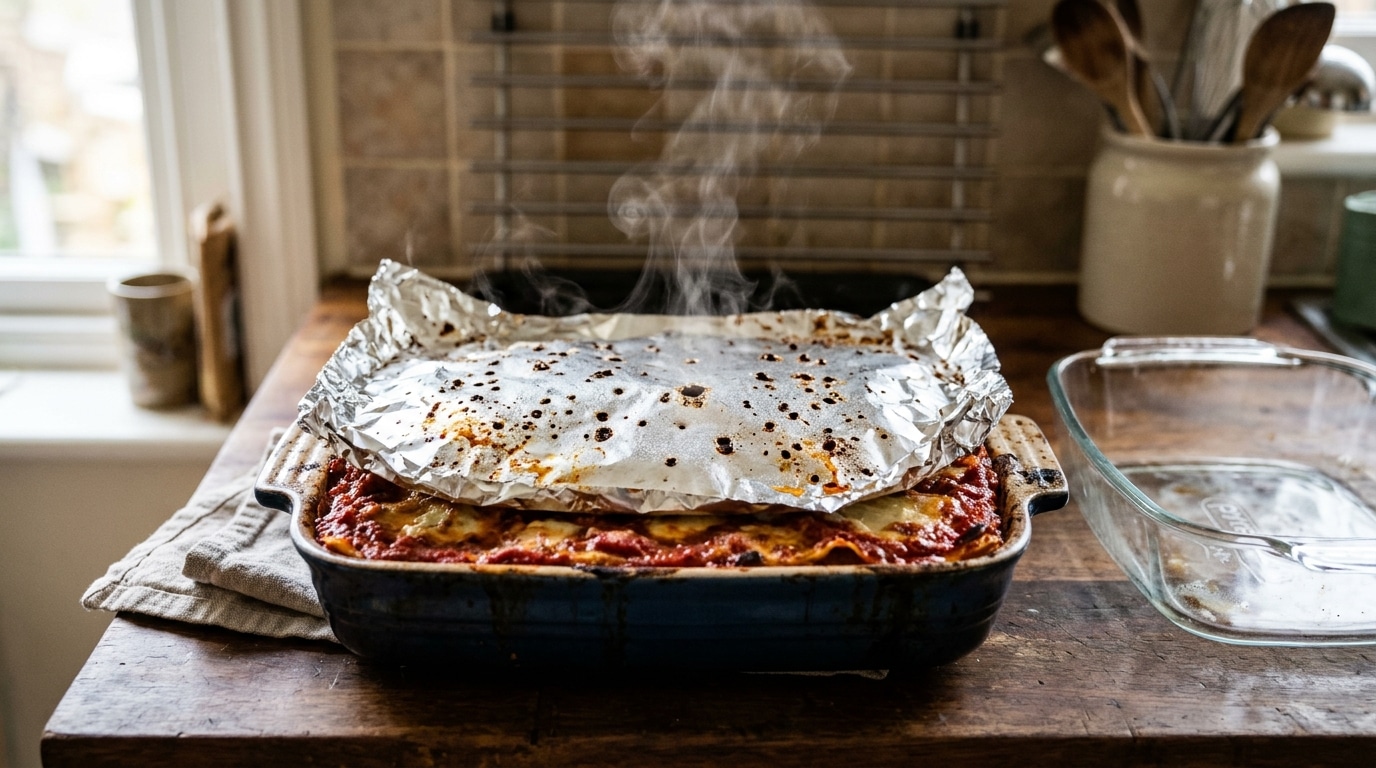
A plate of tomato lasagna comes out of the oven, cloaked in its trusty sheet of aluminum foil. Yet as you lift it away, the surprise is undeniable: the silvery sheet is peppered with tiny holes, as if gnawed from the inside. This material, long believed to be totally corrosion-proof and inert for generations, seems to react with certain foods. Is this just an aesthetic detail with no consequence, or does this phenomenon reveal something more worrying about what ends up on the plate? The answer lies in a discreet chemical reaction, well known to health authorities, but largely overlooked in kitchens.
- Acidity and salt multiply by ten the release of aluminum from non-anodized aluminum foil when in contact with foods.
- For acidic dishes such as tomato sauces or marinades, it is better to favor glass, ceramic, or stainless steel rather than bare aluminum.
- Average aluminum exposure remains controlled in France, and no study has demonstrated toxic effects from ordinary dietary intake in the general population.
- Why aluminum foil degrades in contact with certain dishes
- Acidity and salt, the two factors that accelerate aluminum transfer into the plate
- Smart practices and containers to favor for cooking with peace of mind
Why aluminum foil degrades in contact with certain dishes
These tiny holes are not a whim; they result from a genuine chemical reaction between the metal and the compounds present in certain foods. Aluminum, despite its smooth and shiny appearance, is not a completely inert material. In contact with acidic substances, such as those found in tomato sauce for lasagna, a portion of the metal literally dissolves, leaving behind these characteristic perforations.
Researchers have shed light on the matter: when chicken or fish is baked for an hour in aluminum foil, they measured up to 42 milligrams of aluminum per kilogram of food. A figure that provides a concrete sense of what the metal can yield under heat and certain ingredients. In repeated use with acidic preparations, daily aluminum intake can even rise to 3.5 milligrams, according to the same studies. This is enough to reconsider a culinary habit that seemed so ordinary and self-evident.
Acidity and salt, the two factors that accelerate aluminum transfer into the plate
Not all dishes respond the same to aluminum foil, and two criteria clearly stand out: acidity and salt. The public health portal Santé.fr is clear on this point: non-anodized aluminum, meaning without a protective surface coating, can release small quantities of metal into foods. This release is multiplied by ten when preparations are very salty or acidic. Tomatoes, citrus fruits, rhubarb, vinegar-based condiments, and wine-simmered dishes are thus at the top of the list of foods to monitor.
The BfR explicitly recommends avoiding cooking or storing such preparations in non-anodized aluminum, and to ban aluminum foil for heating acidic foods in the oven. However, this finding should be nuanced: containers equipped with a protective layer do not behave like bare foil. That thin film greatly reduces aluminum transfer to foods, even in the presence of acidity. The distinction between classic aluminum foil and packaging with a protective coating should be understood, as it drastically changes the situation.
Smart practices and containers to favor for cooking with peace of mind
In light of these findings, there’s no need to panic, but a few simple adjustments can limit unnecessary aluminum exposure. The National Agency for Food, Environmental and Workplace Health Security (ANSES) notes that average exposure in France remains broadly controlled, at about 0.28 milligrams per kilogram of body weight per week for adults and 0.42 milligrams for children aged 3 to 17. By way of reference, the European Food Safety Authority (EFSA) set in 2008 a provisional tolerable weekly intake of 1 milligram per kilogram of body weight, seven times stricter than the previous value. In practice, only 0.2% of adults and 1.6% of children exceed this limit in France, according to Santé.fr. Here are a few practical steps to cook more calmly:
- Prefer glass, ceramic, or stainless steel for acidic preparations such as tomato sauces, wine-based dishes, or vinegar-marinated foods
- Reserve aluminum foil for neutral foods and avoid prolonged contact with salty or acidic ingredients
- Choose packaging with a protective coating when contact with aluminum is unavoidable
- Don’t overlook other exposure sources, such as certain foods naturally high in aluminum or some antacids, which often weigh more in the overall balance than cooking utensils
From a health perspective, ANSES notes that potential toxic effects of aluminum primarily concern the central nervous system and bone tissue. But to date, no study has demonstrated such effects in the general population exposed via ordinary dietary intake. It’s therefore not about panicking after every lasagna dish covered in foil, but about understanding that certain uses deserve to be reconsidered, keeping in mind that acidity and salt are the real accelerators of this discreet chemical reaction.
Thus, those tiny holes in aluminum foil are not merely an aesthetic detail to ignore, but the visible sign of a well-documented chemical phenomenon. Adapting containers to the nature of the dishes remains the simplest reflex to limit avoidable exposure, without giving up the everyday practicality of this ubiquitous material.
