

Recently, three major media outlets conducted a significant investigation based on leaks of confidential documents. At a Russo-Chinese meeting on military collaboration, the two parties discussed ways to slow down, jam, or even destroy SpaceX’s Starlink constellation.
The Evidence of a Genuine Collaboration Between China and Russia
For some time now, the Starlink project has been nothing less than the largest satellite constellation in human history, which moreover holds a near-monopoly on low Earth orbit. As of this writing, the project counts roughly 9,820 operational satellites in orbit. In the long run, this constellation is expected to surpass 40,000. Yet, rumors have recently circulated that China and Russia intend to undermine the project.
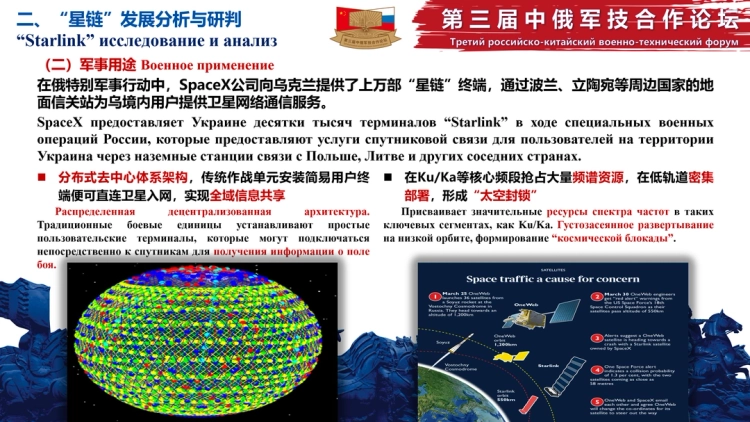
The exiled Russian investigative outlet The Insider collaborated with European outlets Le Monde and Der Spiegel as part of an investigation on the topic, published on July 9, 2026—shortly picked up by the Washington Post. This publication refers to confidential documents and details the holding of the Third Secret Forum on Russo-Chinese Cooperation in Guangzhou (China) in 2023. During this event, the two countries allegedly shared tactical presentations describing methods to bring down the American constellation.
“These documents reveal a partnership that has far surpassed the stage of joint statements to become a structured and multidisciplinary program aimed at developing weapons that neither country could conceive alone.”
Legal Recourse, Mobile Countermeasures Systems, and Cyber Attacks
The idea centers on a “cyber-attrition plan” built around a three-step strategy. First, there is the question of legal and diplomatic pressure to slow the expansion of the constellation. China and Russia envisage forming an international coalition aimed at denouncing SpaceX’s near-monopoly in low orbit. They also plan to file joint complaints with global regulators—notably the International Telecommunication Union (ITU)—to challenge frequency allocations.
The second phase of the plan is to saturate space and locally cut the signal by merging electronic warfare programs. This would enable the design of mobile countermeasures systems capable of breaking the link between ground terminals and satellites in specific combat zones. Regarding the final stage, the investigation mentions direct attacks on satellites, especially cyberattacks. This mainly refers to malware intended to inject viruses, spoof access, and freeze control systems of terminals and satellites.
While the U.S. Space Force clearly takes the threat seriously, it is worth recalling that hacking or saturating a sprawling, evolving mesh like Starlink is not an easy feat. Indeed, SpaceX continually updates its software precisely to mitigate such risks.
A Possible Resort to Physical Weapons
Regarding the attacks, satellites could also face physical threats. The investigation reveals that China and Russia would consider using missiles or projectiles dispersal vectors that release clouds of dense metal projectiles, for example steel balls. Another idea involves kamikaze-type micro-satellite clouds of CubeSats that would allow the destruction of several satellites with each impact.
On this last point, caution is warranted. There is little doubt that the physical destruction of thousands of Starlink satellites would saturate the low orbit with millions of uncontrollable fragments. These debris would indiscriminately destroy other communications or military satellites, regardless of nationality. It should be noted, however, that any attack could also threaten the new Chinese constellation SpaceSail, which currently counts about 240 objects.
