
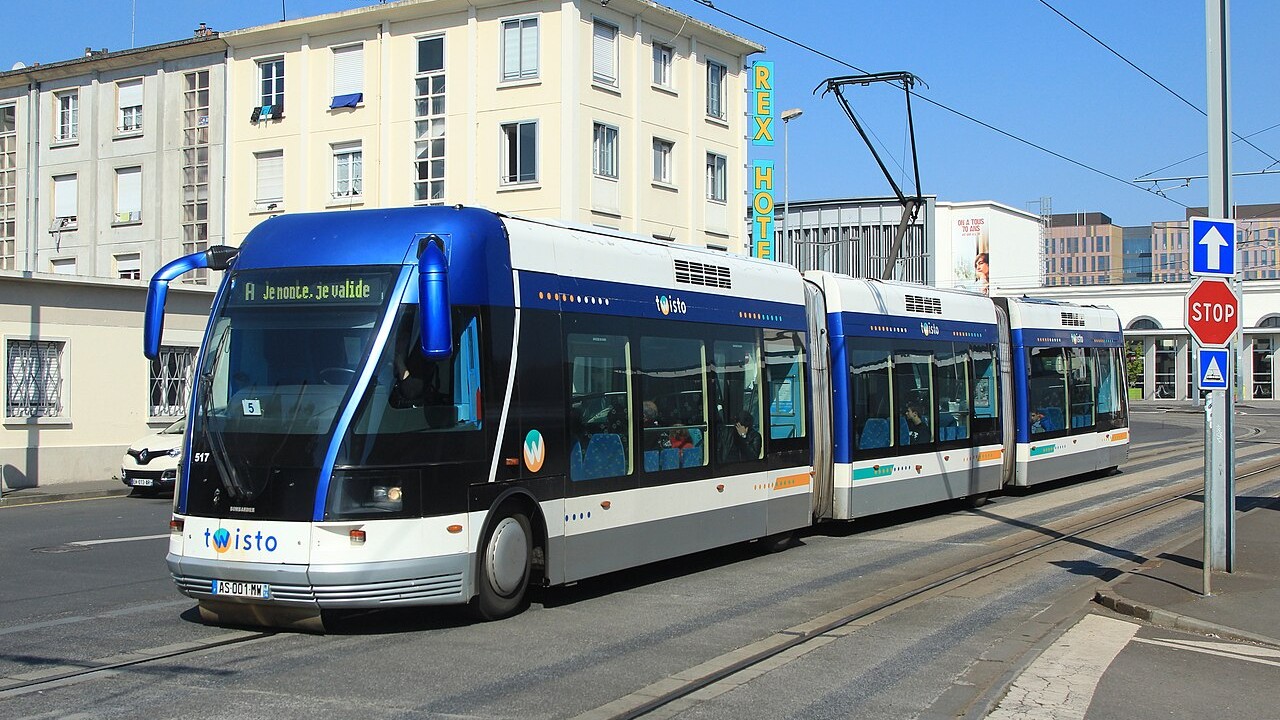
Fifteen years. That is how long Caen’s rubber-tired tram lasted before ending up scrapped, even though its contractual warranty ran through 2032. A system billed at more than 200 million euros to the taxpayers of Normandy, designed to last three decades, which ultimately was demolished due to reliability issues. The story of Caen’s TVR remains, to this day, one of the most cited examples in France when discussing failed technological bets in public transportation.
Key takeaways
- A revolutionary technological project rejected by a referendum but imposed by local elected officials
- Recurring breakdowns: 100 service interruptions per month and spectacular incidents as early as 2003
- The early termination of the contract cost 17 million euros in compensation before rebuilding
A Technological Gamble Approved Despite an Unfavorable Referendum
Back in 1991. The Caen metropolitan area sought a public transport mode on a dedicated right-of-way, cheaper than a traditional tram. The choice fell on an experimental technology, TVR (Transport sur Voie Réservée), a hybrid vehicle operating on rubber tires but guided by a central rail, developed by Bombardier. The project was unanimously approved on November 27, 1991, given the expected savings compared to a tram: the per-kilometer cost of the TVR was estimated in 1997 at 50 to 70 million francs versus 120 to 140 million francs for a tram. A financial argument that appealed to the elected officials, but not necessarily to residents.
For the project, nearly failing before it even started. The 1995 municipal elections put the project in jeopardy: the incumbent mayor faced his socialist rival who promised to organize a referendum on the project if he won, which ultimately translated into a popular vote where the majority of voters rejected the TVR. The elected officials pressed on with the project anyway. The rubber-tired tram was inaugurated on November 18, 2002, with a price tag announced at 215 million euros. It was supposed to operate without major interruptions until 2032.
Series of Breakdowns and Premature Wear
The problem did not take long to appear. As early as 2003, tires blew out twice while in service. In 2003, tires burst twice, hurling a piece of the bodywork dozens of meters away without causing injuries. A decade later, the incident recurred in another form: in 2013 a TVR engine had fallen onto the track at Caen. Between them, derailments punctuated regular operation, with the TVR also experiencing derailments in the early years in Nancy and Caen, the other French city that had chosen the same technological route.
Beyond the spectacular incidents, it is the accumulation of daily breakdowns that wore down users. A transport union official described at the time “100 red faults per month,” meaning service interruptions of more than three minutes or forced returns to the depot. Result: growing disaffection and a somber assessment from local leaders. “In Caen, users prefer the bus, which is unique in France,” lamented the president of Viacités at the time. A remark that alone sums up the failure of a system meant to symbolize the modernization of urban transport.
The decision to abandon the experiment came in September 2011, barely nine years after the inauguration. Viacités considered replacing it with a more reliable system by September 2011, and the standard steel-wheeled tram was officially chosen on December 14, 2011. The mayor of the time tried to buy time, hoping to keep the existing trams running until 2022 to smooth the metropolitan finances, but he abandoned the plan in the face of annual maintenance costs around 40 million euros. A figure that, in itself, justified the premature abandonment: maintaining a failing system cost almost as much each year as the operation itself would yield.
The Double Penalty: Termination Damages and Full Reconstruction
The TVR stopped circulating for good on December 31, 2017 at 8:00 p.m., after fifteen years of chaotic operation. Ending a contract signed for thirty years does not come without financial consequences. The termination of the contract signed in 2002 for an initial duration of 30 years with STVR cost the urban community 17.3 million euros, to which another 12.3 million euros had to be added to settle the last loan installment with the banks. Another source notes that 17 million euros in breach-of-contract damages tied the urban community to Colas and Bombardier. Two nearly identical sums, two ways of telling the same painful bill to pay before even laying the first rail for the new tramway.
Rebuilding a network capable of replacing the TVR was no mere formality: the entire platform had to be rebuilt, stations adapted, signaling redesigned. The replacement would cost 245 million euros, including 24 million in state aid, 30 million from the region and Europe, and 45 million from the department, as stated at the time by the president of the urban community. When adding works and indemnities, the total transition bill exceeded 260 million euros, for a project that had already cost 215 million fifteen years earlier. The new rail tram, built by Alstom, was finally inaugurated on July 27, 2019, after nineteen months of intensive construction.
Caen was not the only city to suffer with this technology. Nancy, the only other French agglomeration to adopt Bombardier’s TVR, followed a nearly identical path: put into service in 2000, its rubber-tired tram was abandoned as well, from 2000 to 2023, before the Nancy network ceased operating its rubber-tired tram on March 12, 2023. A curious detail closes this story with a double bottom: part of Caen’s withdrawn trams ended up traveling to Nancy, not to run there, but to serve as spare parts for the other ailing network. Two cities, one supplier, one verdict: the promise of a tramway cheaper than rail ultimately cost far more than expected.
Sources: banquedesterritoires.fr | ville-rail-transports.com
