
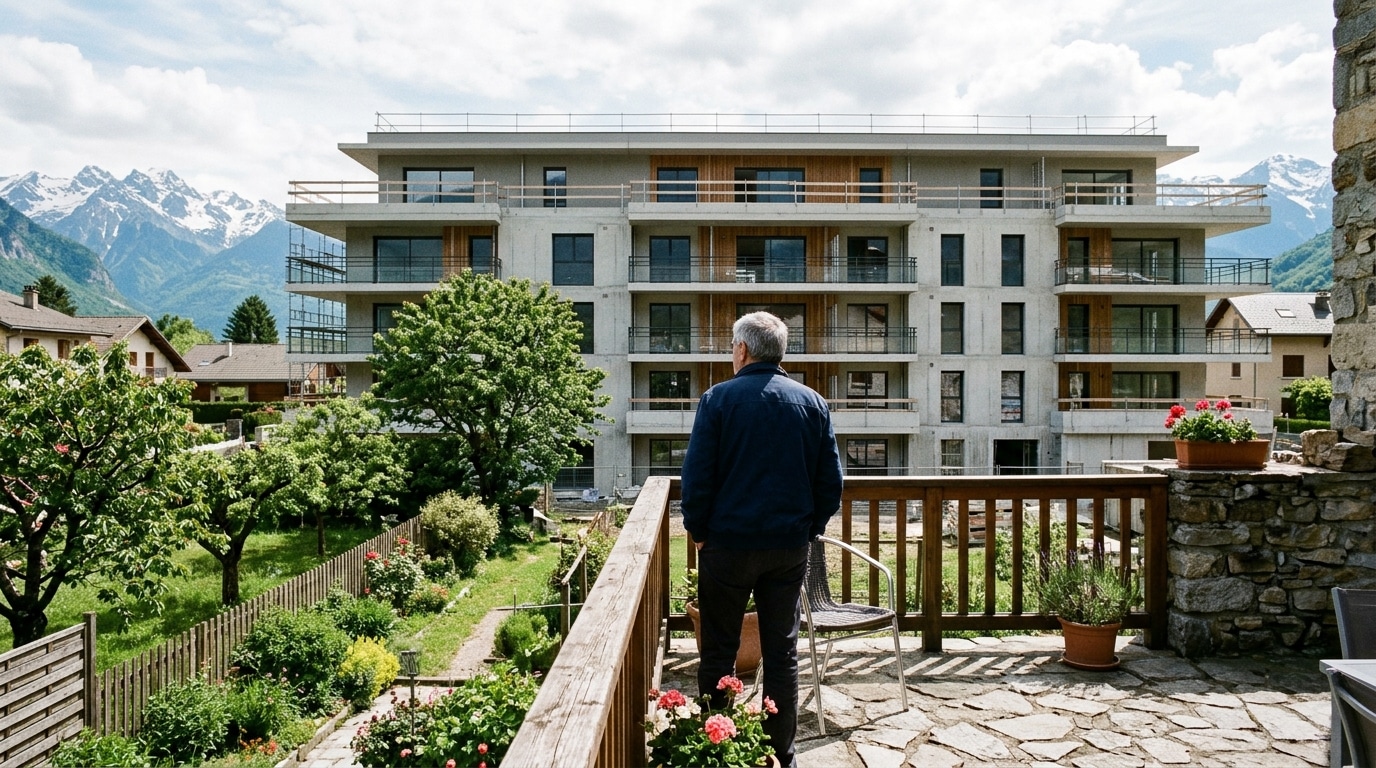
There is a fundamental difference between a pleasant view and a right to a view. The former is merely an amenity enjoyed at the moment of purchasing a property, but it is never guaranteed over time. The latter, by contrast, does not exist as a general right under French law. This is the starting point of a situation that is as unsettling as it is instructive: a homeowner bought his dwelling partly for its mountain panorama, convinced that this scenery would form an integral part of the property. A few years later, five floors of concrete rise before his windows, with no rule having been violated. How can such a situation be perfectly legal? The answer lies in a few principles of urban planning law, often little known to the general public.
- The landscape view is not a right protected by French urban planning law, even if it motivated the purchase of the property.
- Challenging a building permit requires that the project directly affects the dwelling AND violates the applicable urban planning rules, within a two-month period after the start of regular on-site display.
- Once this deadline has passed or the construction is completed, taking action becomes very difficult, hence the importance of researching urban planning rules before buying.
- The landscape view is not a right protected by urban planning law
- The legal conditions for contesting a building permit
- The deadlines and steps to act in time
- The available solutions and remedies when the construction is already completed
The Landscape View Is Not a Right Protected by Urban Planning Law
Contrary to a widespread belief, the view enjoyed from one’s home is not considered a right secured by urban planning regulations. A neighboring plot of land can easily accommodate a construction, even if it blocks a panorama that partly influenced the decision to buy the dwelling. Urban planning law governs precise rules, but it does not protect the visual appeal of a real estate asset. In other words, the mountain that was visible from the living room has never been legally included in the deed of ownership.
This reality often surprises those who knowingly paid more to enjoy an unobstructed panorama. Yet, as long as a construction project complies with the applicable urban planning rules, the mere fact that it spoils a view does not, in itself, provide a sufficient ground to oppose it in court.
The Legal Conditions for Contesting a Building Permit
Nevertheless, it is possible to challenge a building permit, but under very precise conditions. For an appeal to have a chance of success, the disputed project must directly affect your dwelling, and it must violate the applicable urban planning rules. These two criteria must be met jointly: the mere loss of view, however frustrating, is never by itself enough to justify annulling the permit.
Concretely, this means you must be able to demonstrate an irregularity with respect to the urban planning rules. Without this demonstration, even a building that literally blocks the horizon remains legally unchallengeable.
The Deadlines and Procedures to Act in Time
Time plays a decisive role in this type of dispute. The deadline to contest a building permit is typically two months, and it begins running from the start of a regular display on the land concerned by the project.
Here are the elements to watch to avoid being caught off guard by this deadline:
- Monitor the start of a regular display on the site for any new construction
- Take into account the action deadline, which is generally two months after this display
- Ensure that the project directly affects your dwelling
- Verify that the project violates the urban planning rules to act properly
After this two-month deadline from the start of regular display has begun, the possibility to contest the permit fades away, regardless of the perceived severity of the impact on the living environment.
The Solutions and Remedies Available When the Construction Is Already Finished
When the contest deadlines have passed, or worse, when the construction is already under way, the room for maneuver is significantly reduced. It becomes much harder to assert one’s rights once the time limits have expired. This situation illustrates why vigilance up front remains the best weapon: once the five floors of concrete are in place, it is too late to reverse matters based solely on the loss of view.
In this context, prudence invites one to anticipate before purchasing a property advertised for its panorama. Being informed about the applicable urban planning rules helps avert many disappointments. For ultimately, it is not that the mountain has disappeared, but rather the belief that it would remain visible indefinitely that has, once again, proven to be poorly grounded in the law.
