
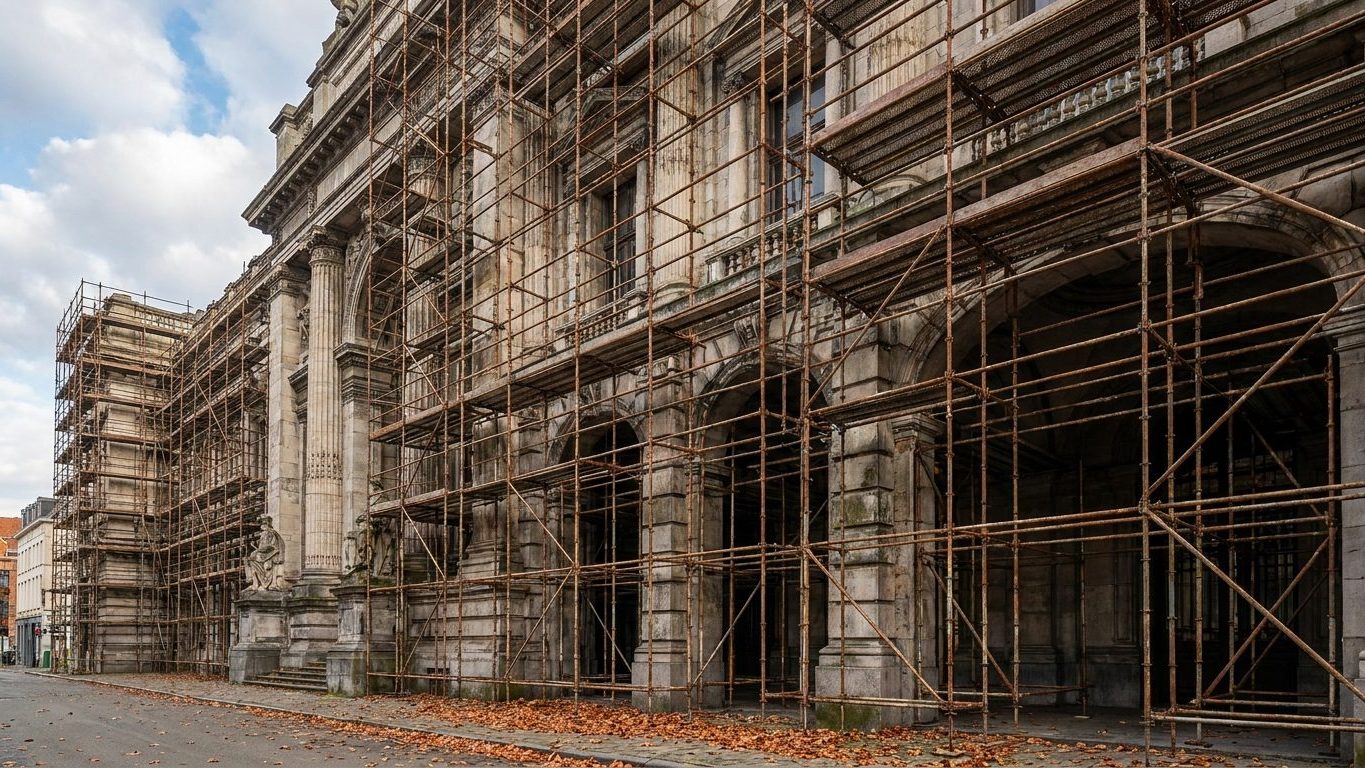
Since 1984, a forest of metal tubes has surrounded the Brussels Palace of Justice. These scaffolds, intended to support a restoration that never truly began, eventually degraded to such an extent that the Belgian state had to release public funds to renovate them. A paradox: fixing the tool meant to fix the building.
Four decades of waiting for a simple coat of paint on steel tubes.
- The scaffolding around Brussels’ Palace of Justice has been in place since 1984, four decades after its installation.
- The Belgian state has spent nearly €5 million on the maintenance, reinforcement, and renovation of these temporary structures.
- The building’s full restoration is now expected only by 2035, for a total estimated cost of more than €600 million.
The largest building of the 19th century, prisoner of its framework
With a footprint of 26,000 m2, it is considered the largest building constructed in the 19th century and remains one of the largest buildings in the world, even surpassing Saint Peter’s Basilica in Rome. Built by order of Leopold II and designed by architect Joseph Poelaert, the structure was meant to embody the grandeur of a young state. Today, it is best known for something else: its chronic inability to rid itself of its own scaffolding.
Installed in 1984, these scaffolds were never able to serve the renovation of the building’s 18,000 square meters of facade, of which the Belgian state is the owner. The reason lies in bankruptcy. The company that was supposed to carry out the renovations in the 1980s went bankrupt, as explained in 2021 by Secretary of State Mathieu Michel, then in charge of the Buildings Agency. The project, intended to last a few years, became an endless wait, leaving the metal structure standing like a permanent set.
Renovating the scaffolding itself: the bill climbs
A scaffold is not designed to stay in place for forty years. Exposed uninterruptedly to Brussels’ wind, rain, and frost, the Palace of Justice’s scaffolding eventually showed signs of weakness that threatened the safety of the construction site itself.
In 2021, the Belgian state thus had to face a nearly absurd move: funding the repair of its own construction framework. The scaffolding must first be reinforced and adapted by the contractor Monument Vandekerckhove, at a cost of €1.5 million, in order to support both the restoration study and the actual restoration of the facade. This amount represents only a portion of the total bill for these girders since their installation.
Since the 1980s, nearly €5 million has already been spent on renting, installing, purchasing, maintaining, and reinforcing the scaffolding around the building, according to figures released in March 2026 by the Buildings Agency. Five million euros to keep in place a structure that, originally, was to serve only a few seasons. The amount, in and of itself, illustrates the scale of the bureaucratic deviation that has affected this dossier for two generations.
The dismantling has finally begun, but the end remains elusive
May 24, 2024 will remain a symbolic date for Bruxellois accustomed to this iron landscape. Mathieu Michel had announced in 2022 that he would personally dismantle the scaffolding with his screwdriver; the promise was kept, even if he ultimately left his toolkit at home that day. The first structures were removed from the central upper part of the front facade, revealing, along the way, the Minerva statue, unseen for decades.
The work has progressed since, facade after facade.
The right side of the front facade was completed in May 2025, followed by the central portion. The left flank remains, where work continues with the installation of a platform for people with reduced mobility. But the promise of a fully scaffold-free Palace, once set for 2030 to coincide with Belgium’s bicentennial, has slipped again. The Buildings Agency now expects that all façades of the Palace of Justice will be restored by 2035.
A project that will have lasted longer than the careers of most of those who started it.
This dossier is not limited to the metal tubes. The total cost of the renovation project is currently estimated at more than €600 million, of which about €480 million goes to the interior renovation alone, a figure separate from what is allocated to the scaffolding and which fuels opposition criticisms regarding the management of the dossier across decades. The €5 million spent to keep a simple construction structure standing thus represents only a tiny fraction of the overall bill, but it remains the most visible and the most biting symbol of forty years of public dithering.
Sources: justice-en-ligne.be | ted.europa.eu | mathieumichel.be
