
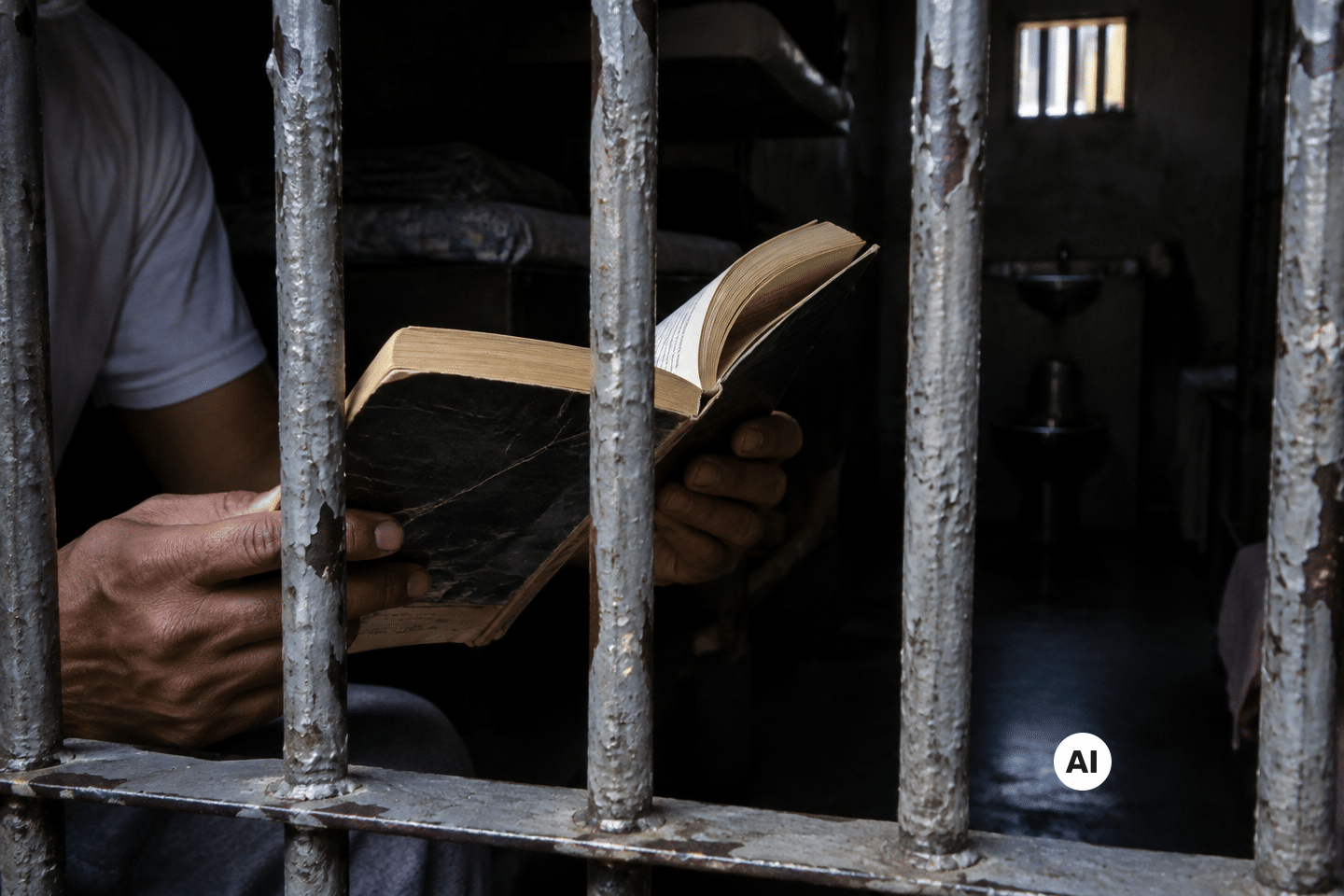
A closed book, four days shaved off a prison term. This equation, endorsed by a Brazilian high court, is anything but anecdotal. Since a ruling in August 2025, finalized in October, it has become the standard across the country’s courts, provided one strict condition is met: the reading must be verified, supervised, and validated by the justice system itself.
Four Days of Freedom Earned for a Single Closed Book
The mechanism has existed for several years, but it has just been reinforced by a landmark ruling. Resolution No. 391 of Brazil’s National Council of Justice (CNJ), adopted in 2021, establishes the rules for what is termed the remittance of punishment through socio-educational practices. Reading literary works holds a special place in this scheme, on par with work or training.
The arithmetic is straightforward on paper: every book read and acknowledged by the justice system reduces a sentence by four days. A prisoner can thus claim up to twelve books per year, equal to a maximum of forty-eight days of regained liberty. When applied to multi-year sentences, the cumulative effect is anything but negligible.
This rule did not arise from nowhere. It responds to a decision by the Federal Supreme Court, which granted habeas corpus to a detainee from the state of Santa Catarina by recognizing the right to a sentence reduction based on reading. In August 2025, the Superior Court of Justice (STJ) reaffirmed this principle in a repetitive appeal, under Theme 1278, relying on Article 126 of the Penal Execution Law. The ruling became definitive in early October of the same year.
A Reading Report Validated by a Commission Appointed by the Judge
That is the general principle. Yet the mechanism is more exacting than it might appear, and this is precisely where the merit of the system lies. A prisoner borrows a book from the prison library, has a reading window of twenty-one to thirty days, and must submit a reading report within the following ten days.
This report is not a mere formality. It is forwarded to the court responsible for sentence execution or to a validation commission specially established for this purpose. It is this verification step that converts a personal act—the act of reading—into a legally recognized action. Without validation, there is no sentence reduction.
The STJ has been careful to spell out the boundaries of this qualitative control. A reading certified by a professional paid directly by the inmate is not sufficient: the commission must be established by the judge himself to guarantee independence in the assessment. The CNJ also governs what must not occur. No censorship, no pre-approved list of authorized titles, no school-exam style scrutiny. This prohibition rests on the law that established the National Policy for Reading and Writing, which protects a reader’s freedom of choice—even behind bars.
A Brazilian Program That Redefines Rehabilitation Through Words
Behind this legal mechanism lies a particularly tense reality within prisons. The latest Brazilian Public Security Yearbook records about 965,000 people deprived of liberty in the country, with a shortfall of more than 281,000 available spaces. In this context of chronic overcrowding, every tool capable of reclaiming time and meaning from detention takes on special significance.
Some states have embraced the national mechanism as a genuine local program. Espírito Santo, for instance, where the Justice Secretariat launched Remição pela Leitura. It now covers 920 inmates spread across 24 penitentiaries, with the same federal rules: four days per book, twelve books, and a maximum of forty-eight days per year.
What stands out is the wager underlying this system. Rather than relying solely on coercion, it rewards a measurable and verifiable intellectual effort. Reading becomes a reintegration lever supervised by the judicial institution itself, not merely a tolerated pastime behind walls.
Whether this model, now affirmed by the Brazilian Superior Court of Justice, will inspire other penitentiary systems grappling with overcrowding remains to be seen. For the moment, the formula is clear: in Brazilian prisons, a closed book can be worth far more than the few hours spent reading.
Sources :
- Dizer o Direito – Reading can trigger sentence remittance (STJ, Theme 1278)
- Estratégia Carreiras Jurídicas – Remission of sentence by reading: STJ criteria and rules
Article prepared with the help of AI · Our method
