
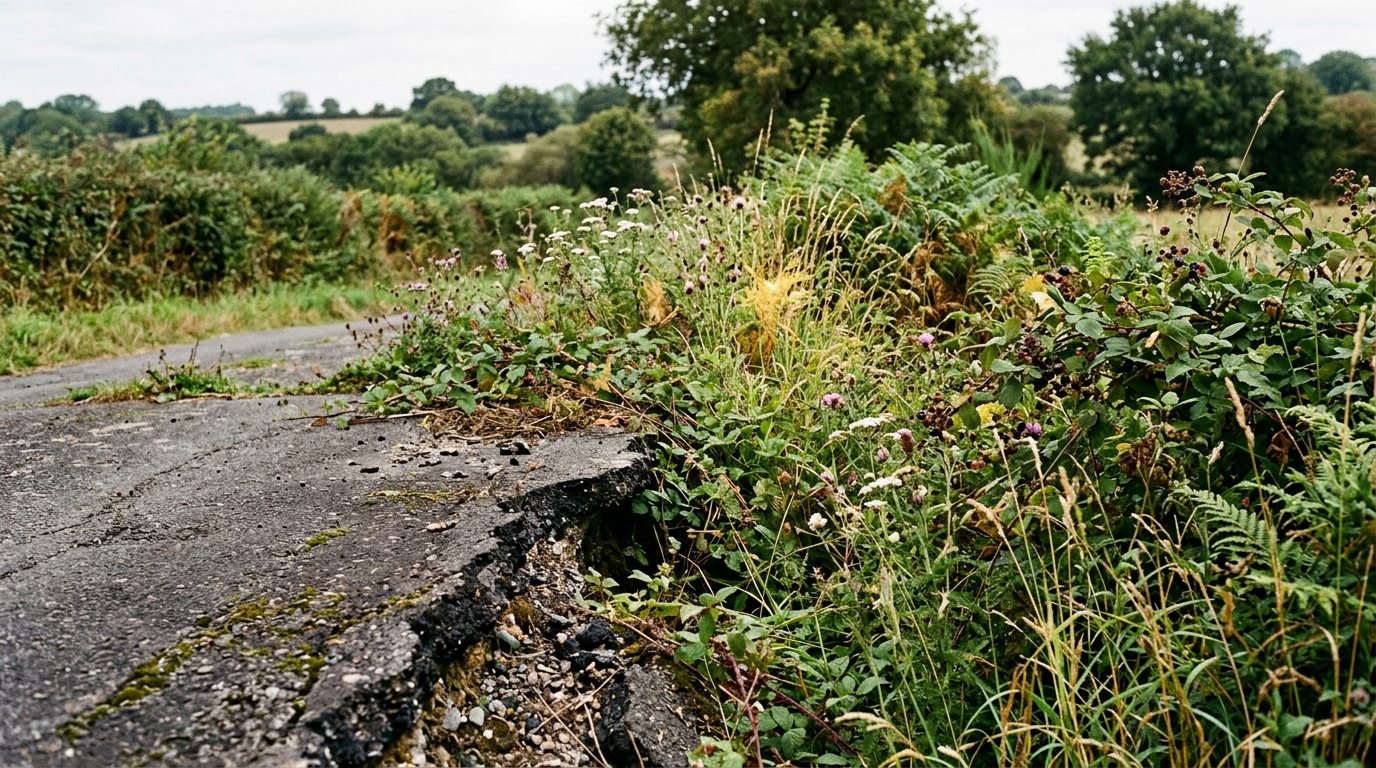
Have you ever noticed, while crossing Vendée or Charente-Maritime, those strips of farmland that look oddly straight and seem to lead nowhere? It isn’t a trick of your imagination. Beneath these peaceful fields and those neglected fallows lies a pharaonic project that the French state has paid handsomely for, without ever laying a single bit of gravel on it. Sixty-five kilometers of land reserves, bought at a premium, have waited for decades for a highway that will probably never come. A look back at one of the most astonishing phantom serpents of French territorial planning.
- The State bought 65 km of land between Fontenay-le-Comte and Rochefort in the 1990s to build the A831, declared of public utility in 2005
- In July 2015, François Hollande refused to extend the declaration of public utility, definitively abandoning the project in light of ecological concerns of the Poitevin Marsh and the Marais de Rochefort
- Since 2016, the State has considered a 2×2 carriageway alternative to ease the crossing at Marans, but the project remained on hold in 2021
- The State bought 65 km of land that leads nowhere
- A highway promised in 1990, never built
- Fields, wastelands and millions wasted for nothing
- Why this phantom project could still be revived
The State Bought 65 km of Land That Leads Nowhere
Between Fontenay-le-Comte, in Vendée, and Rochefort, in Charente-Maritime, stretches a land corridor of about 65 kilometers that largely belongs to the public sector. These parcels are not incidental: they were acquired with a precise objective, namely to lay a highway connecting two major axes of the French road network. But today, this ribbon of cultivated fields, bocage hedgerows, and wetlands looks more like an administrative scar than a construction site in the making.
The most troubling aspect of this story is that these lands are not the result of a mistake or an oversight. They stem from an openly stated political will, financed with public funds, and validated by a properly issued decree. Yet, no ramp, no toll, no paved road has ever materialized on this route. One must go back nearly thirty-five years to understand how we ended up here.
A Highway Promised in 1990, Never Built
The tale begins in the 1990s, when the idea germinated to complete the famous Route des Estuaires by creating the A831 highway. The objective is simple: connect the A83 near Fontenay-le-Comte to the A837 at Rochefort, in order to shorten dramatically the journey between Nantes and Bordeaux, while alleviating La Rochelle, then cut off from the northern highway network. On paper, the project ticks all the boxes of a national-interest infrastructure project.
On 12 July 2005, a decree officially declares the project of public utility, triggering the alignment of local urban plans in many affected communes. Appeals were filed before the Conseil d’État and even before the European Commission as early as 2007, but they all failed, without restarting the works. In 2011, the A831 was included in the national transport infrastructure plan, confirming its priority status. Two years later, the Mobility 21 commission itself recognized the socio-economic interest of the link and its positive impact on serving the port of La Rochelle. Everything seemed to be moving in the right direction, until the wind turned decisively.
Fields, Wastelands and Millions Spent for Nothing
The chosen route posed a major problem: it would have to cross two of the Atlantic coast’s most valuable wetlands, the Marais Poitevin and the Marais de Rochefort, both Natura 2000 sites. Faced with the mobilization of environmental associations and real ecological risks, by the end of 2013 the State conditioned the continuation of the project on the absence of budgetary consequences for itself and on a strengthening of the environmental integration of the route. A compromise that, in reality, already sounds like a first retreat.
The coup de grâce fell in July 2015. President François Hollande refused to extend the declaration of public utility, which was due to expire on July 12 of that year. The A831 was then definitively abandoned, after a political standoff that had pitted for years local elected officials in favor of unlocking the area against environmental defenders worried about these fragile ecosystems. The result: land purchased, procedures completed, millions of euros spent on studies and land acquisitions, for a project that would never begin. The parcels involved have since been intended to be returned to local farmers or integrated into environmental compensation measures.
Why This Phantom Project Could Still Be revived
The highway’s abandonment did not erase the underlying problem: the saturation of roads between Fontenay-le-Comte and La Rochelle, particularly at the crossing of Marans. As early as 2016, the State forwarded to the concerned departments protocols for technical and financial support to consider building a 2×2 carriageway axis, a more modest alternative than a highway but intended to sustainably relieve traffic.
Yet, ten years after the initial abandonment, this 2×2 carriageway project remained largely on hold in 2021. In the field, residents continue to endure a heavy flow of trucks on a departmental road that was never designed to accommodate such volumes. While local authorities regularly demand real progress, the question remains: will these 65 kilometers of land reserves ever host an infrastructure worthy of the name, or will they remain indefinitely as a static landscape, a silent witness to an unfinished political ambition?
In this autumn when debates on territorial planning regularly return to the foreground, the story of the A831 reminds us how grand infrastructure projects can collide with the realities on the ground—ecological stakes, budgetary constraints, and shifting political arbitrations. One open, almost vertiginous question remains: how many other segments of this kind, bought and then forgotten, lie dormant elsewhere in France, awaiting a project that may never come?
