
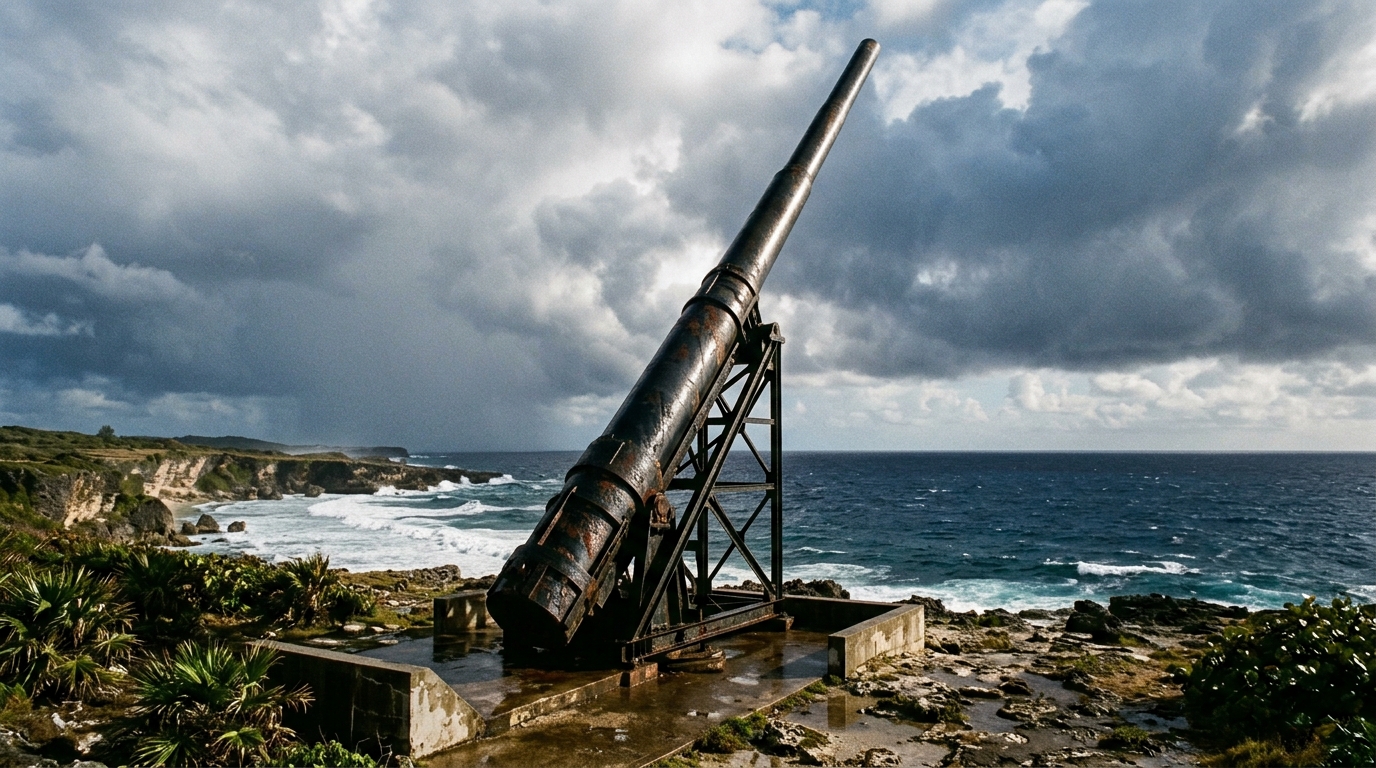
On the southern coast of Barbados, between two tropical showers, a steel tube as long as a ten-story building still points toward the sky. No one has maintained it for decades, vegetation is nibbling away at its foundations, and yet this peculiar object tells one of the boldest attempts in the history of space conquest. For this giant cannon, now rusted, it once sent a projectile to 180 kilometers in altitude, brushing very seriously against the boundary that is generally considered the start of space. A feat largely unknown to the general public, eclipsed by the official rocket race, and one that deserves that we linger on it.
- The HARP project, launched in the 1960s by Canada and the United States under the leadership of Gerald Bull, aimed to send payloads into space using a cannon rather than a rocket.
- In 1966, this 36-meter cannon propelled a shell to an altitude of 180 km, far surpassing the Kármán line located at 100 km.
- The project was abandoned in 1967 for geopolitical and financial reasons, leaving the cannon to rust on-site to this day.
- When the army dreamed of reaching space with a cannon
- 180 km altitude: the overlooked feat of the HARP project
- Why this giant of steel was sacrificed in full glory
- What Barbados’ rust still teaches us today
Quand l’armée rêvait d’atteindre l’espace avec un canon
In the 1960s, amid the Cold War, the great powers sought ever more original ways to send payloads beyond the atmosphere. Rockets cost a fortune; every launch mobilized entire teams and months of preparation. It is in this context that emerged an idea that now seems almost fanciful: what if one could send an object into space simply by firing it with a cannon, as in Jules Verne’s era?
Thus was born the HARP project, for High Altitude Research Project, the product of a collaboration between Canada and the United States, propelled by the scientist Gerald Bull, a ballistic engineer as brilliant as he was controversial. The idea seems crazy on paper, but it rests on an ironclad logic: rather than burning tons of fuel to propel a rocket, why not use the explosive energy of powder to catapult a projectile directly toward the upper atmosphere? Barbados was chosen for its strategic location near the equator, which eases trajectory calculations and reduces risks for inhabited zones.
180 km d’altitude : l’exploit méconnu du projet HARP
The on-site cannon is no toy. It measures no less than 36 meters in length, an impressive scale achieved by welding together two old naval cannons recovered from military ships. This steel mastodon, capable of generating phenomenal pressure at the moment of firing, would enable a series of experiments that culminated in 1966 with a result that exceeded all expectations.
During that shot, famous among specialists, an instrumented shell was propelled to 180 kilometers altitude. To give a sense of scale, the Kármán line, the symbolic boundary that unofficially marks the start of space, sits at about 100 kilometers. The projectile launched from Barbados thus crossed it by a wide margin, with no engine, no onboard fuel, propelled only by the initial detonation. To this day, it remains one of the highest cannon launches ever performed in history, a feat that could have reshaped how lightweight payloads are sent into space.
Pourquoi ce géant d’acier a été sacrifié en pleine gloire
If the HARP project seemed destined for a bright future, it ran into obstacles that had nothing to do with science. The tense geopolitical context of the era made authorities wary of a technology capable, in theory, of sending military payloads to very high altitudes. Gerald Bull, the father of the project, also maintained increasingly controversial ties with certain governments, which ultimately cast a shadow over his entire body of work.
Funding dwindled gradually, diplomatic tensions accumulated, and in 1967, the project was simply abandoned. The cannon, symbol of an extraordinary scientific ambition, was left on-site, without dismantling or any attempt at salvage. It must be noted that moving it would have represented a substantial logistical cost, far exceeding the interest then shown in it. Ironically, Gerald Bull would later pursue a darker career, before being assassinated under circumstances that remain largely mysterious to this day.
Ce que la rouille de la Barbade nous apprend encore aujourd’hui
Today, the HARP project’s cannon has become a local curiosity, almost a quiet tourist draw for the most curious visitors who venture away from Barbados’ usual white-sand beaches. Rust has overtaken its structure, tropical vegetation clings to its sides, and yet its silhouette still commands a certain respect for anyone who takes the time to stop.
This relic is not merely a forgotten artifact. It embodies a line of inquiry that some engineers continue to explore discreetly, notably to consider low-cost launches of lightweight satellites. The idea of a space cannon resurfaces regularly in discussions about alternatives to conventional rockets, given the considerable economic stakes of accessing space. In this sense, this rusty steel tube does not belong entirely to the past: it reminds us that an idea deemed too audacious at one time can become relevant again decades later, carried by new technological advances.
There is something striking about imagining this cannon, planted amid Caribbean vegetation, having once sent a projectile higher than most aircraft ever fly. This little-known story illustrates how space conquest was not only written in the grand official launch centers, but also through bold experiments, sometimes abandoned along the way for reasons far from science. A question remains worth asking: how many other ambitious projects lie dormant, forgotten, perhaps waiting to be rediscovered?
