
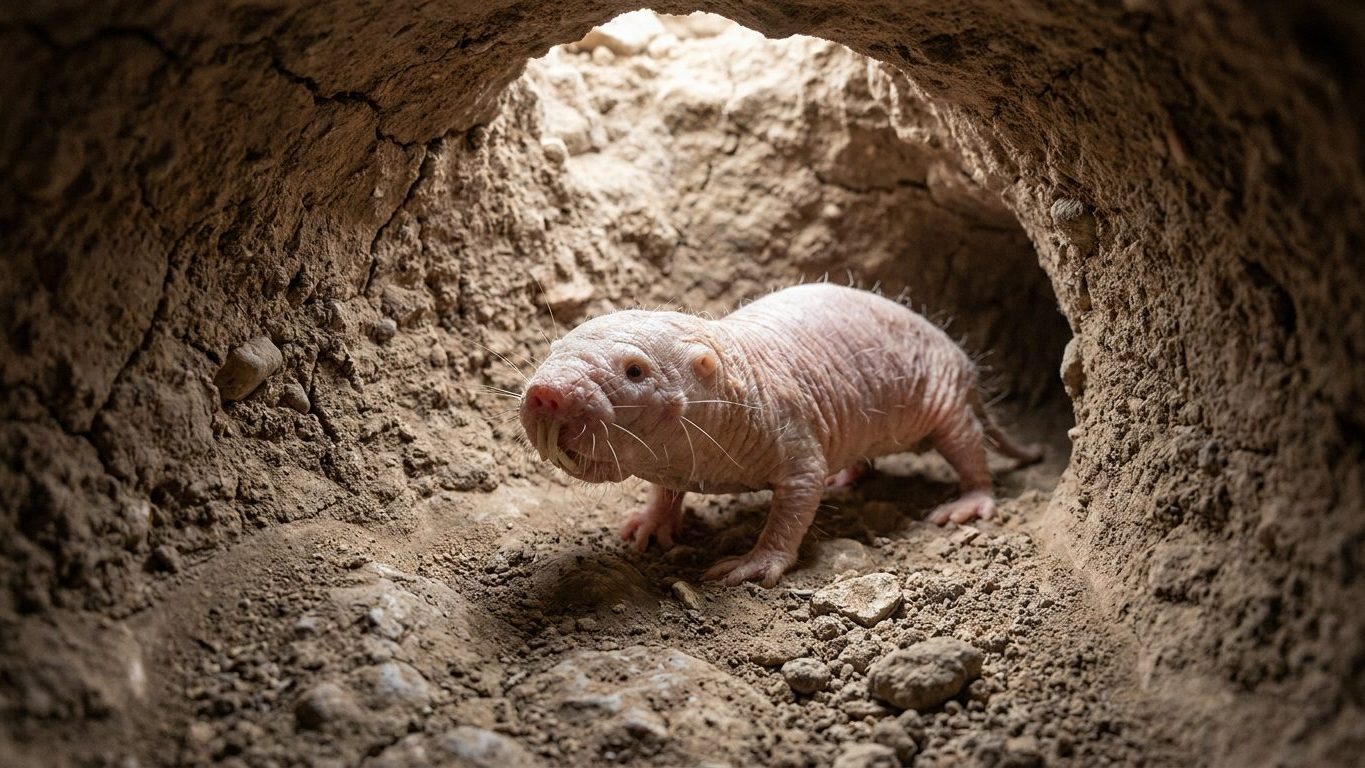
Thirty-five grams on the scale, the size of a sausage, yet a biological profile that fits into none of the known categories. The naked mole-rat (Heterocephalus glaber) can live beyond thirty years in captivity, almost never develops tumors, and endures roughly eighteen minutes in an atmosphere completely devoid of oxygen. A mouse of similar weight dies of old age in two or three years and suffocates in less than a minute under the same conditions.
- The naked mole-rat can reach thirty years in captivity, ten times longer than a comparable mouse, without its age-related mortality risk increasing with age.
- A high-molecular-weight hyaluronic acid produced by its cells blocks cancerous proliferation and prevents tumor formation.
- The animal shifts to an anaerobic metabolism using fructose during total oxygen deprivation, enabling it to survive eighteen minutes without air.
Longevity That Defies the Gompertz Law
In 2018, a team from Calico Life Sciences published in the journal eLife an analysis of an extensive dataset comprising 3,299 naked mole-rats spanning three decades. Led by Graham Ruby, Megan Smith, and Rochelle Buffenstein, the study relies on a mathematical model known as the Gompertz-Makeham law, which posits that the mortality risk increases exponentially with age. The result: unlike every other mammal studied to date, the age-related mortality risk did not rise, even at ages twenty-five times greater than reproductive maturity. In this species, the aging counter seems to be simply blocked.
Some bats live even longer, surpassing forty years.
This conclusion has been challenged by other researchers who argued that historical data used might be biased by incomplete records from the oldest colonies. The original authors responded by removing these dubious data from their analysis and obtaining results identical to their initial publication. Moreover, female breeders do not experience menopause and continue to reproduce past thirty years, an age at which most rodents have already died.
Cancer, Almost Absent Even When Induced in the Laboratory
The lack of tumors is not absolute. A few cases of spontaneous cancers have indeed been documented in naked mole-rats, notably four cases reported by researchers studying this “cancer-resistant” species. Yet their frequency remains minuscule compared with that observed in any other rodent, including animals deliberately exposed to carcinogenic substances in laboratory settings.
The most studied lead is a high-molecular-weight hyaluronic acid produced in abundance by the animal’s cells. Researchers have identified this anticancer mechanism—mediated by the high-molecular-weight hyaluronic acid—whose tissues in the naked mole-rat are markedly enriched relative to those of mice and humans. This molecule prevents cells from crowding beyond a certain density—a phenomenon known as contact inhibition—that blocks the uncontrolled proliferation at the origin of tumors. A second barrier, enforced by the proteins p16 and p27, locks the cell cycle as soon as any suspicious division begins.
In 2023, a team led by Vera Gorbunova transferred the gene responsible for this hyaluronic acid, named Has2, into laboratory mice. The mice carrying this gene exhibited a median and maximal lifespan increase of 4.4% and 12.2%, respectively, along with a 34% reduction in cancer incidence in aged animals compared with control mice. The gains remain modest in comparison to the performance of the original species, underscoring the difficulty of translating a mechanism so ancient from one species to another.
Eighteen Minutes Without Air, Like a Plant
Underground, within networks of tunnels that can exceed four kilometers in length, the air grows scarce as dozens of individuals breathe in the same space. A 2017 study in the journal Science placed naked mole-rats in an atmosphere entirely devoid of oxygen. Under these experimental conditions, naked mole-rats tolerate hours of extreme hypoxia and survive eighteen minutes of total oxygen deprivation without apparent injury, whereas a mouse subjected to the same conditions cannot be revived even if placed back in normal air less than a minute after exposure begins.
No other warm-blooded vertebrate approaches this resistance.
During anoxia, the naked mole-rat shifts to an anaerobic metabolism powered by fructose, which is actively accumulated and converted into lactate in the brain. Fructose enters cells via a transporter named GLUT5, then is phosphorylated by an enzyme, ketohexokinase, with far greater efficiency than the conventional hexokinase. This metabolic redirection avoids the blockages that, in the majority of mammals, poison tissues when oxygen disappears. The process resembles the capacity of certain plants or fish to ferment sugars in the absence of air.
The animal also displays other sensory and thermal peculiarities. It shows unusual insensitivity to pain caused by acids, a trait linked to the carbon-dioxide-rich atmosphere of its tunnels. Its internal temperature, instead, tends to track the soil temperature rather than being constantly regulated, a trait more akin to a reptile than to a typical mammal.
An Army of Mammals, Under Close Scientific Surveillance
The naked mole-rat lives in colonies that can range from 20 to 300 individuals, with a single reproducing female—the queen—supported by one to three males. The rest of the colony, workers and soldiers, digs the galleries, searches for tubers, and defends the group, a eusocial structure identical to that seen in ants or termites and almost never observed in mammals. Once queen, the female continues to grow, even as an adult, by increasing the space between the vertebrae of her spine.
The naked mole-rats never drink water.
This accumulation of anomalies now attracts laboratories specializing in aging and tumor resistance, which study the animal as a biological model rather than a zoo oddity. The mechanisms it combines—protective hyaluronic acid, a double cellular lock via p16/p27, and a fructose-based backup metabolism—remain largely unique to its subterranean biology. The transfer of the single Has2 gene into mice, with only a few percent gain in longevity, clearly shows that none of these mechanisms alone suffices to reproduce thirty years of life with almost no tumors.
Sources: science.org | science.sciencemag.org | ui.adsabs.harvard.edu
