
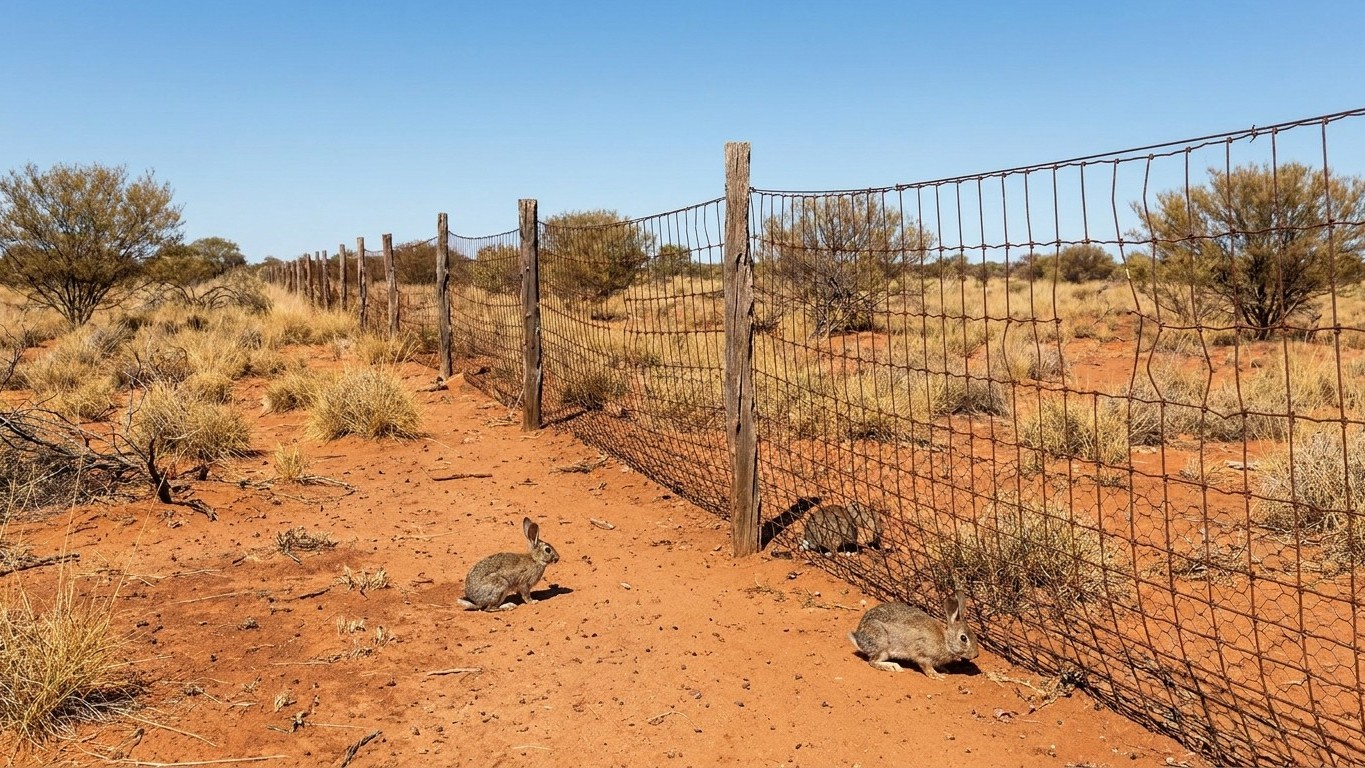
3,256 kilometers of fencing driven into the Australian bush, from one ocean to the other. And yet, at the very moment the last post was hammered into the ground in 1907, the enemy it was meant to stop had already won the race. The State Barrier Fence, better known as the Rabbit-Proof Fence, remains one of the most ambitious civil engineering projects ever undertaken to contain an animal invasion. It is also one of the most instructive failures in the history of the fight against invasive species.
Everything begins in 1859, in Victoria. An English settler named Thomas Austin released twenty-four wild rabbits on his property near Geelong for the pleasure of hunting. He thought that the introduction of a few rabbits could do little harm and would add a touch of home, along with a bit of hunting. The history would spectacularly prove him wrong: without a natural predator and in ideal conditions, rabbits multiplied at a staggering rate. Barely thirty years later, they had already crossed the continent to the Nullarbor, at the gates of Western Australia.
À retenir
- A fence built over six years was breached by rabbits even before its completion
- Camel-riding boundary riders patrolled in near-total isolation to repair breaches
- 600 million rabbits swarmed across Australia while the fencing remained powerless
A line of defense conceived too late
Facing the threat, the authorities of Western Australia reacted. In 1896, a surveyor named Arthur Mason was sent to the southeast of the state to assess the scale of the problem. He suggested building a series of fences, one along the border with South Australia and another farther west. A Royal Commission ruled in 1901: the state would build its barrier. The project began the same year.
It wasn’t just one fence, but three. No. 1, the longest, crosses the state from south to north for 1,833 kilometers, from Starvation Boat Harbour to Cape Keraudren. No. 2, shorter, threads further west. No. 3, known as the “Emu Barrier Fence,” runs east-west for about a hundred kilometers, between Kalbarri and the interior. Together, they form a mesh wall of 3,256 kilometers, completed in 1907.
The problem was that while the posts were being planted, the rabbits did not stop running. By 1904, despite the vigilance of boundary riders, rabbits had already been found west of the unfinished fence, which led the government to order a second line, 130 kilometers farther west. And the scenario repeated: the fence was completed after the rabbits had already crossed into the state, and the ongoing deterioration of the barrier meant there was almost always a place where the rabbits could pass. A wall that takes six years to build simply cannot compete with an animal capable of reproducing several times a year. The finish line had been crossed before the ribbon was even cut.
Camels against wind, fire and termites
After the initial failure, maintenance of this behemoth of barbed wire planted in the middle of nowhere became necessary. This is where the almost-forgotten figures of Australian history enter: the boundary riders. Their mission? To traverse endlessly sections of fencing to mend the breaches opened by floods, fires, termites, or simply the emus and kangaroos that would ram the fence head-on.
The organization was methodical. Four sub-inspectors shared about 800 kilometers of fence each, while twenty-five boundary riders regularly patrolled 160-kilometer sections. At the start, these men traveled by bicycle, a choice that now seems almost comic given the state of the sandy tracks. Very quickly, it became clear that another animal would do the job much better: the camel. Imported from Afghanistan and India decades earlier for desert exploration, these animals capable of days without water became the unofficial vehicle of the rabbit-control effort. The riders using camels covered routes of about 110 kilometers, completed every six days, while their bicycle colleagues traveled average distances of about 50 kilometers, twice a week.
These men lived in almost total isolation. Along the line, huts and water points punctuated the route, and galvanized steel drums, padlocked, were used to store the rider’s provisions, replenished by carts that passed about every two months. No telephone, no rapid rescue in case of trouble: for safety, the riders had to meet at the end of their segment on prearranged dates, and if one failed to show, the other had to continue until locating him.
A failure that eventually served something else
The rabbit-control tally, however, was clear. Despite decades of effort, the rabbit population continued to climb in both eastern and western extents of the line. By the late 1940s, the rabbit population exploded to as many as 600 million individuals. One of the longest fencing projects ever constructed by humans never truly fulfilled its original mission. It was only the arrival of myxomatosis, a virus deliberately introduced in the 1950s, that dramatically reduced rabbit numbers where thousands of kilometers of fencing had failed.
Yet the barrier did not end up being torn down. As its role against rabbits faded, it became clear that the fence played a major part in limiting periodic mass migrations of emus, so it came to be known as the State Vermin Barrier Fence, then Emu Fence, before taking its current name of State Barrier Fence. Today, this fencing still cuts through the bush to slow dingoes, foxes and wild dogs that prey on livestock.
What this story really tells isn’t merely the failure of a pharaonic project, but the structural difficulty of winning a race against a species that reproduces faster than you can build. A century later, Australia continues to patrol thousands of kilometers of similar fences, including a colossal anti-dingo barrier of more than 5,000 kilometers across the center of the country, a testament that the gamble of giant fencing has never truly been abandoned, despite the lesson of 1907.
Sources: breakingthecycle.education | amusingplanet.com
