
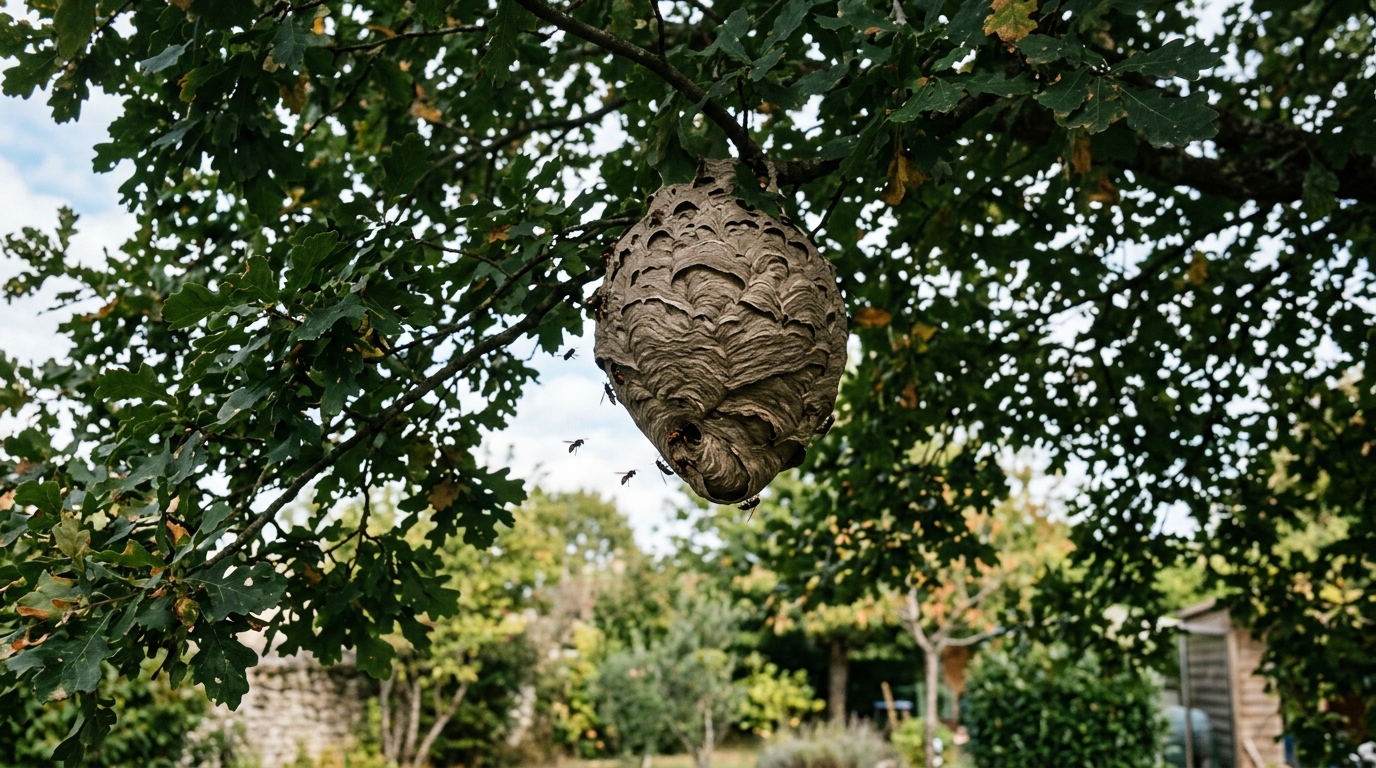
A discreet nest in spring can harbor more than 2,000 individuals by August. The Asian hornets do not suddenly colonize the territory during the warm season: their colonies, invisible for months, experience a demographic explosion at the end of summer. This summer peak changes everything for understanding the real danger and the right moment to act.
Imagine a seed planted in spring that would, in barely a few weeks, grow into a tree several meters tall. That is roughly what the Asian hornet colonies experience each year, except that their growth does not yield wood, but thousands of workers eager to defend their territory. Right now, as summer draws to a close, many French people worry about seeing these insects more numerous than ever around their gardens, apiaries, or orchards. Yet these hornets did not invade the country overnight: they have been there since spring, patient, discreet, almost invisible. What changes at this time of year is simply the size of their nest, now a genuine aerial fortress.
A nest the size of a basketball that becomes an insect bomb
In spring, it all begins in a nearly mundane way. A single queen, emerging from hibernation, establishes her nest in a hidden corner: a dense shrub, a wall cavity, sometimes even a garden shed. This primary nest contains only a few dozen individuals. At this stage, nothing hints at the scale the colony will reach a few months later.
But from the early summer, an astonishing phenomenon occurs: the colony changes residence. It migrates to a secondary nest, typically built high in trees, sometimes more than ten meters above the ground, making it almost impossible to spot from the street or a garden. It is in this new nest that growth becomes truly spectacular, each additional worker actively contributing to enlarging the structure.
As a result: by late summer, some nests reach up to 80 centimeters in diameter and one meter in height, housing sometimes several thousand hornets. This maximum size is not a matter of chance; it corresponds to a demographic peak precisely aligned with the species’ biological calendar.
Why the end of summer changes the game for colonies
The summer heat plays a central role in this acceleration. It stimulates the metabolism of the larvae and markedly shortens their development time. More food available, more active workers, more growth: the cycle self-feeds until it peaks, with spikes observed precisely at the end of August.
To feed an ever-growing number of larvae, the workers intensify their hunt for proteins. Domestic bees, favored prey of this invasive species, experience maximum pressure between late August and October. It is also during this period that beekeepers notice the most damage to their hives, a phenomenon directly linked to this demographic explosion.
It is only from the beginning of autumn that the colony shifts its priority and starts producing the future queens and the reproductive males. On average, each nest yields between 50 and 200 new queens, which will then hibernate before founding their own colonies the following year. The maximum workforce reached in August thus directly precedes this reproductive phase, a turning point for the species’ survival.
The trap of detecting too early or too late
Many individuals spot a nest in spring and think they acted in time by reporting it or destroying it. Yet removing a primary nest does not guarantee anything: another swarm may have formed elsewhere, unseen, and continued its development discreetly.
Conversely, waiting until September to intervene gives the new queens time to leave the nest and disperse into the wild. Each fertilized queen can establish a colony the following year, which mechanically multiplies the problem across the territory. It is also estimated that the Asian hornet disperses over nearly 80 kilometers per year thanks to these numerous founding queens that swarm every spring.
Thus, the most effective intervention window sits in midsummer, before queen production, but after the nest has reached a size that can be reliably spotted. This is precisely why a French law now governs the fight against this species, officially classified as Invasive Alien Species by the Muséum national d’Histoire naturelle.
What the summer population peak really reveals
This seasonal phenomenon explains why reports explode during this late-summer period, even though hornets have been on the territory for several months already. It is not a sudden invasion, but a biological cycle that has matured, almost invisible until it reaches its peak.
According to the Muséum national d’Histoire naturelle, the yellow-legged hornet is now present across France, including Corsica, as well as in several neighbouring European countries. Understanding this demographic dynamic allows intelligent adjustment of surveillance and intervention periods. Detecting nests at the very start of summer, before they reach their maximum size, remains the most effective strategy to limit their impact on local ecosystems, especially on bee colonies already weakened for other reasons.
The real danger is therefore not the appearance of hornets in spring, but the magnitude that each colony quietly reaches before the end of summer, a cycle that repeats each year and that closes entirely with the first frosts, between November and February, when the entire colony dies except for the young queens that have already flown away.
In the end, what seemed like a sudden proliferation is only the logical culmination of a cycle started several months earlier. One question remains to be asked each year, as the fine days return: rather than loitering after the hornets in the heat of summer, shouldn’t we learn to monitor their nests well before they become visible to everyone?
