
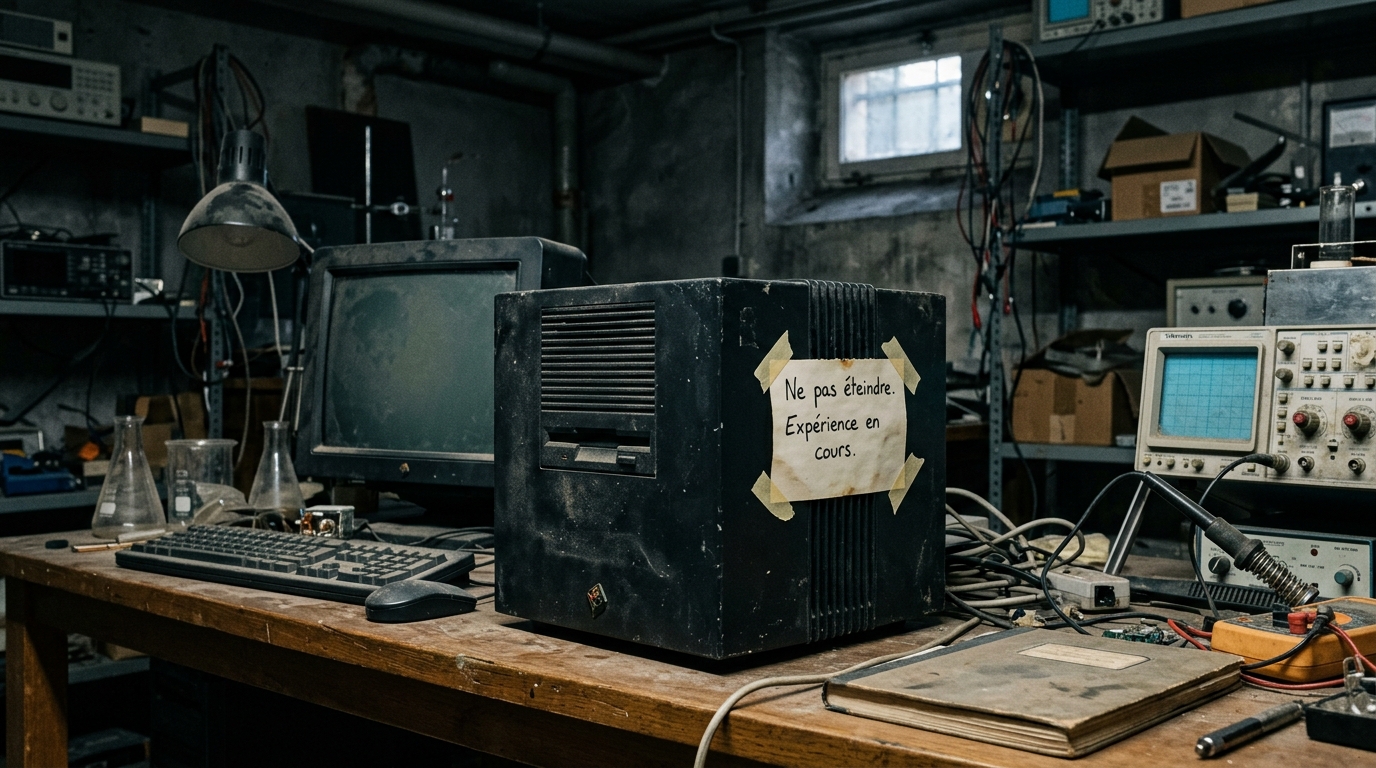
Imagine for a moment that the device that put the world online isn’t a climate-controlled supercomputer or a high-tech data center, but a simple black box sitting on a shelf, with a hand-written instruction as its only protection. Yet this is precisely what we still uncover today in the CERN basements near Geneva.
Là, among the remnants of physics experiments and the memories of fundamental research, lies an unassuming computer that nevertheless changed the face of the world. Its name, the NeXT Cube, may not ring a bell with the general public, but its role in human history is immense. This machine, kept powered on for no one for more than thirty years, continues to bear a handwritten label whose message has never been removed, nor even debated.
A warning frozen in time, like a symbol of the quiet turning point that occurred here in 1990.
The day a computer became the world’s first server
It all begins in the late 1980s, in the corridors of CERN, where a young British engineer named Tim Berners-Lee seeks a solution to organize and share information among researchers scattered around the globe. To carry out this project, he uses a NeXT Cube, a futuristic-looking workstation, shaped as a matte black cube, manufactured by NeXT. This company was founded by Steve Jobs after his dramatic departure from Apple in 1985. Between 1988 and 1995, NeXT produced several models of this line, but it is this exact cube, with its clean design and magnesium chassis, that will become the stage for a major technological turning point.
In the latter half of 1990, Berners-Lee writes on this machine what would become the WorldWideWeb software, simultaneously a browser and an editor. He also installs there the first web server in history, enabling the hosting and viewing of pages linked by hypertext. The concept now seems almost self-evident, but at the time it was a quiet revolution born in the anonymity of a scientific basement. Berners-Lee himself would later call this computer the actually usable computer, underscoring how this machine, despite the commercial failure of the NeXT line, proved strikingly effective at giving birth to the web.
Why a handwritten label is worth more than a safe
On the side of this historic machine one can still find a handwritten label, whose message remains disarmingly clear: This machine is a server. Do not power down! In other words, this machine is a server—do not switch it off. A simple sentence, almost banal, but it recalls how the world’s first web server operated for a long time without redundancy, without automatic backups, without any fallback infrastructure. Everything rested literally on this black cube and on the goodwill of never cutting its power supply.
A second label, placed beneath the keyboard, completes the picture for curious visitors: At the end of the 80s, Tim Berners-Lee invented the World Wide Web using this Next computer as the first Web server. What we witness here is a form of technical memory nearly tangible, where a simple scrap of paper sufficed to protect one of the most pivotal objects in contemporary history, where one might have imagined far more sophisticated security measures. Proof, if proof were needed, that some revolutions are born from the simplest things.
The day CERN offered the Web to the planet
The first version of the WorldWideWeb browser is completed a few days before Christmas 1990, after roughly two months of intensive development. But the story does not end there. It is only in August 1991 that the software becomes accessible to the general public, via an announcement posted to the era’s discussion groups, then highly popular among computing enthusiasts. The Web thus gradually emerges from its scientific bubble to begin its slow ascent across the world.
The real turning point, however, comes on April 30, 1993, when CERN decides to place the World Wide Web’s source code into the public domain. This choice, as discreet as it is historic, means that no one can claim ownership or patent this technology. In plain terms, the invention born from this cube becomes a common good, accessible to all, without restrictions or royalties. This decision, made within CERN’s offices, still shapes how billions of people navigate, exchange, and inform themselves every day around the world.
From the black box to the global network: what this relic reveals
Today, the historical machine is no longer connected to the internet, of course, but it has not disappeared into a box of archives either. It is proudly exhibited at CERN’s public museum, Microcosm, located on the Meyrin site in the canton of Geneva. Visitors can see the black cube as it was, with on its keyboard a copy of the founding document written by Berners-Lee, titled Information Management: A Proposal, the theoretical birth certificate of the Web.
What stands out is the gap between the scale of the upheaval caused by this machine and the modesty of its appearance. The cube’s NeXT design would later see a second aesthetic life when Steve Jobs, who returned to Apple in 1997, used it as inspiration to create the Power Mac G4 Cube. A discreet yet real lineage linking this forgotten object in a basement to the minimalist ethos that would become Apple’s hallmark. This black cube is therefore not merely a museum piece: it embodies the tipping point between an era when information moved slowly and the era today, when it crosses the planet in an instant.
Looking at this silent relic today, one realizes how major technological revolutions do not always erupt in a blaze of glory, but sometimes emerge from the quiet of a basement, sheltered from view. This black cube, faithful to its handwritten instruction for more than thirty years, continues to remind us that the Web, now ubiquitous in our lives, began as a fragile, nearly forgotten object that could have been stopped with the mere flick of a switch. A thought to ponder the next time we open a browser without a second thought.
