
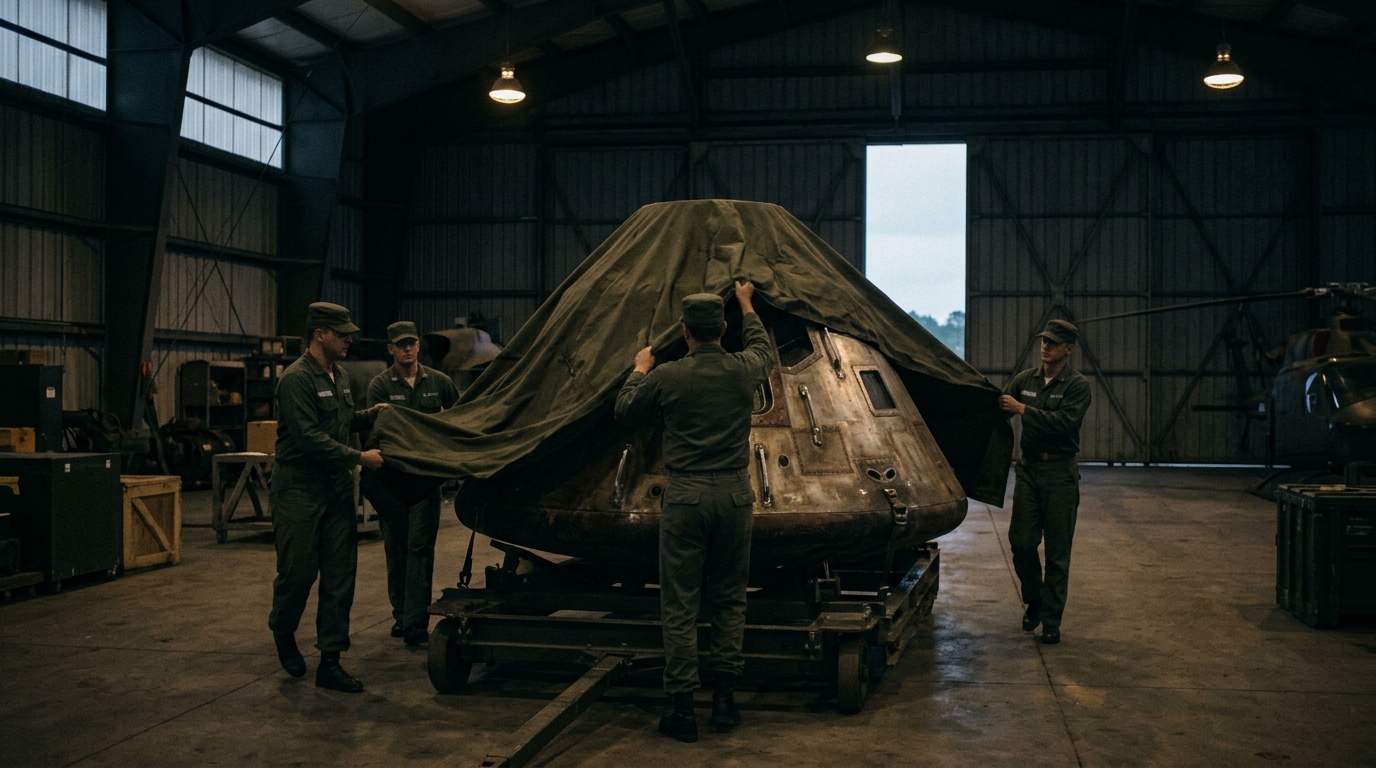
The summer of 1969 belongs to Neil Armstrong. Everyone recalls that small step on the Moon, broadcast to hundreds of millions of astonished viewers. Yet beneath the glow of that planetary triumph, another space destiny faded away in a quiet murmur, without cameras or speeches. A few weeks before Apollo 11’s lunar landing, the United States Air Force discreetly buried one of its most ambitious and most secret projects. An inhabited orbital laboratory, conceived not for science or prestige, but for espionage. Its name: the Manned Orbiting Laboratory, or MOL. Here is the story of a mission erased from memory, whose participants remained anonymous for nearly half a century.
A covert espionage laboratory hidden behind a Gemini capsule
Publicly announced at the end of 1963, the MOL carried the appearance of a scientific showcase. Officially it aimed to
demonstrate the usefulness of humans in space for military missions. A neat, almost banal formulation. In reality, the heart of the project was far more sensitive: the plan was to place in a low polar orbit a long, 18-meter station, a gigantic manned camera aimed at scrutinizing Soviet installations with unprecedented precision.
To accomplish this, engineers devised a clever arrangement. They would take NASA’s famous two-person Gemini capsule, tweak it slightly, and couple it to a reconnaissance module propelled by a Titan-3C rocket. Two men would live there for 30 days, isolated from the world, occupied with photographing ground targets. Within the intelligence services, the project carried a code name worthy of a spy novel: Dorian. A launch site was even built especially in California.
Military astronauts trained for a mission that never took off
To populate these orbital stations, the military selected 17 military pilots. Elite men, carefully chosen, trained in the strictest secrecy. A troubling fact: at the moment of their recruitment, all were unaware of the project’s true purpose. It was only later that they were told their real mission, that of espionage astronauts. They thus became members of a clandestine corps, a handful of men prepared for an adventure about which the general public would never know.
The irony of their story is dizzying. Some of these pilots possessed the mettle of the greatest, and several could have walked on the Moon instead of Armstrong. After the program was halted, six of these men went on to join NASA and flew aboard the space shuttle. Among them was a certain Robert Crippen, who would later reveal that the day of the cancellation remained etched in his memory as one of the low points of his life. Their names, however, stayed classified until 2015.
Why NASA signed the project’s death warrant
If the MOL never launched, it was not for lack of ambition. It was the result of a deadly mix of factors. First, money. In six years the program consumed about $1.56 billion, and projections kept climbing, moving from around 1.5 to nearly 3 billion. Yet, at the same time, the Vietnam War was swallowing large portions of the defense budget. The calculation became hard to justify.
Then came the quiet revolution of machines. Automated reconnaissance satellites made rapid progress and demonstrated that they could perform exactly the same job: photographing the enemy with remarkable precision, but without risking a single human life and at a far lower cost. The CIA chief at the time even feared that a deadly orbital accident would paralyze all space intelligence. The verdict dropped like a guillotine: the project was officially canceled a few weeks before Apollo 11 launched toward the Moon.
What the MOL’s shadow reveals about the 1969 space race
The MOL story reminds us of a truth often overlooked: the space conquest of the 1960s was not just an adventure of exploration and dream. It was also, in the background, a military confrontation. Behind the glittering tableau of Apollo played out another race, quieter and more strategic, where space became a privileged observation post to monitor the adversary.
The fate of the MOL also illustrates a fundamental shift of our era: the moment when machines take over from humans. These military astronauts were, in a sense, the first casualties of automation applied to space. Their spy-robots proved simply better than they were for the mission planned. A strikingly modern debate, which still resonates today as we ponder probes and rovers.
So, while the world held its breath before images of the Moon, a handful of men watched the dream of a lifetime vanish in utter silence. The MOL never flew, but its long-buried story speaks volumes about the hidden priorities of a certain era. And one cannot help wondering: how many other equally bold projects lie dormant in the security-cleared drawers of space exploration?
