
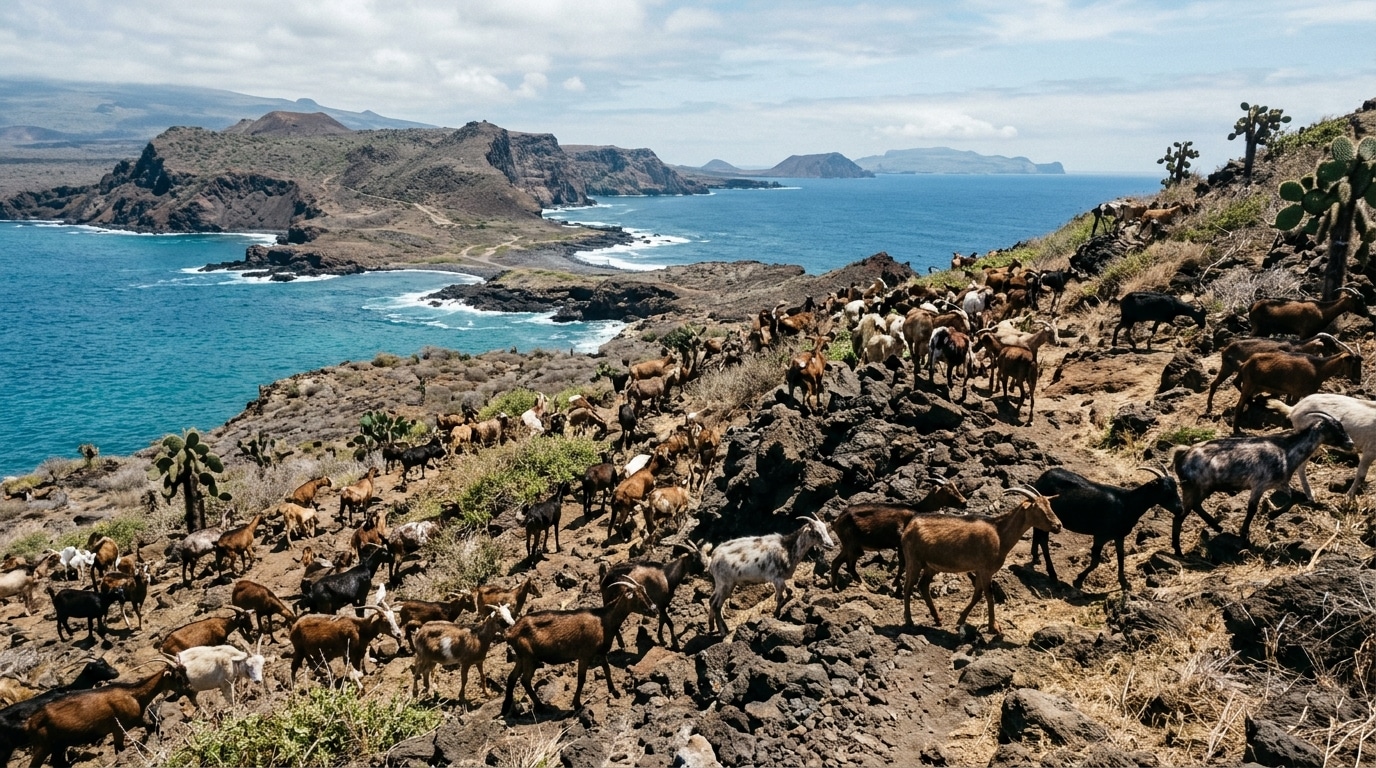
Imagine being able to trace the thread of an ecological catastrophe back to its origin: a single act, seemingly inconsequential, that was enough to tilt an entire ecosystem. In the Galápagos, this volcanic archipelago that inspired the greatest theories of evolution, it took only a handful of goats to transform a natural sanctuary into a battleground. In the late 1950s, settlers released about a hundred of these animals on Santiago Island. No one then imagined that the herd would multiply at a dizzying pace, reaching hundreds of thousands of hungry heads. The result: a disaster that nearly erased from the map species millions of years old. Here is how an archipelago nearly reached a point of no return, and how scientists carried out one of the most spectacular rescue operations ever undertaken.
One Hundred Goats, a One-Way Ticket to Chaos
It all starts with a banal gesture. In the late 1950s, settlers land about a hundred goats on Santiago Island, one of the jewels of the Galápagos archipelago. The aim is modest: to have a local supply of meat and milk. But in this isolated natural laboratory, where predators are nearly nonexistent and food is plentiful, these herbivores find ideal conditions to thrive.
The phenomenon resembles a chain reaction. With nothing to curb their reproduction, the goats multiply from generation to generation. Three decades later, this small group has grown into an army of 250,000 creatures that graze everything that grows. What began as a domesticated herd had become a full-blown biological invasion. And Santiago is not an isolated case: since the 19th century, several mammals introduced by humans have proliferated across the archipelago, upsetting balances that had been in place for ages.
When Herbivores Turn a Paradise into a Desert
A goat may seem harmless. But multiply that appetite by hundreds of thousands, and you get a vegetation-shredding machine. These animals overgraze relentlessly, devouring young shoots, shrubs, and cacti. The result: native flora retreats, soils become bare, and erosion takes hold. The lush paradise gradually descends into arid terrain.
The tragedy goes far beyond the disappearance of a few plants. By entering direct competition with native species, the goats threaten one of the Galápagos’ most emblematic symbols: the giant tortoise. Deprived of the vegetation it depends on, this living icon sees its recovery hindered. Several endemic species, found only here and nowhere else on the planet, are cornered, confined to a few natural refuges such as crater floors. In plain terms, a seemingly innocent act nearly erased irreplaceable biological heritage shaped by millions of years of isolated evolution.
The Titanic Hunt to Wipe It All Clean
Faced with the scale of the disaster, the authorities of the Galápagos National Park and the Darwin Heritage Foundation launched a response equal to the task: the Isabela Project. Planning began in the late 1990s, followed by a major implementation spanning almost seven years. The ambition was colossal: restore an area of about 517,000 hectares, making it at the time the largest island restoration effort ever undertaken within a protected area.
The method, too, was as methodical as it was impressive. Elite snipers first scour the terrain on foot, then continue the pursuit from the air, by helicopter. But the real stroke of genius bears a name almost biblical: the Judas goats technique. The idea? Sterilize certain goats, equip them with tracking collars, and release them. Naturally gregarious, they instinctively join the last wild herds hidden in the island’s corners. It is enough to locate them by radiotelemetry to uncover the stragglers. A traitor in the service of conservation, in a way. In total, more than 140,000 goats were eliminated across roughly 500,000 hectares, for a budget near 10 million dollars.
What Santiago Taught the World
Every detail of the operation was designed to preserve the ecosystem, down to the carcasses of the culled animals. Rather than remove them, the teams chose to let them decompose on site. The logic is as simple as it is clever: the nutrients swallowed by the goats over the years would thus return to the soil, nourishing the land. Carrying them away would have impoverished the island forever.
The results did not take long to arrive. Highland shrubs, young trees, and Opuntia cacti regained ground. Species that had formerly taken refuge in the craters reappeared, and the Galápagos rail, a quiet local bird, became abundant once more. Nature, given a chance, knows how to reclaim its rights with astonishing speed. All is not perfect, though: on Santiago, the disappearance of the goats left the field open to introduced brambles, which have colonized large portions of the highlands. A proof that a disrupted ecosystem never fully returns to its original state.
The story of Santiago boils down to a lesson as lucid as it is troubling: sometimes a tiny choice can trigger a gigantic catastrophe, and a colossal effort can attempt to mend the damage. Today this episode stands as a global benchmark in ecological restoration, but also as a warning. At a moment when invasive species spread across the planet, often in our own gardens, shouldn’t we ask what chains of reactions we set off, often without realizing it?
