
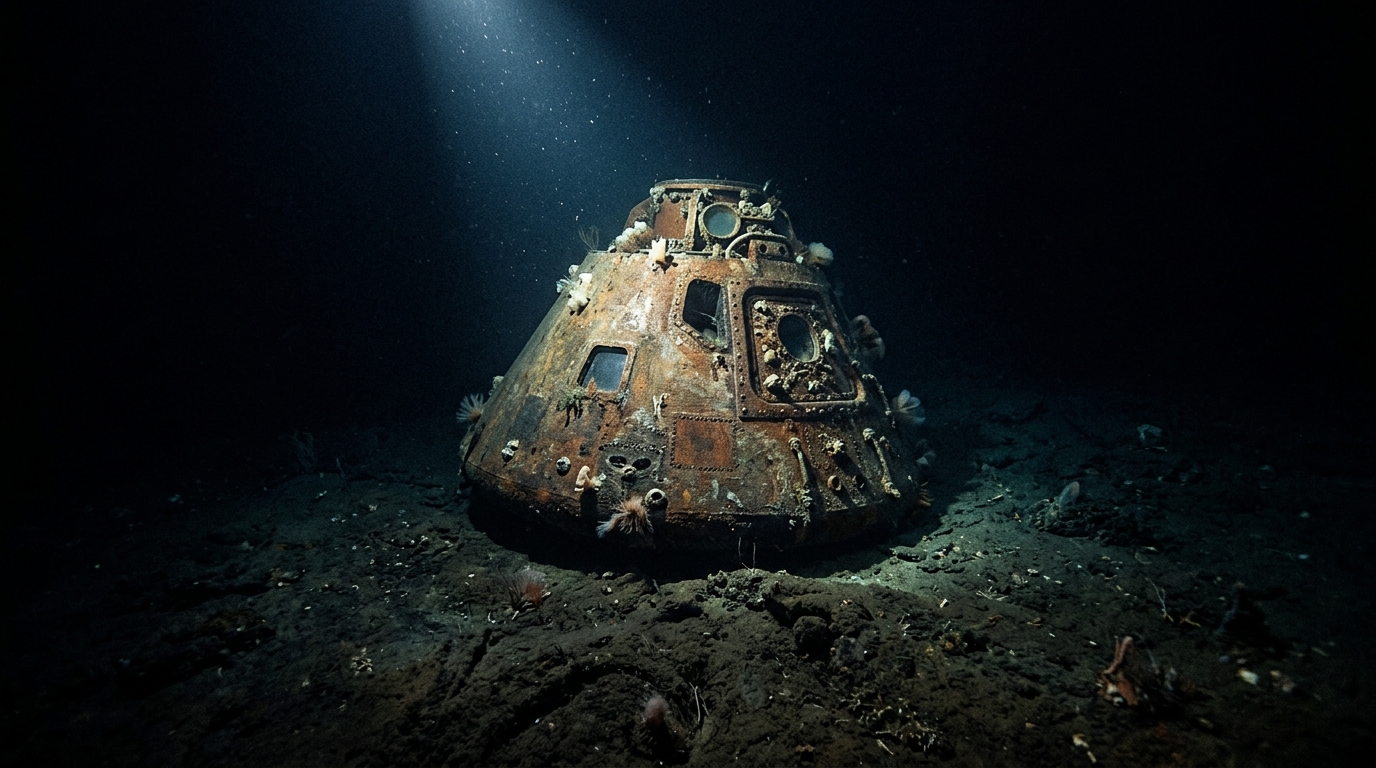
What remains of an American space capsule after spending nearly four decades about 4,900 meters beneath the Atlantic seabed? Surprisingly, enough to restore it piece by piece. The story of Liberty Bell 7 is one of those that blends technical achievement, real fear, and archaeological patience. This small vessel, which spent only fifteen minutes in space with astronaut Gus Grissom aboard, experienced a splashdown that nearly turned into a tragedy, before disappearing into the depths for thirty-eight years. A tale worth a detour, as it illustrates how the early days of space conquest were sometimes hanging by a thread, or rather by a hatch.
- The Liberty Bell 7 capsule hatch opened accidentally after splashdown, nearly drowning astronaut Gus Grissom before his rescue at the last moment.
- The capsule sank to a depth of about 4,900 meters in the North Atlantic after the rescue team had to jettison it to avoid risking the helicopter.
- Found 38 years later thanks to a side-scan sonar and a remotely operated vehicle, the wreck was then fully restored piece by piece at Cosmosphere in Kansas, where it is now on display.
- The flight that was meant to mark American space history
- The hatch that pops: a few seconds that change everything
- The helicopter powerless against the sinking capsule
- Found again 38 years later at 4,900 meters depth
The flight that was meant to mark American space history
We are at the heart of the space race, that era when Americans and Soviets competed to prove their technological dominance. The Mercury-Redstone 4 mission, better known by its baptismal name Liberty Bell 7, sits within this tense, competitive context. Aboard is Virgil “Gus” Grissom, one of the seven original Mercury program astronauts, about to undergo a suborbital flight of barely fifteen minutes. A short duration, certainly, but at the time a remarkable achievement for an agency still in its infancy.
The flight proceeds without notable hiccups. Grissom executes his parabolic trajectory, brushes the edge of the atmosphere, then begins his descent toward the Atlantic Ocean. Splashdown, that phase when the capsule plunges into the water after slowed descent thanks to its parachutes, goes smoothly. All indications point to the mission ending in good conditions, and that the astronaut will be recovered without trouble by the nearby Navy helicopters. It is at this precise moment that everything changes.
The hatch that pops: a few seconds that change everything
As the capsule floats calmly on the surface, the Liberty Bell 7 hatch opens abruptly, with no one truly understanding why in the moment. This mechanism, designed to allow a quick exit for the astronaut in case of emergency, triggers in an entirely unexpected manner. Seawater rushes into the cabin with disconcerting speed, turning a routine operation into a crisis within seconds.
Grissom has no choice but to scramble out of the capsule as it fills inexorably. The astronaut ends up in the water, his spacesuit playing a crucial role, but double-edged. If it is meant to provide buoyancy, it also begins to take on water through a valve left open. Grissom’s head remains visible at the surface, floating beside the wreck that sinks away. The situation rapidly becomes critical for the man who had just experienced one of the most intense moments of his astronaut career.
The helicopter powerless against the sinking capsule
In this race against time, two priorities press simultaneously on rescue teams: to recover the distressed astronaut and to attempt to salvage the capsule itself, a precious technological witness to the mission. An initial helicopter positions itself to hoist Grissom, but the waterlogged suit greatly complicates the maneuver. The astronaut, exhausted, is ultimately saved narrowly by a second aircraft, as his suit threatened to fill to the point of sinking him permanently.
Meanwhile Liberty Bell 7 continues taking on water at a furious rate. A helicopter tries to keep it aloft using a cable system, but the weight of the flooded capsule quickly surpasses the lifting capabilities of the craft. The Navy teams face an impossible choice: risk losing the helicopter with its crew, or jettison the capsule. They opt for the latter. Liberty Bell 7 is released and begins its long descent toward the ocean floor, about 90 miles northeast of the Bahamas, taking with it the mission’s secrets.
Found again 38 years later at 4,900 meters depth
The capsule vanishes from radar for nearly four decades, resting more than 16,000 feet beneath sea level, a depth somewhat deeper than the Titanic wreck itself. A location that makes any recovery attempt exceptionally perilous, given the pressure and darkness at such depths. It would take an expedition organized by Liberty Bell-7, Inc., in partnership with Discovery Channel, for things to finally move. Thanks to the Ocean Explorer 6000 side-scan sonar, developed by Oceaneering International, the wreck was eventually located in the Blake Basin, in the North Atlantic, at a depth of 16,043 feet.
The recovery phase then unfolds with a brand-new remotely operated vehicle, named Ocean Discovery, specially built for this delicate mission. After several dives, the device succeeds in bringing the precious capsule to the surface. The day of its return to Port Canaveral falls by a curious calendar coincidence exactly thirty-eight years after the original flight. Liberty Bell 7 then begins a new journey, this time on land: its meticulous restoration at Cosmosphere in Hutchinson, Kansas. Specialists from the Spaceworks division dismantle the craft into no fewer than 25,000 individual pieces, each cleaned of the salt accumulated during all those years underwater, before being carefully reassembled.
This odyssey of Liberty Bell 7, blending space achievement, maritime fright, and archaeological salvage, sums up in itself the heroic and sometimes precarious saga of the early days of space exploration. It reminds us that behind every successful mission lie unforeseen events that could have turned into tragedy, and that technology, however advanced for its time, remains subject to the whims of chance. Now on display at Cosmosphere, the capsule continues to tell this story to all who are interested in humanity’s first steps beyond our atmosphere.
