
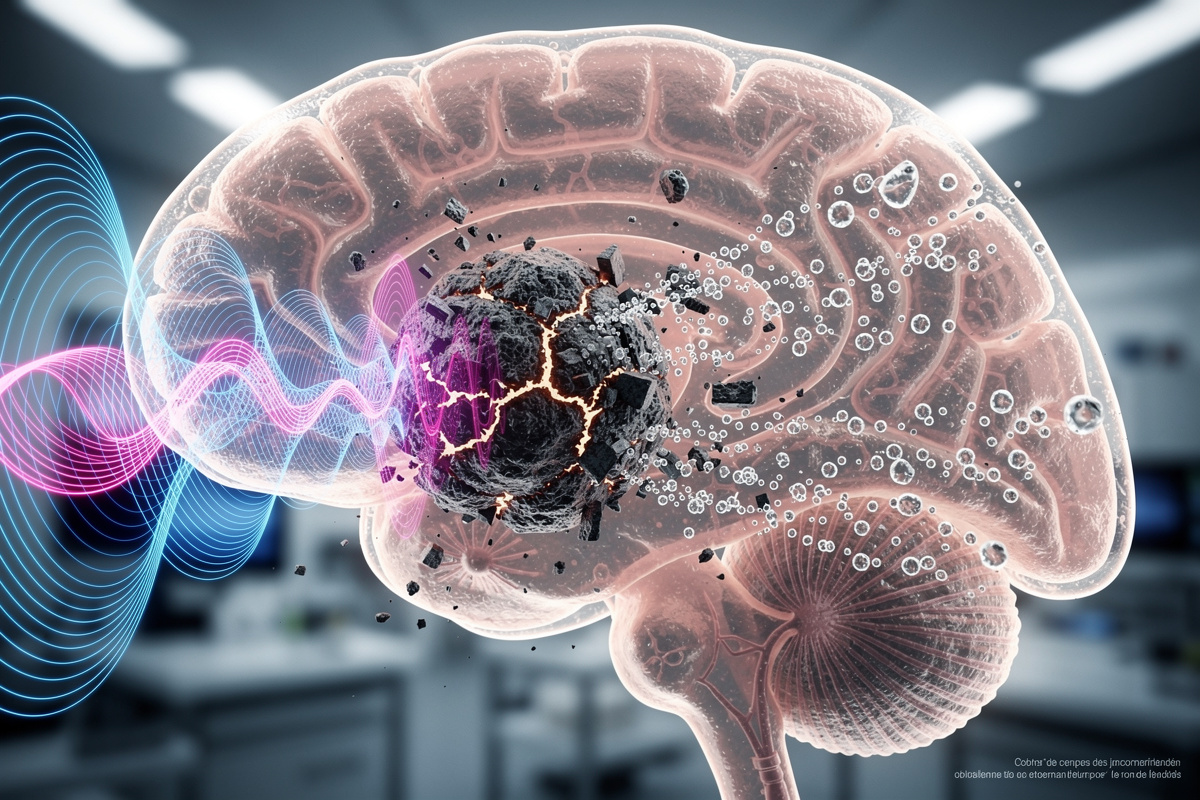
Imagine a team of researchers who manage to deliver a treatment into the skull of a mouse without any incision, simply by sending ultrasound combined with microbubbles through the bone. This scenario, worthy of a science-fiction film, is actually real: scientists at the University of Virginia have just demonstrated that this technique works astonishingly well on gliomas, those dreaded brain tumors. Even better, they discovered that the barrier meant to protect the brain becomes, once colonized by cancer, easier to cross than the surrounding healthy tissue. A finding that could change the game for glioblastoma, the most aggressive form of these tumors.
Brain Tumors Turn Their Own Shield into an Exploitable Weakness
Credit: © DR
Glioblastoma is among the most feared cancers in neuro-oncology. This form of glioma, the most common in adults among primary brain tumors, is almost always fatal within five to ten years and causes more than ten thousand deaths each year in the United States. A figure that underscores the medical urgency surrounding this disease, still too often associated with a grim prognosis despite advances in modern medicine.
What makes this cancer particularly difficult to fight is not only its virulence but also its location. The brain possesses a formidable defense system designed to push back almost anything trying to penetrate it, including treatments that could save lives.
When the Brain’s Protective Barrier Becomes a Cancer’s Accomplice
This natural defense goes by the name: the blood-brain barrier. It continuously filters what moves between the bloodstream and brain tissue, blocking the vast majority of anticancer drugs before they even reach their target. A daily protection, but it becomes a major obstacle when treating a tumor lodged at the very heart of the organ it guards.
Yet, cancer cells do not stay quiet in the face of this barrier. As they proliferate, they modify its structure to the point that its behavior becomes unpredictable in tumor regions. This instability had until now raised legitimate doubts about the effectiveness of barrier-opening techniques once cancer is established. The results obtained in mice, however, overturn this concern: far from complicating things, this tumor-induced alteration of the barrier would eventually make it more permeable than healthy brain tissue, thus opening an unexpected and exploitable breach.
Microscale Bubbles and Sound to Puncture a Fortress Considered Impenetrable
To take advantage of this weakness, researchers at the Focused Ultrasound Cancer Immunotherapy Center rely on a technique as ingenious as it is noninvasive: focused ultrasound combined with microbubbles. These microbubbles, activated by sound waves precisely directed through the skull, create tiny temporary openings in the blood-brain barrier, without any cranial surgery required.
The study, published in the journal Radiology, confirms that gliomas respond particularly well to this approach. Rather than posing an additional challenge, the tumor zone behaves as a more accessible entry point than expected, giving researchers a real therapeutic window where one might not have anticipated it being so open.
Size Matters: Why Some Molecules Pass While Others Fail
One of the most useful lessons from these studies concerns the size of the molecules used for treatment. Researchers noted a genuine window of opportunity: molecules that are too small and those that are too large prove less effective. Among these extremes, molecules of medium size emerge as markedly more efficient at reaching the tumor.
This seemingly technical observation carries substantial implications. It means that the design of future treatments cannot be left to chance: the size of therapeutic molecules must now be considered in light of their compatibility with this ultrasound-based delivery method.
What This Discovery Really Changes for Future Glioblastoma Treatments
Richard J. Price, co-director of the center and author of the study, emphasizes that these results will enable better prioritization of clinical trials and refine their design from the earliest stages. Rather than testing therapies blindly, research teams now have a concrete criterion to guide their choices of molecules and protocols.
This breakthrough also opens the door to designing new gene therapies and drug treatments specifically engineered to take advantage of focused ultrasound, rather than merely adapting existing therapies to this technology. It should be noted, however, that these studies remain in an early stage: conducted in mice, they must be confirmed by further research before considering human applications.
Yet, this discovery offers a glimmer of hope in a field where therapeutic advances are scarce. By turning a structural weakness of cancer into a foothold to fight it, American researchers show that sometimes it is more effective to turn an enemy’s defenses against it than to destroy them head-on. A path that, if confirmed in the long term, could give glioblastoma research some much-needed renewed momentum.
