
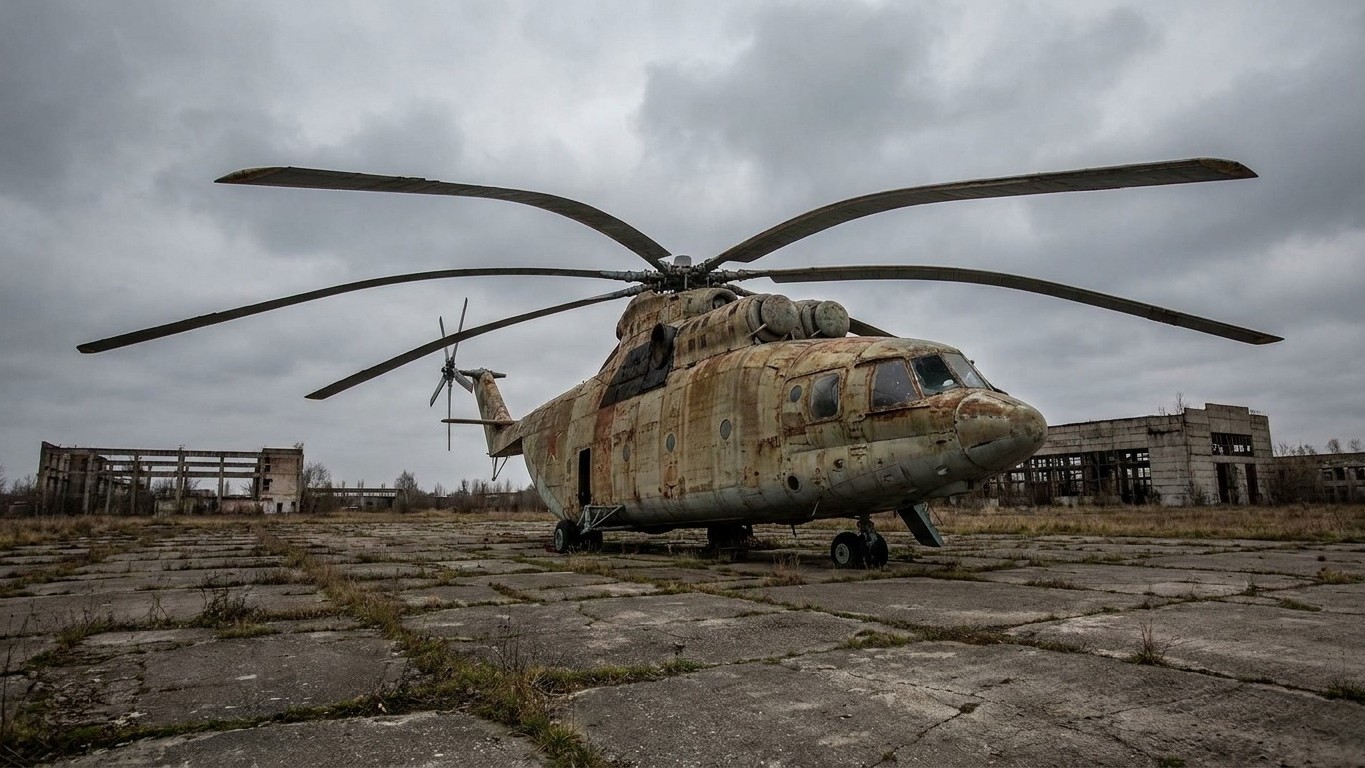
About forty kilometers from Moscow, on the tarmac of Mil’s Panki plant, a metal hull more than thirty-seven meters long has waited for half a century to have its fate decided. This is not an anonymous wreck. It is one of only two ever built of the Mil V-12, the heaviest and most massive helicopter aviation has produced. The program was abandoned in 1974, and the aircraft rusts quietly where it last landed, like a mechanical dinosaur left to the elements.
The dizzying figure is its maximum takeoff weight: 105,000 kilograms. The helicopter had an empty weight of 69,100 kilograms and a maximum takeoff weight of 105,000 kilograms. To put the scale in perspective, that is roughly the weight of a multi-story building, suspended in the air by two rotors turning in opposite directions.
Key takeaways
- Why could a helicopter weighing over 100 tons be built in the Soviet era?
- How could an abandoned program yield a record still unmatched after 55 years?
- What mystery surrounds the divergent fates of the two only prototypes ever assembled?
An achievement unmatched since 1969
On August 6, 1969, somewhere above the countryside near Moscow, test pilot Vasily Kolochenko and his crew write a page that no one has rewritten since. The largest helicopter ever built, with transverse rotors and four engines, registered CCCP-21142, lifted a payload of 40,204.5 kilograms to an altitude of 2,255 meters. According to several sources, the exact load even climbed to 44,205 kilograms according to some readings. The result, in any case, still stands: these records have never been beaten by another helicopter.
Five decades later. No manufacturer—Russian, American, or Chinese—has managed to do better. It is a record that survived the collapse of the USSR, the end of the Cold War, and the arrival of entire generations of new aircraft without ever being challenged. A performance that raises questions: how could an abandoned program produce a machine still unequalled?
An unconventional architecture, born from a precise military need
The V-12 is no ordinary helicopter. Its silhouette resembles more a giant propeller-driven aircraft than a rotorcraft: two wings, each carrying a 35-meter-diameter rotor, borrowed and duplicated from the Mil Mi-6, unfold on either side of the fuselage. The aircraft measures 37 meters in length, with a rotor span of 67 meters and a height of 12.50 meters. One rotor turns clockwise, the other counterclockwise, thus eliminating the need for a tail rotor.
This architecture is not the whim of an engineer plagued by a lack of inspiration. The development targeted a heavy-lift helicopter capable of transporting the major components of missiles to deploy them in silos lacking road infrastructure. In the midst of the arms race, Moscow wanted the ability to move large pieces of intercontinental ballistic missiles to remote areas without depending on the road network. The V-12 was meant to be the Soviet arsenal’s flying truck.
Yet the early days were chaotic. The first flight, on June 27, 1967, ended prematurely due to oscillations caused by a control problem, the exact cause being a harmonic amplification of cockpit-floor vibrations feeding back into the stick. Western press, alerted by a blown tire and a bent rim, spread rumors of a fatal crash. Such reporting, widely but erroneously echoed in the Western press, claimed the aircraft had been destroyed. The first prototype, registered SSSR-21142, would not actually take off for the first time until July 1968.
Two examples only, two different destinies
Here is another peculiarity of this story: two aircraft built, and that’s all. The second prototype, likewise assembled at the Panki experimental plant, spent an entire year in the workshop waiting for its engines before flying for the first time in March 1973, and it bore curiously the same registration as the first. An administrative oddity that perfectly reflects the improvisation of a program never truly stabilized.
In 1971, the first prototype even crossed Europe to be shown at Le Bourget, where it impressed aviation show visitors. A series of flights over Europe culminated with its participation in the 29th Paris Air Show, carrying the exhibition code H-833. It was the beast’s media apex. Three years later, the curtain fell: the program was abandoned for lack of industrial prospects. Despite its technical feats, the Mil V-12 project never reached mass production and was halted in 1974.
The context changed faster than the aircraft. Missiles became mobile on lighter road launchers, making the original mission of transporting silo components obsolete. And above all, the experience gained from the V-12 benefited another, more modest project: while the V-12’s development influenced the Mi-26, the prototypes remain the largest helicopters ever built. The Mi-26 would enter service and still flies today in the armed forces and in civilian companies, proof that the V-12’s adventure was not entirely futile.
A museum for one, an abandoned tarmac for the other
The fate of the two examples diverges clearly. One found refuge in the Monino Aviation Museum, east of Moscow, where volunteers regularly repaint it to keep it presentable for visitors. The other, left on the Panki industrial site where it was assembled, never received the same treatment. Exposed to the elements since the program’s end, it embodies that quintessentially Soviet habit of letting abandoned prototypes rust away on site rather than destroying or restoring them.
This great rusty forgotten relic continues to fascinate aviation enthusiasts who can sometimes photograph its metal flanks eaten away by decades of exposure. A carcass that still carries its weight of history: that of an oversized Soviet ambition born from the military logic of the Cold War, which ended up beating a record no engineer anywhere in the world has managed to erase since.
Sources: thisdayinaviation.com | thisdayinaviation.com
