
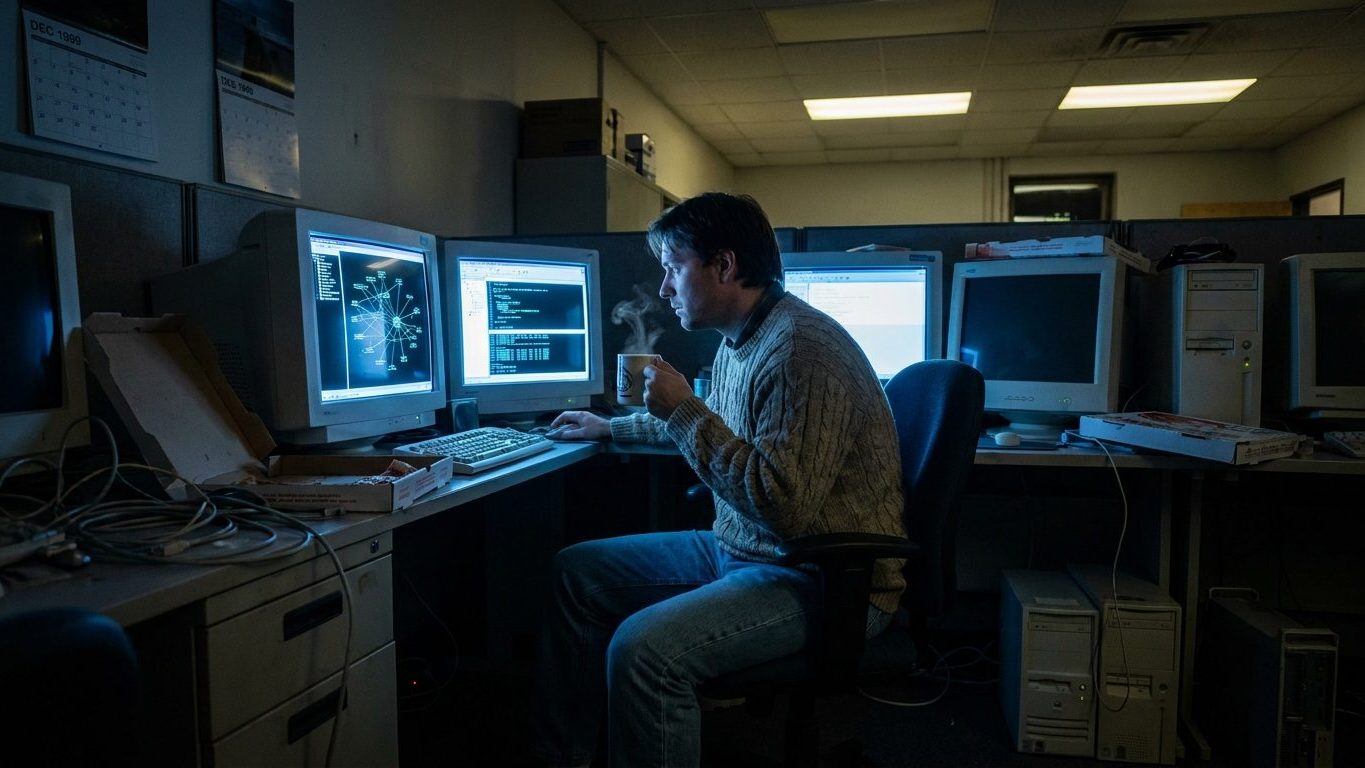
From the night of December 31, 1999, into January 1, 2000, control rooms remained lit well past midnight. Technicians watched over screens, coffee in hand, ready to respond at the slightest alarm. Across the world, people held their breath as clocks teetered from one century to the next.
Nothing happened. Or almost nothing.
Planes continued to fly, ATMs kept dispensing cash, and hospitals operated as usual. The following day, a question surfaced in conversations: why so much worry for so little consequence? Many saw it as proof that the threat had been exaggerated, that we had collectively panicked over a problem that, in essence, did not truly exist.
- The Y2K bug stemmed from coding years with two digits in old computer systems, creating confusion between 1900 and 2000.
- Governments and corporations invested heavily over years to identify, fix, and test all of their computer systems.
- The absence of a visible catastrophe demonstrates preventive effectiveness, yet it creates the paradox of a threat forgotten because it was addressed in time.
A Programmer’s Shortcut That Became a Time Bomb
To grasp what drew so much concern, one must revisit an old programming habit. The issue arose from the way dates were stored in computer systems, frequently abbreviated to two digits for the year. Writing “99” instead of “1999” saved space, a cost-cutting consideration that mattered in an era of hardware with limited capacity.
This shortcut posed no problem as long as we stayed in the 1900s. But at the turn of the year 2000, systems faced the risk of stepping back a century. A system that read “00” could interpret it as 1900 instead of 2000. In software that calculates deadlines, interest, storage durations, or schedules, such a century misinterpretation could cascade into real consequences: an invoice might appear settled long before it was paid, a contract could seem expired before it even started, an inventory might display an nonsensical expiration date.
The danger also extended to automated processes—those tiny programs embedded in devices we rarely consider as “computing.” Rather than being a mere bug, this was a problem of systemic obsolescence that demanded a fundamental redesign of the architecture of information systems. It wasn’t a single error to patch; it was a logic repeated thousands of times across disparate programs, crafted by generations of developers.
Years of Invisible Work Behind the Scenes Before the Celebration
Confronted with this realization, governments and corporations did not wait for December 31 to act. To avert potentially catastrophic consequences of the Y2K bug, governments, businesses, and organizations worldwide poured resources into upgrading and correcting their computer systems. The efforts included identifying vulnerable systems, updating software and hardware, and conducting exhaustive tests to ensure compatibility with the Year 2000. The first step was to inventory: to locate, within lines of code sometimes decades old, every instance where a date was stored with two digits.
Simply cataloging was not enough. This modernization was made even more complex by the fact that some older components were no longer maintained, sometimes necessitating complete replacements of entire systems. Some hardware had to be swapped outright, simply because deeper fixes were not feasible.
Then came the testing phase, the step that consumed the most time. It required emulating the transition to the year 2000 under real conditions, verifying that the corrections didn’t break other functions, and repeating tests as many times as needed. The problem had been anticipated far enough in advance that most affected programs were updated before the year 2000 arrived.
The Paradox of a Catastrophe We Never See
That is where the story takes a turn that feels almost unfair. If nothing happened, it is precisely because the risk was treated with seriousness and handled in a methodical fashion. The absence of catastrophe does not prove that danger was absent; it demonstrates the effectiveness of prevention. The quiet of that night wasn’t proof that the problem didn’t exist; it was the observable result of unseen labor.
This mechanism extends far beyond the IT domain. A well-maintained system seems to have no problems, which makes the labour behind that stability invisible. Prevention is only noticed when it fails. When it succeeds, it vanishes from sight, replaced by the impression that the danger was never real.
The Year 2000 bug was not a non-event, but rather a demonstration of the effectiveness of preemptively addressing a risk. Here lies the reversal: what many long described as irrational fear was, in fact, a catastrophe averted. And an averted catastrophe, by definition, leaves no visible trace for the public that only saw the outcome, never the path taken to reach it.
There lies a political paradox: when a problem is well anticipated and managed, the fact that the catastrophe did not occur disappoints the public, who concludes that the fuss was for nothing, and mocks those who worried, even though it was precisely these people who prevented the disaster. The success of preventive action thus backfires on those who led it, accused of crying wolf for a wolf that never arrived because it had been kept at bay in time.
One simple, almost unsettling question remains: how many other alerts treated with the same seriousness end up forgotten too, dismissed as false alarms?
Sources: larousse.fr | presse-citron.net
