
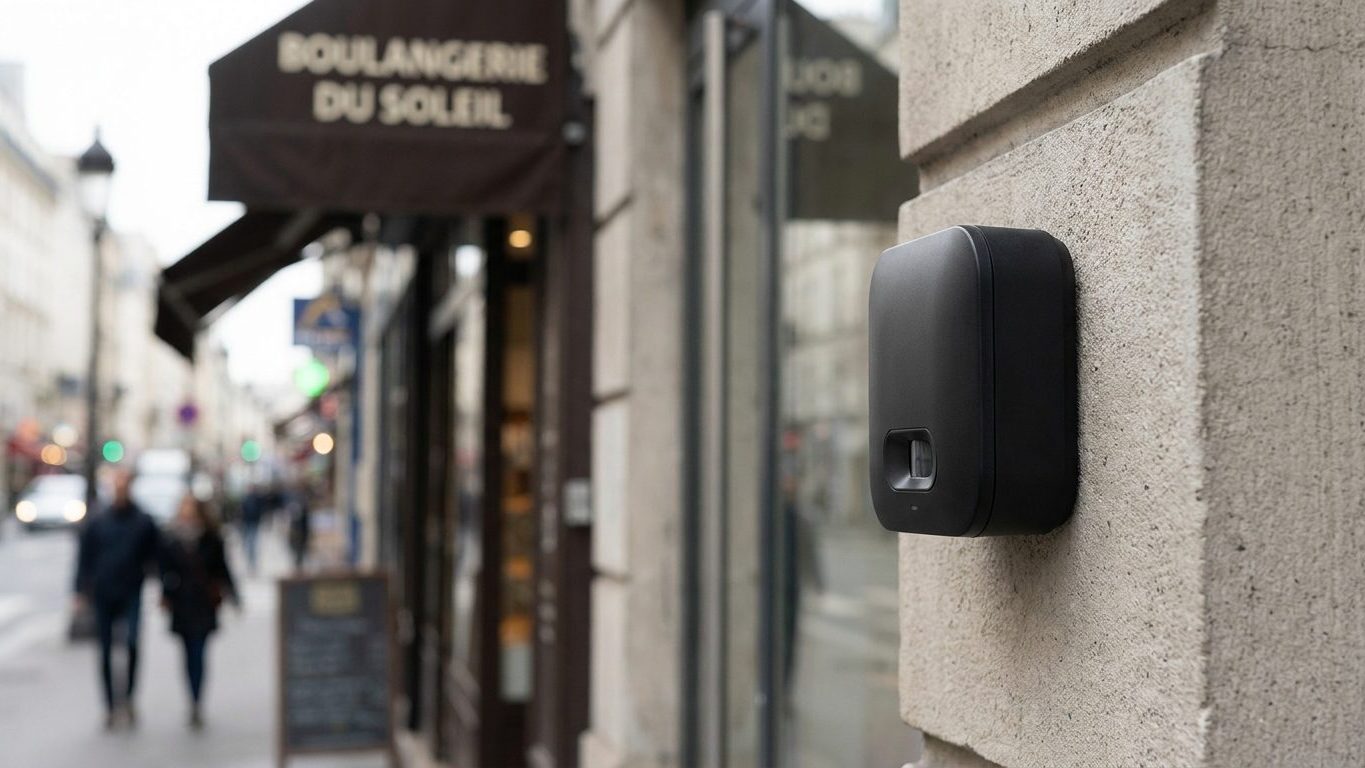
When classes end, in front of certain shop windows in the city center, a sharp whistle loops from morning to evening. Adults passing by hear nothing, or almost nothing. This silence isn’t a problem with the device: it’s exactly the effect sought.
- The Mosquito emits ultrasound at 17.5 kilohertz, inaudible to most adults but perceptible to the young.
- Hair cells at the base of the cochlea, responsible for perceiving high tones, gradually deteriorate with age and never regenerate.
- Several countries have questioned the ethics of this device for violating young people’s rights to socialize and to dignity.
A calibrated whistle to clear the sidewalks
The device is called the Mosquito. These are boxes that emit ultrasounds at a frequency above 8,000 Hz, better known in France under the name Beethoven. The device emits a very high-frequency sound, between 17.5 and 18.5 kilohertz, a band to which the young are more sensitive than adults. Its range can reach up to around forty meters around the installation point. Shop windows, parking lots, building lobbies: the unit can slip into anywhere groups tend to gather.
Its inventor, the Welshman Howard Stapleton, designed it after his daughter was harassed.
The product has been freely available for sale since 2005. Thousands of units have been sold in Europe and North America, with the strongest concentration in the United Kingdom, where merchants, municipalities, schools, and police services are the main customers, far ahead of individual buyers.
Why your ear no longer detects the high pitch
The cochlea, this spiral organ housed in the inner ear, is organized tonotopically: each area responds to a precise frequency. Low tones are processed at the base of the spiral, well protected; high tones, by contrast, are captured at the entry, exposed on the frontline. It is precisely the hair cells of this entry zone that decode the Mosquito’s 17 kilohertz.
The hair cells at the base of the cochlea, those that process the highs, gradually and irreversibly deteriorate, never regenerating. A loud noise, an ototoxic drug, or simply aging can reduce their count. The loss sits exactly where the Mosquito’s frequency is coded. It then progresses in silence, for years, with no pain signaling the phenomenon.
This erosion does not begin at retirement.
The range of frequencies perceived extends from 20 hertz to 20,000 hertz in a young adult, then narrows with age, first affecting the high frequencies. Ordinary speech, meanwhile, sits much lower in the spectrum: we continue to understand a conversation, to follow a song on the radio, without ever suspecting the hole that has opened up at the very top of the acoustic scale.
The same sidewalk, two sound realities
In practice, the effect is immediate. In the United States, a neighbor recounted turning on his unit one evening: within about fifteen minutes, the group of teenagers playing basketball under his windows had left the scene, first trying to locate the source of the noise. For the adults nearby, nothing to report.
Result? The same forecourt, two worlds.
In Quebec, the National Institute of Public Health recommended a moratorium on the use of the Mosquito, due to a lack of solid data on its safety. Its assessment also pointed to an infringement on the right to socialize for youths and on the freedom of assembly, recognized by the Quebec Charter of Rights and Freedoms. The report further noted that this kind of device runs in direct contradiction with the close-work done with adolescents.
In the United Kingdom, the director of the rights NGO Liberty described the device as a dog whistle for ultrasonics at best, and a sonic weapon directed against children at worst. In Geneva, the president of the Greens denounced a device that treats adolescents like nuisances, an affront to human dignity in his view. In France, a question was raised in the National Assembly about these boxes emitting shrill sounds inaudible to those over 25, labeled as an “anti-youth” repellent. The parliamentarian who introduced the text questioned the government’s intentions regarding their commercialization.
The threshold of 25 years remains theoretical, not absolute: older people, sometimes seniors, likewise perceive this shrill note, as do babies and young children. In short, this whistle does not sort generations one by one: it draws, on the sidewalk, the invisible map of what each cochlea has already lost, or not yet.
Sources: inspq.qc.ca | laboratoires-unisson.com
