
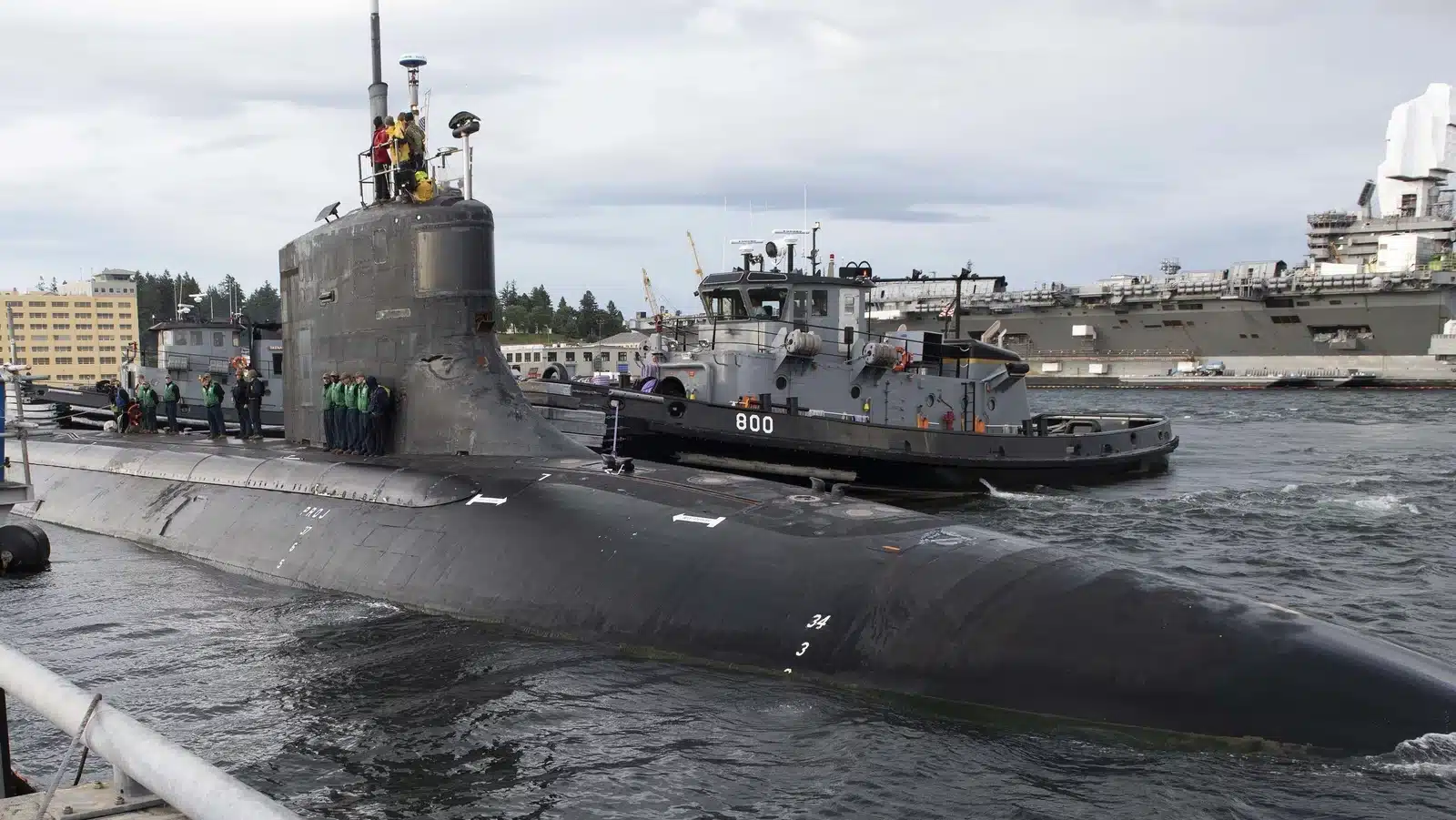
A nuclear-powered submarine collided with an unmapped undersea mountain last month, injuring eleven crew members in the process, according to the U.S. Navy.
The USS Connecticut, a Seawolf-class fast-attack submarine, had struck an “unknown object” in international waters of the South China Sea on October 2. According to NPR, the impact caused several minor injuries among eleven crew members. The vessel resurfaced before heading to Guam, southeast of the Philippine Sea.
A few hours after the incident, the Navy merely noted that the collision did not involve another submarine, offering no further details on potential damage to the hull. What was it then? According to a new report published on November 1, the USS Connecticut would have struck “an unexplored undersea mountain”.
This is not the first such incident. In 2005, a seamount off Guam rose up in front of the USS San Francisco, which was traveling at more than 30 knots at a depth of about 160 meters. The impact caused numerous injuries and claimed one life among the crew of 137. The bow, meanwhile, looked like a crushed soda can.
The submarine itself eventually returned to sea three years later, sporting a “new nose.” The bow of its twin, the USS Honolulu, which had been slated for retirement, was in fact welded onto the San Francisco. The submarine went on to serve for eight more years. It is now undergoing work to be transformed into a “training ship.”
Widely Unexplored Seafloor Elevations
Submarine mountains are remnants of extinct volcanoes. The majority are cone-shaped, but some develop large flat summits. Researchers estimate that more than 100,000 of these structures rise more than 1,000 meters above the seafloor. According to the National Oceanic and Atmospheric Administration, scientists have, however, mapped less than 0.1% of this sample.
“New estimates suggest that taken together, submarine mountains cover around 28.8 million square kilometers of the Earth’s surface,” notes the NOAA. “It is larger than deserts, tundra, or any other terrestrial habitat on the planet.”
The habitats they create are considered as “biological hotspots,” housing a wide range of species. Their steep sides foster the upwelling of nutrients, providing an ideal living space for sessile organisms such as corals and sponges.
