
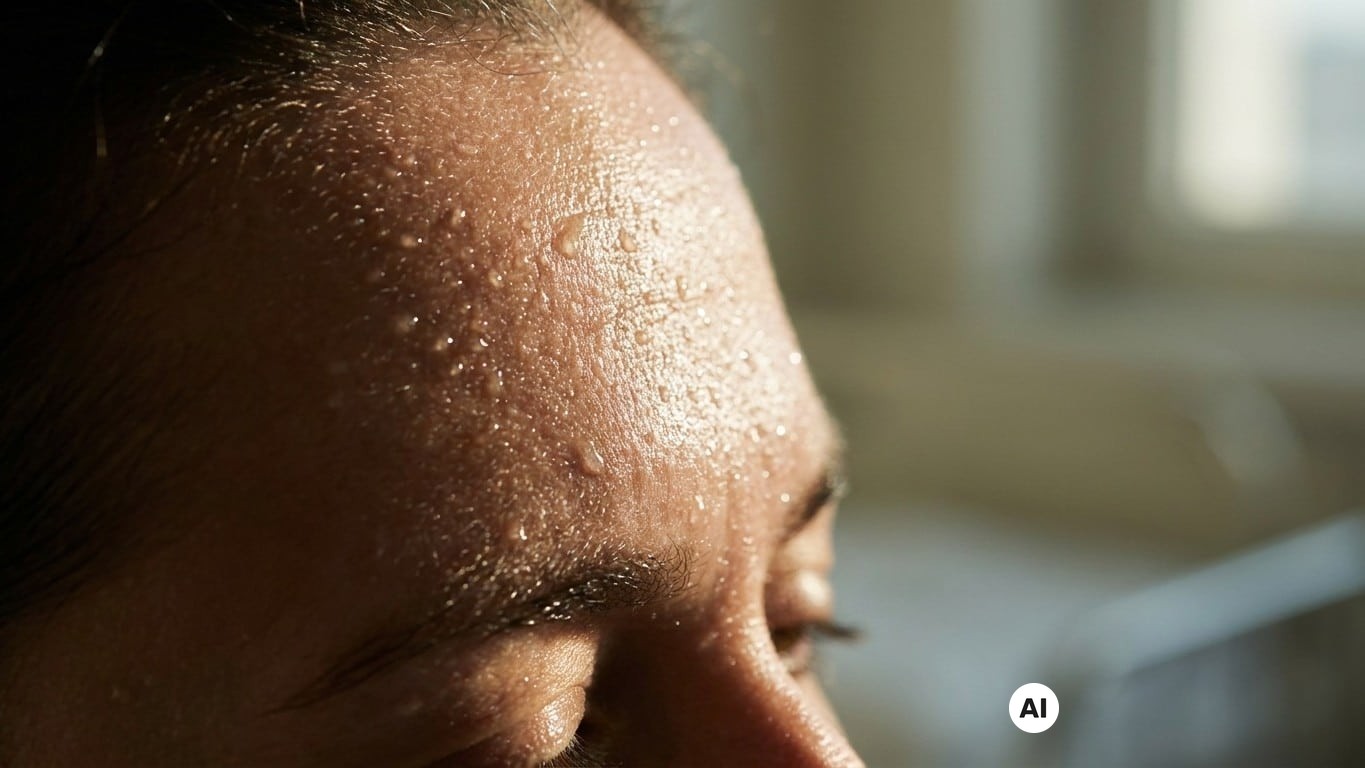
The sweat pours down, the T-shirt sticks, the forehead shines. And yet, nothing. Not a hint of refreshment. This paradox of a body that sweats buckets without cooling down isn’t an anomaly: it’s fundamental physics, poorly understood, that can be deadly. Because sweat doesn’t actually cool you down. It is its evaporation that does. A tiny nuance, but with enormous consequences.
When sweat accumulates on the skin, it absorbs thermal energy from the surface of the skin, and as it evaporates, it allows heat to dissipate into the air, resulting in a drop in body temperature. The liquid alone does nothing. It’s the transition from liquid to gas that pulls heat away. A bit like blowing on a burn: the air itself doesn’t cool, it’s the evaporation of moisture on the skin that relieves
As it evaporates, sweat carries away a vast amount of heat: this mechanism can account for up to 80% of the heat evacuated during intense exertion. The human body has therefore designed a remarkably efficient air conditioner. The hypothalamus acts as a highly sophisticated thermostat, constantly receiving information from sensors in the skin and in the blood, and as soon as the temperature deviates, it launches precise protocols.
This system works in tandem with vasodilation. Cutaneous vasodilation transfers heat from the core to the skin, while the evaporation of sweat cools the blood before it returns to the deep tissues of the body. Two complementary actions, but evaporation remains the centerpiece. Remove it, and the system collapses.
When humidity cuts the air conditioner
It is a highly effective natural air-conditioning system… as long as the air remains relatively dry. Because if the air is already saturated with moisture, it cannot absorb any more water vapor. Sweating no longer evaporates—or does so very poorly. The cooling system is “broken.” Heat is no longer evacuated, and the body overheats.
The result is measurable and chilling. At 30°C with 80% humidity, the perceived temperature reaches 37°C. The body is put to a grueling test, and the risk of heat stroke rises sharply. This is precisely what the heat index measures: not the air’s temperature, but the temperature felt by a body unable to evaporate sweat normally. This index, used by the U.S. weather service, provides a “felt temperature” based on heat and humidity in the shade, ranging from “caution” to “extreme danger.”
The borderline is even harsher. If the human body can technically survive temperatures of 50°C in very dry air, heat can become deadly at 35°C when the air is saturated with humidity. A fifteen-degree difference. The gap between a carefree summer outing and a life-threatening emergency hinges on one factor: can the air still absorb water vapor?
Scientists have estimated that a humid heat of 35°C constitutes the “upper safety limit”: beyond this, the body can no longer cool itself through sweat evaporation and cannot maintain stability of temperature. The relevance of this limit has only been tested in humans in laboratories recently, and the results indicate the situation is even more concerning than initially thought.
Heatstroke: when the body loses its grip
Heatstroke is a severe form of hyperthermia. It occurs when the body is unable to regulate its internal temperature, causing a rapid rise above 40°C. At this stage, proteins break down, cells suffer, and vital organs are at risk.
The progression is treacherous. The illness begins with extreme fatigue, headaches, cramps, and heavy sweating, then paradoxically a decrease in sweating as the body tires. Less sweat in a humid environment: the last line of defense disappears. When the body overheats beyond 40 degrees, we speak of heatstroke. It is a medical emergency.
This isn’t a condition confined to marathon runners. The phenomenon can occur after prolonged sun exposure, intense physical effort in hot environments, or in poorly ventilated spaces. An attic bedroom at 33°C at night, a car left in the sun, a construction site near the sea at 28°C with 85% humidity: the conditions are met far more often than people think.
A tally that grows heavier each summer
The figures from the summer of 2025 in France speak for themselves. It ranked as the third-hottest summer since 1900, with an average temperature 1.9°C above the norm. France endured four heat waves, and 69 departments experienced at least one, affecting 80% of the population. More than 5,700 deaths were attributed to heat exposure over the entire monitoring period, representing over 3% of all-cause mortality.
What stands out in Santé publique France’s data is the temporal spread of risk. Seventy percent of heat-related summer deaths occurred outside the officially declared heatwave days. Weather alerts cover only a fraction of the real danger. The body also suffers on days without orange alerts, once humidity blocks evaporation.
A high temperature combined with a high humidity level can be deadly beyond certain thresholds, and this reality concerns everyone, not just the vulnerable. Nine occupational fatalities potentially linked to heat were recorded in 2025 in France, involving eight men and one woman aged 35 to 63, including six in construction or agriculture. Active workers, in their prime, whose bodies simply stopped evaporating quickly enough.
Next time you sweat without feeling cool, look not at the thermometer but at the hygrometer. If humidity exceeds 80%, your skin is coated with a useless layer of sweat. Drinking water remains essential, but a fan or moving to a dry space will do far more to lower your body temperature than an hour spent dripping in place. Evaporation forced by wind, even if warm, remains more effective than sweat that has nowhere to go.
Sources: At least 480 excess deaths during the early-summer 2025 heatwave, according to Santé publique France (franceinfo.fr) | Heatwave and health: excess mortality. Bulletin of July 23, 2025. (santepubliquefrance.fr)
Article prepared with the help of AI · Our method
