
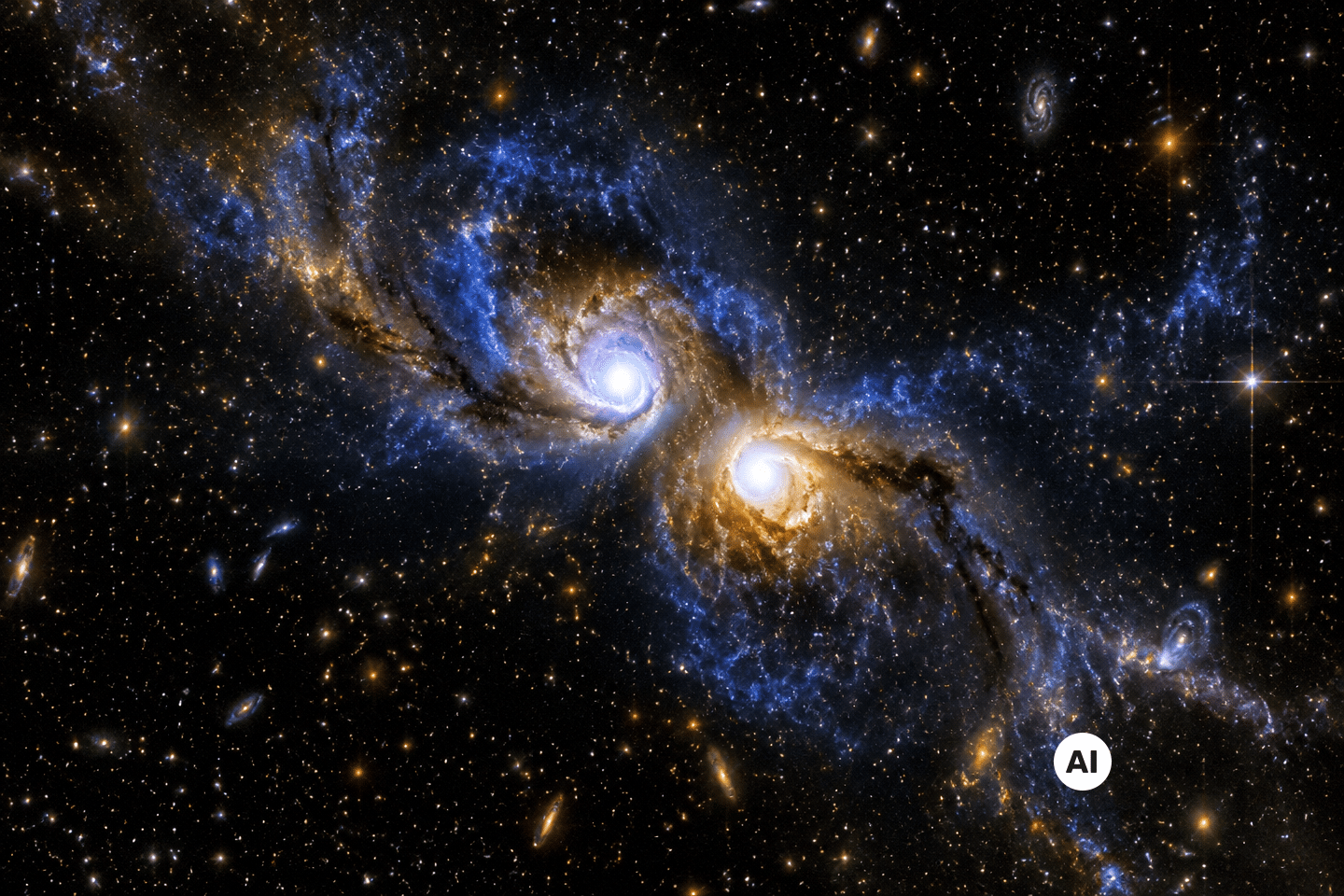
Two supermassive black holes, spotted side by side, barely 900 million years after the Big Bang. The observation may seem almost routine on paper, but black holes this massive should not have had time to form so early. The James Webb Space Telescope has just captured the tight pair of quasars—the oldest yet detected, and also the most compact among those known at the cosmic dawn—and there is no consensus explanation for their presence at this epoch in the history of the universe.
Two giant black holes where the universe should have produced none
The pair is catalogued under the name J1602+4228AB. Astronomers have also given it a more poetic nickname, Nāpōwawāʻenakaulua, which means “two celestial bodies of powerful and unfathomable darkness in the glow of energy reincarnated in the universe.” A name that matches the anomaly it denotes.
The pair was spotted thanks to the James Webb Space Telescope, with the support of the Gemini North telescope. The two instruments allowed the isolation not of one, but of two distinct quasars, separated by only 18,100 light-years. To give a sense of scale, this distance is barely one-fifth the diameter of our Milky Way.
A quasar, as a reminder, forms when a central supermassive black hole is surrounded by a disk of gas and dust. The friction of this material falling into the black hole heats the disk to extreme temperatures, so that it begins to shine more intensely than the entire stars of its host galaxy. It is this luminosity that makes quasars visible across cosmological distances.
Here, the two black holes show impressive masses, 1.5 billion and 400 million times that of the Sun. Figures that would not be surprising in the current universe, where such black holes are relatively well documented. The issue is that this pair does not date from the present universe.
900 million years after the Big Bang, growth hard to explain
To place this observation in time, nine hundred million years after the Big Bang corresponds to roughly one-fifteenth of the current age of the universe. In other words, we are observing this pair of quasars in its infancy, during the epoch of reionization, just a few hundred million years after the appearance of the very first stars, galaxies, and black holes.
According to the most commonly used theoretical models, building a supermassive black hole, on the order of a billion solar masses, takes a long time. If one starts from stellar-mass seed black holes fed at a normal rate, it is very difficult for them to accrete, merge with others, and reach such a mass in less than a billion years.
Yet, this pair of quasars already existed 900 million years after the Big Bang. Silvia Onorato, a researcher at NOIRLab and head of the team behind this discovery, notes that these black holes exhibit masses comparable to those seen today in the present-day universe.
It is precisely this discrepancy that unsettles astronomers. There is no definitive theoretical explanation for how one of these giant quasars could exist so early in the history of our universe, let alone two. The known physics struggles to justify growth this rapid over such a short period.
Why spotting this pair is almost a statistical miracle
On paper, quasar pairs should not be rare. Galaxy mergers are common events on cosmic scales, and each merger can bring two supermassive black holes close enough to shine simultaneously as quasars. Pairs of quasars should therefore exist in the early universe, even if such massive pairs are not expected there.
But three major obstacles make these detections extremely challenging. First, the phase during which a black hole shines as a quasar is short, in the context of the universe’s history. The phenomenon fades relatively quickly, greatly reducing the observation window.
Second, distance plays a decisive role. The older an object is, the farther away it is from us, and the more its light has faded while traversing the vastness of space. Observing a quasar as it was 900 million years after the Big Bang amounts to capturing a faint light signal, buried in the immensity of the cosmos.
Finally, even when a promising signal is detected, one must still separate two distinct objects from a single blurred source. This is precisely where current instruments change the game: the companion was spotted in data from the James Webb Space Telescope, and the GNIRS spectrograph on Gemini North made it possible to separate the two light points, separated by only 18,100 light-years, at such a distance.
This combination of factors explains why such a discovery is almost a stroke of scientific luck. It wasn’t enough that the pair existed; it had to be observed at the right moment, with the right instrument, and with sufficient resolution to avoid confusing it with a single object.
According to NOIRLab’s press release, the differences between the spectra of the two quasars tilt the team toward a genuine pair, but a gravitational-lensing model remains necessary to completely rule out the image being a duplicated view of a single quasar. It remains to be seen whether this pair of quasars is an isolated anomaly, or the first hint of a population of giant black holes that the early universe would have managed to create far faster than expected.
The study is published in The Astrophysical Journal Letters.
Article prepared with the help of AI · Our method
