
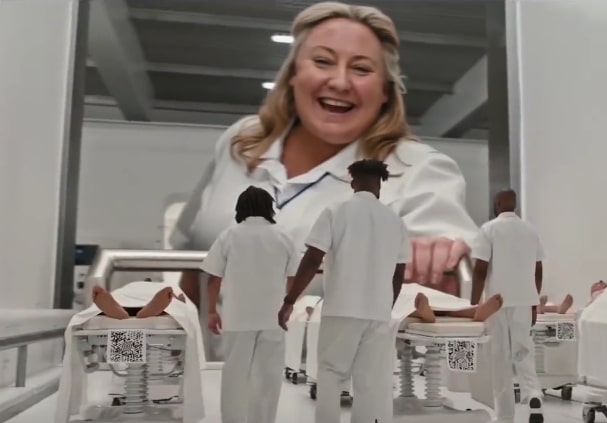
In this Hollywood production, scientists propose shrinking humans to about 13 centimeters to fight overpopulation. And yet in reality, this would be far from the best solution!
The film Downsizing by Alexander Payne, featuring Matt Damon, hit theaters on January 10, 2018. The plot centers on two Norwegian researchers who are concerned about humanity’s impact on the Earth and have developed a technique to shrink people. They argue that the next mass extinction concerns humanity and that it is linked to overpopulation.
In the story, this technique is first tested on 36 volunteers in Norway and then becomes available worldwide, at least in industrialized nations. It envisions drastically reducing a normal person’s size to 12.9 centimeters, for a weight of merely 20 grams. The tests on the Norwegian community appear to be successful, since after four years the non-biodegradable waste produced fits into a standard trash bag.
This environmental argument is also quite present in the film, and often comes forward as a reason for people to opt for shrinking. Moreover, to give them further motivation, a bank account multiplied by a thousand is promised along with tax credits. But what should be made of the film’s main idea?
According to Mireille Chiroleu-Assouline, professor of economics at the University of Paris 1 Panthéon-Sorbonne and a specialist in environmental economics, this idea, though entirely fictitious, “would obviously have effects in reducing the amount of waste produced by the human species. There would, potentially, be a possibility of reducing the ecological footprint,” as reported to the Huffington Post.
For her part, Professor François Conte spoke in a interview with LCI and explained that it was “unthinkable to shrink a human being” because they are “made of atoms” and that in the event of reduction, the “atoms would then have to shrink during this transformation”. Yet to achieve such a result, the human would need to have “fewer atoms”, while “the average distance between the protons and neutrons making up the nucleus of an atom and the electrons orbiting that nucleus cannot be changed”.
Thus, shrinking humans is completely impossible, and even if it were possible, what should one think? For Mireille Chiroleu-Assouline, the film’s idea is a politically correct way to highlight humanity’s impact on Earth, a “lazy” means (and thus insufficient) to address environmental concerns. Indeed, while the film’s premise aims to counterbalance the notion—also controversial—of overpopulation, rather than reducing the number of people, the idea is to shrink their size. Therefore, in no way is Western consumption mode questioned, and as she notes, the quantity of waste remains proportionally the same, just as energy use per cubic centimeter of individuals remains the same.
In addition to this false solution, the professor also notes that in the film, the choice to shrink is voluntary. The story thus resembles more of an allegory of what humanity faces in reality. Indeed, there is no obligation to adopt pro-environmental behavior, and as a result, few people embrace it. That is why policies tend to offer benefits to those willing to change their way of life, such as through tax credits.
Here is the trailer for the film Downsizing :
Sources: Huffington Post – 24heures – LCI
