
Infrared light can induce molecules to vibrate at roughly 40 trillion oscillations per second, and this motion can literally rip apart the membrane of a cancer cell within minutes. This technique, demonstrating a 99% success rate in laboratory tests, cured half of mice with melanoma — without chemotherapy, surgery, or radiotherapy.
What you will learn
- How a molecule already used in medical imaging can be transformed into a mechanical anticancer weapon
- Why this approach could bypass the resistance problem that limits traditional chemical treatments
- What researchers have learned about how the body eliminates these molecules
Destroying a cancer cell by pure vibration
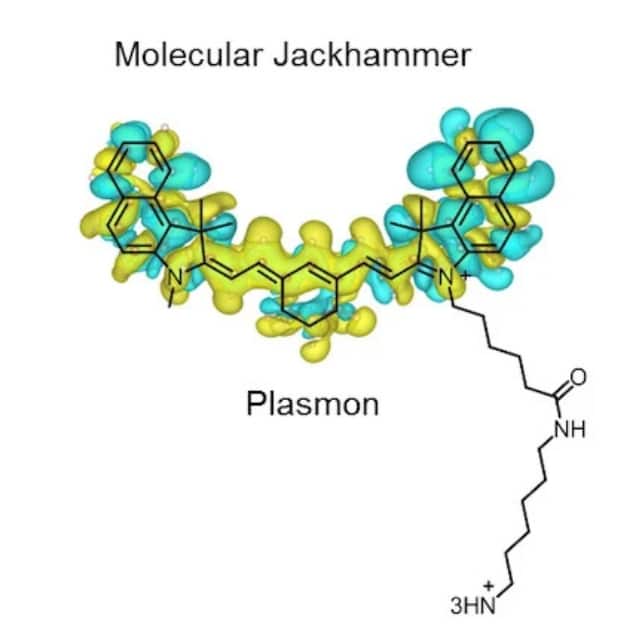
The “molecular jackhammer” approach relies on aminocyanine molecules — synthetic dyes already widely used in medical imaging to detect cancer. When stimulated by near-infrared light, these molecules begin to vibrate synchronously at about 40 trillion oscillations per second — a frequency sufficient to physically tear apart a cancer cell’s membrane.
Published in late 2023 in Nature Chemistry by a collaboration between Rice University, Texas A&M University, and the University of Texas, the initial results showed a 99% success rate in destroying cancer cells in cultured samples. In mouse models of melanoma, half of the treated animals were cured of cancer.
A million times faster than earlier molecular machines
This technique builds on previous work concerning motor molecules of the Feringa type, which could also disrupt hazardous cellular structures. But the new molecular jackhammers represent, according to James Tour, a chemist at Rice University, “an entirely new generation of molecular machines”: their mechanical motion is more than a million times faster, and they are activated by near-infrared light rather than visible light — a crucial advantage since infrared penetrates much deeper into bodily tissues, opening the door to treatments for cancers in bone or organs without surgical intervention.
The precise mechanism involves plasmons — collective movements of electrons within the molecule that induce a mechanical vibration across the entire structure. “This is the first time a molecular plasmon has been used in this way to excite the whole molecule and produce a mechanical action,” explains Ciceron Ayala-Orozco, a co-author of the study. These plasmons carry a “arm” that allows the molecule to attach to the cancer cell membrane while the vibrations tear it apart.
Low likelihood of cellular resistance
The researchers’ hopes extend beyond the lab’s success rate. Because this is a purely mechanical action — not chemical — cancer cells should not be able to develop resistance to this technique, unlike traditional chemotherapy where acquired resistance remains a major challenge.
Safety questions under investigation
A follow-up study published in late 2024 in Advanced Science explored several variations of these hammering devices aimed at different cancer types while assessing their potential toxicity. Researchers found that small doses of non-activated molecules are rapidly internalized and cleared by normal cells — an encouraging sign for their safety profile in future therapeutic applications.
For now, results remain limited to laboratory and animal models; translating this approach to humans remains a significant challenge to overcome.
Source: Molecular Jackhammers Drill Pathway To Killing Cancer Cells (stories.tamu.edu)
Article prepared with the help of AI · Our method
