
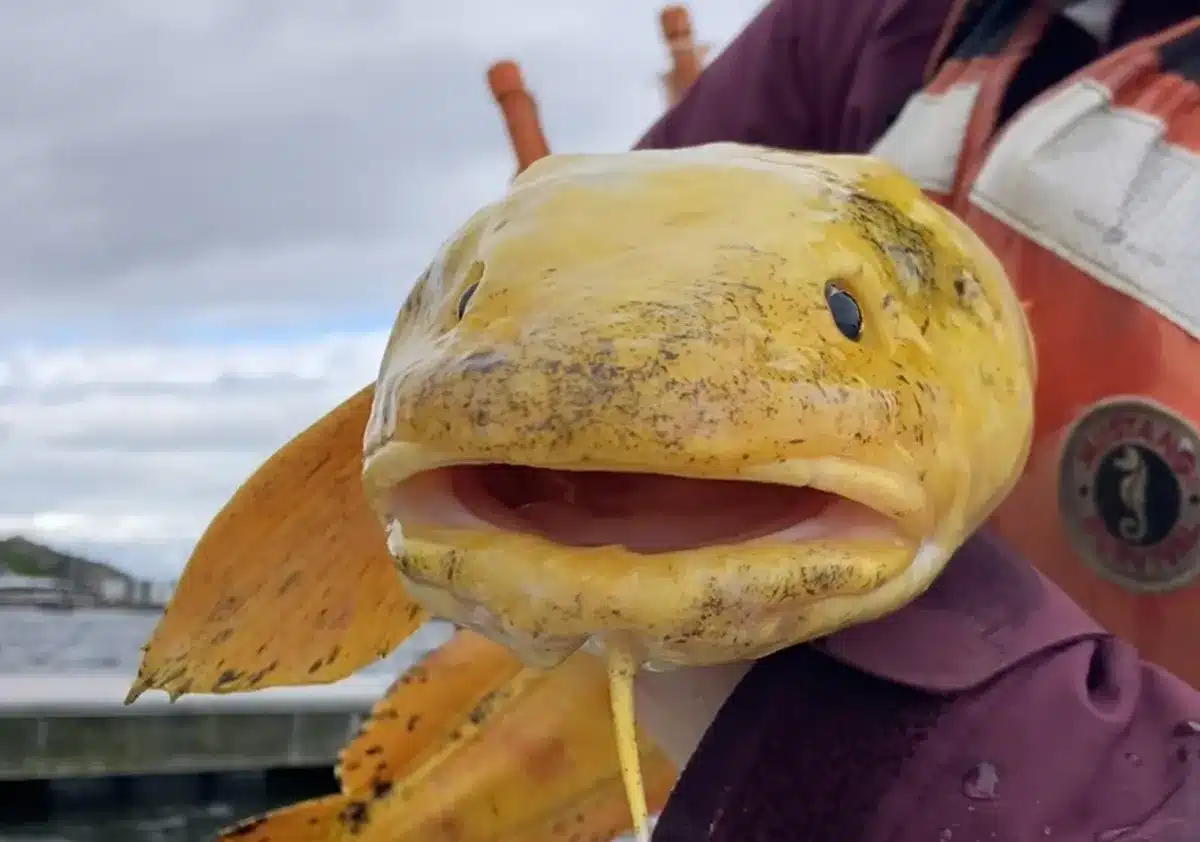
A net rises from the waters of Oswego Harbor in New York. Nothing out of the ordinary at first glance, just a routine survey of invasive species. Then this bright yellow, almost fluorescent object appears, bearing no resemblance to the region’s usual fish. The biologists present immediately understand they are holding something rare in their hands.
An Unexpected Catch During a Routine Survey
The scene unfolds in October 2025, during a surveillance survey of invasive aquatic species conducted by the Lower Great Lakes Fish and Wildlife Conservation Office team, part of the U.S. Fish and Wildlife Service (USFWS). According to local press, the catch dates from October 14. The service released its statement on November 10, describing it as a catch “one in a million.”
This is not an exotic species. The burbot is a freshwater fish native to the Great Lakes, recognizable by the barbels on its snout and chin. It has become rare in Lake Ontario, where its numbers are very low for reasons the service has yet to understand. It typically inhabits deeper, colder waters than the port, which does not exceed 27 feet (about 8 meters) in depth.
This is moreover the first burbot documented during a fishing survey in this port, although sport fishermen had already reported it. This point is the most important for scientists: the early-detection program for invasive species has, this time, crossed paths with a local species that was not being sought.
Xanthochromism, Albinism, Melanism: Three Pigmentation Anomalies
Xanthochromism is a genetic condition that suppresses part of the normal pigmentation and reveals a yellow-orange coloration. According to the USFWS, it is markedly less common in wild fish than albinism, where pigments disappear, or melanism, where dark pigments dominate.
These three anomalies affect pigmentation, but they do not rely on the same mechanism. In albinism, the organism no longer produces melanin. In melanism, it produces too much. In xanthochromism, the balance tilts toward yellow and orange pigments, resulting in a coat that bears little resemblance to the olive-brown speckled pattern that characterizes ordinary burbot.
Color is probably not the only explanation for the fish’s condition. Biologists noted that it appeared emaciated and seemed unhealthy. The press release does not specify whether the anomaly is linked to this, and that is precisely what Cornell University’s veterinary school examination is expected to clarify. It is often assumed that a striking hue makes an animal more susceptible to predators, but the release makes no claim to this for this specimen.
A Rare Case, Already Observed in Other Species
This type of anomaly is known in other wild animals. In August 2024, sport fishermen photographed and then released a bright orange nurse shark near Tortuguero National Park in Costa Rica. Described in 2025 in the journal Marine Biodiversity, it also featured white eyes, a sign of an anomaly associated with albinism. The authors concluded that the animal had reached adulthood despite its coloration, demonstrating that a vivid coat is not necessarily a handicap.
For the Oswego burbot, everything will hinge on the analyses. Biologists hope that this exceptional specimen will inform the health of the Lake Ontario burbot populations, a topic still poorly understood. If Cornell’s examination reveals a cause independent of color, the anomaly could be little more than a spectacular detail in the story of a weakened fish.
Sources :
- Service Crew Discovers Rare Yellow Burbot in Oswego Harbor – U.S. Fish and Wildlife Service (November 10, 2025)
- Rare Yellow Burbot Fish Caught in Oswego Harbor – RochesterFirst
- Rare Yellow Burbot Discovered in Oswego Harbor by the USFWS – OnTheWater
- Extremely Rare Yellow Fish Caught During Survey in Oswego Harbor – Fox Weather
- Orange Nurse Shark Caught Off Costa Rica – ScienceAlert
Article prepared with the help of AI · Our method
