
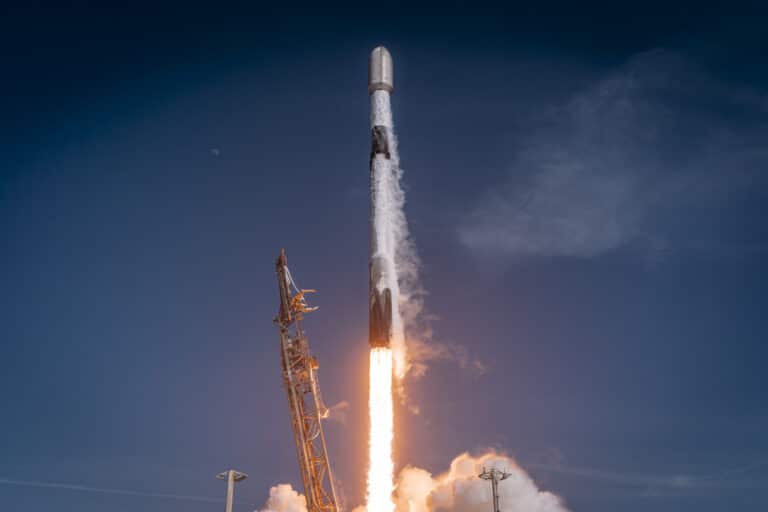
Do you think SpaceX’s Falcon 9 rocket will last forever? While it remains the indisputable pillar of the modern space industry, the famous Elon Musk launcher is quietly slowing its pace. Far from signaling an internal crisis, this modest decline is, on the contrary, meticulously orchestrated. SpaceX is laying the groundwork (and its launch cadence) for the arrival of its new behemoth: Starship. A handover that completely redraws the global map of space launches.
What you will learn
-
Why SpaceX is deliberately slowing the launch cadence of its most profitable rocket.
-
The gradual abandonment of the historic Florida site in favor of a California base that is breaking all records.
-
The staggering plans for Starship, from lunar exploration to “orbiting data centers.”
The Start of a Planned Decline
The numbers speak for themselves: after logging 165 launches last year, SpaceX plans to drop to around 140 launches in 2026. The company president, Gwynne Shotwell, has bluntly confirmed it: the number of Falcon 9 launches will gradually decrease as Starship comes online.
“This year, we will still launch many rockets, but fewer than before. Then, we will progressively reduce the number of our launches as Starship comes online.”
Falcon 9 is far from retirement. It will remain the exclusive taxi for American astronauts to the International Space Station (ISS) until deorbiting is planned after 2030, and will continue to serve the U.S. military. But to realize Elon Musk’s immense ambitions, this rocket, though revolutionary, is now too small. The company’s future rests on Starship, the only vehicle capable of landing humans on the Moon and on Mars, or deploying massive swarms of next-generation Starlink satellites. The company even hints at the wild idea of launching “orbiting data centers” tied to its other artificial intelligence venture, xAI.
Florida Makes Room for the Behemoth
This strategic shift has immediate and highly visible consequences for ground-launch infrastructure. At Cape Canaveral, Florida, the iconic launch pad 39A (leased to NASA) no longer hosts Falcon 9 missions. SpaceX is reassigning this site entirely for future Starship launches, while building a colossal production plant there.
As a logical consequence, SpaceX has even decommissioned one of its two giant drone ships off the East Coast, these floating platforms used to recover boosters at sea. With Falcon 9 flights halted from Complex 39A, a single drone ship is now enough to absorb the tempo at the Florida base.
The California Awakening
If Florida is gearing up for the Starship era, California is currently taking on the heavy lifting. The bulk of Starlink constellation launches are now carried out from the Vandenberg Space Force Base, located northwest of Los Angeles.
The contrast is striking: while Vandenberg had hosted only one launch in 2020, more than half of SpaceX’s missions this year have launched from its facilities. At this pace, the Californian site could even surpass the famous Florida Space Coast in overall activity, a first since 1988, when the Space Shuttle was grounded after the Challenger tragedy. But whether on the East or West Coast, the United States military anticipates a surge in traffic: commanders are already preparing to oversee up to 500 launches per year by 2036.
Article prepared with the help of AI • Our method
