
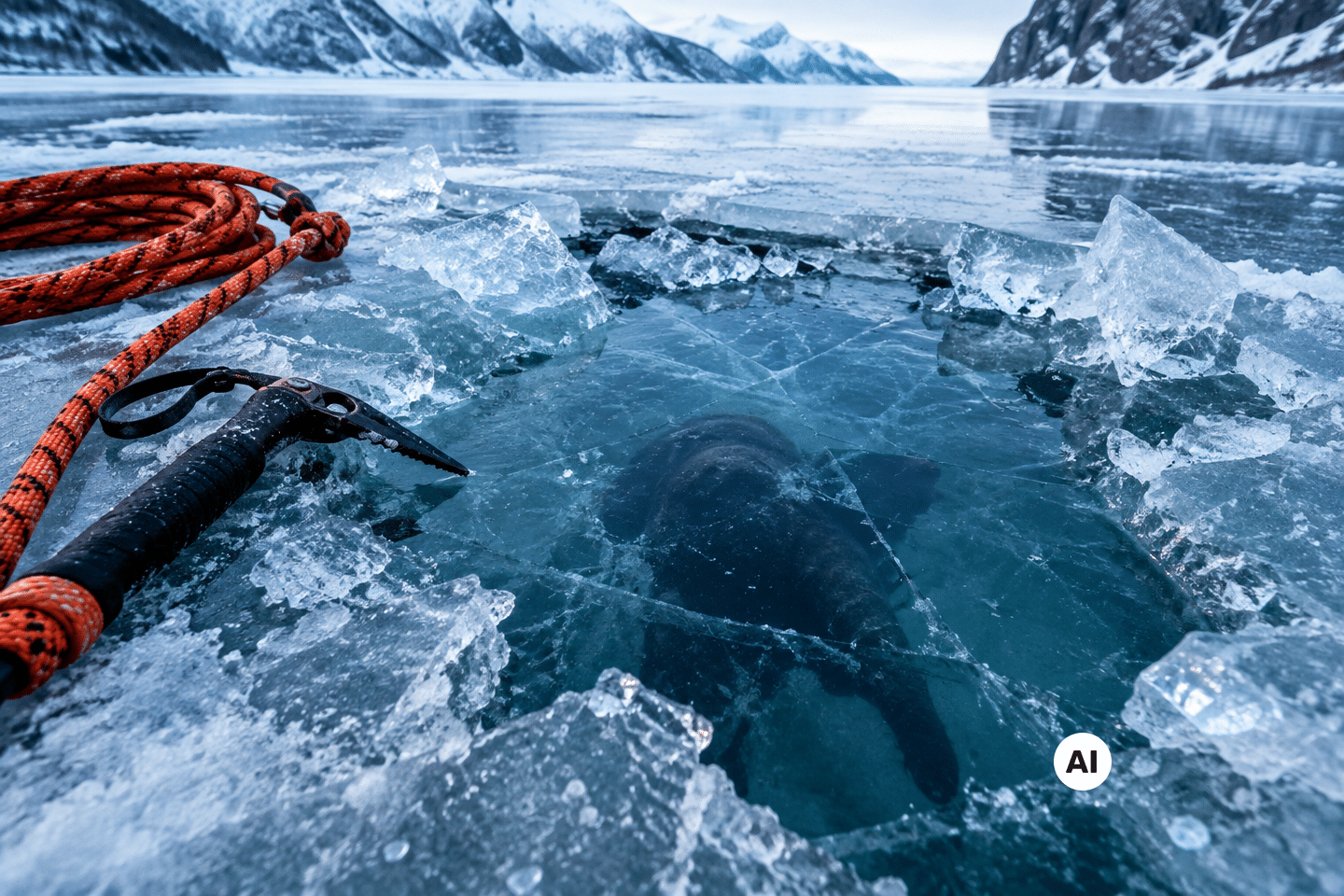
Thirteen point seven degrees. That is the temperature displayed by Anna Bågenholm’s body upon arrival at the hospital, about twenty-four degrees below normal. This 29-year-old Swedish physician was trapped under the ice of a frozen river near Narvik, Norway, and her case would become a landmark in the management of severe hypothermia.
A skier trapped under a frozen river for more than an hour
That May day in 1999, Anna Bågenholm was skiing with friends near Narvik in northern Norway. A fall, an uncontrolled slide, and she was sucked under the ice of a frozen river. The layer that closes over her measures about twenty centimeters in thickness, sturdy enough to prevent her from surfacing.
In the icy darkness, she manages to find a small air pocket wedged against the ice. This survival reflex keeps her conscious for about forty minutes, a window she uses to cling to life and wait for rescue.
But rescuers struggle to free her. In total, she remains trapped beneath the ice for approximately eighty minutes. When the rescuers finally pull her from the water, her heart has stopped for a long time and on paper there is nothing to suggest she will survive this ordeal.
13.7 °C: a record for survival from accidental hypothermia
Upon arrival at Tromsø University Hospital at 21:10, the medical assessment was unequivocal. Her core temperature registered at 13.7 degrees Celsius, a figure that seems incompatible with life. The electrocardiogram showed no signs of cardiac activity, and it had likely been about two hours since her heart stopped beating.
The human body operates normally around 37 degrees. At 13.7 degrees, nearly all biochemical reactions that sustain life slow to an extreme crawl, or stop altogether. Under these conditions, a two-hour cardiac arrest should have signaled a definitive death for any patient at a normal temperature.
It’s precisely this paradox that propelled the case into medical history. Published in The Lancet in 2000, her case remained for many years the lowest body temperature documented in an adult survivor of accidental hypothermia, warmed at Tromsø University Hospital.
In children, an even more extreme case has since been described: a 27‑month‑old boy resuscitated after accidental hypothermia at 11.8 degrees, with no neurological sequelae observed five years later. This pediatric case confirms what the Norwegian case had already demonstrated: extreme cold can sometimes protect the brain rather than destroy it.
Tromsø, the hospital where science rewrote the limits of the human body
Facing a flat electrocardiogram and such a low temperature, the temptation might have been to declare death quickly. Anesthesiologist Mads Gilbert, who led the medical team that evening, rejected that outcome. His reasoning rests on a principle well known to emergency physicians confronted with severe hypothermia: no one is dead until they are warmed and dead.
More than one hundred doctors and nurses took turns over nine hours to try to revive Anna Bågenholm. Rewarming was achieved through extracorporeal circulation, a technique that involves circulating the patient’s blood through a machine capable of gradually warming it before reinjecting it into the body.
The patient regained consciousness about ten days later. Her case has permanently unsettled medical practice. The European resuscitation recommendations published in 2025 now advise transferring hypothermic patients in cardiac arrest directly to a center equipped for extracorporeal resuscitation, with warming via venous-arterial ECMO. The criteria that could previously justify withholding care—such as witnessed arrest, prolonged asystole, or advanced age—are no longer considered contraindications according to the guidelines published by the scholarly society ELSO in the same year.
Researchers who study these extreme cases emphasize one point: a single measure of core temperature is insufficient to decide the survival chances of a hypothermic patient in cardiac arrest. Anna Bågenholm’s case remains, more than two decades later, the most striking demonstration that cold, capable of killing within minutes in many circumstances, can also grant the human brain an unexpected reprieve when everything else seems lost.
Sources :
- Wikipedia – Anna Bågenholm
- The Lancet (2000) – Gilbert et al., « Resuscitation from accidental hypothermia of 13.7 °C with circulatory arrest », vol. 355, p. 375-376
Article prepared with the help of AI · Our method
