
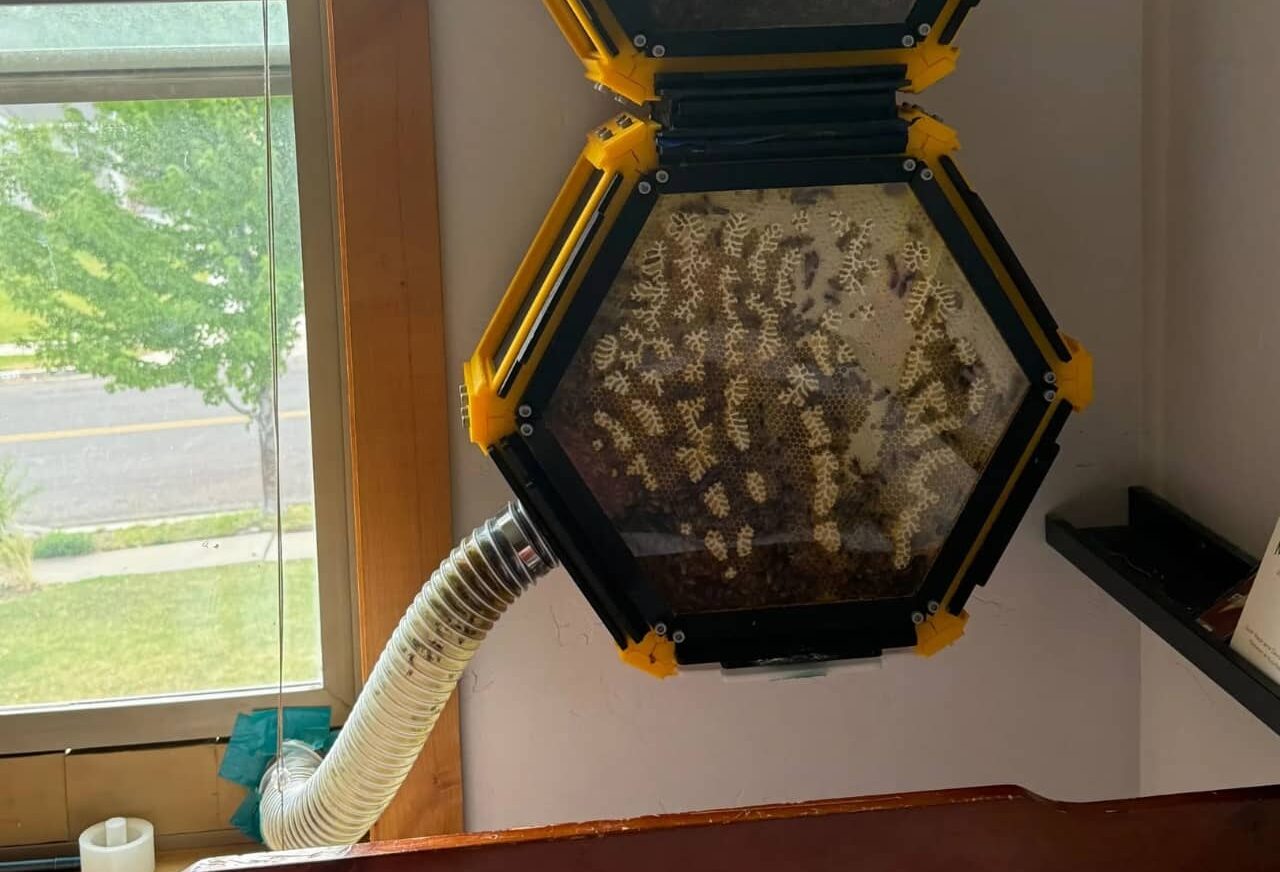
In the United States, a 13-year-old used 3D printing to create a beehive for bees. Although the installation sits on the wall of his bedroom, the teen willingly allows the insects to move in and out freely, so they can venture out and collect the nectar necessary to produce honey.
Hexagonal-Shaped Units
Oliver Taylor, a 13-year-old, lives in the state of Utah, United States. This budding bee enthusiast is behind a clever do-it-yourself project, as revealed by Yanko Design on July 11, 2025. The youngster acquired a starter kit containing 12,000 bees, and within a few months his hive housed no fewer than 40,000 individuals!
While conventional beekeeping hives are typically built from planks, the teenager’s hive consists of two hexagonal-shaped units sourced from 3D printing. These units are connected to a ventilation system that resembles a small air conditioner. This setup gives the bees the freedom to come and go and to engage in one of their main activities: pollination.
There is also a defense system against bees from other colonies that might be tempted to raid the honey (robber bees). The teen has also devised a system to nourish his insects using sugar water.
A Hive on the Path to Improvement
This project becomes even more compelling because Oliver Taylor has demonstrated his ability to solve certain problems. For instance, he has made a few adjustments to limit the chaotic swarming phenomenon, that is, when some bees leave their original hive to establish a new colony. Moreover, the units are removable and thus very easy to maintain and clean.
Today, the teenager is looking to enhance his concept. Indeed, one of the next steps will be to add more modules and thereby increase the number of bees in his colony. However, the young innovator is primarily working on developing a honey extraction system for consumption, as evidenced by a post on Oliver Taylor’s father’s Facebook account.
And could this concept someday be scaled up for mass production and commercialization? If for now there is no sign that industry is taking an interest in this project, it’s worth noting that the fabrication of Oliver Taylor’s hive cost roughly 850 euros. Thus, a conventional hive costs nearly two to three times less. Yet Oliver’s hive has the advantage of being installable indoors, a particularly important detail for protecting bees against the Asian hornet, their main predator.
Source: This teen 3D-printed a beehive for his bedroom (popsci.com)
Article prepared with the help of AI · Our method
