
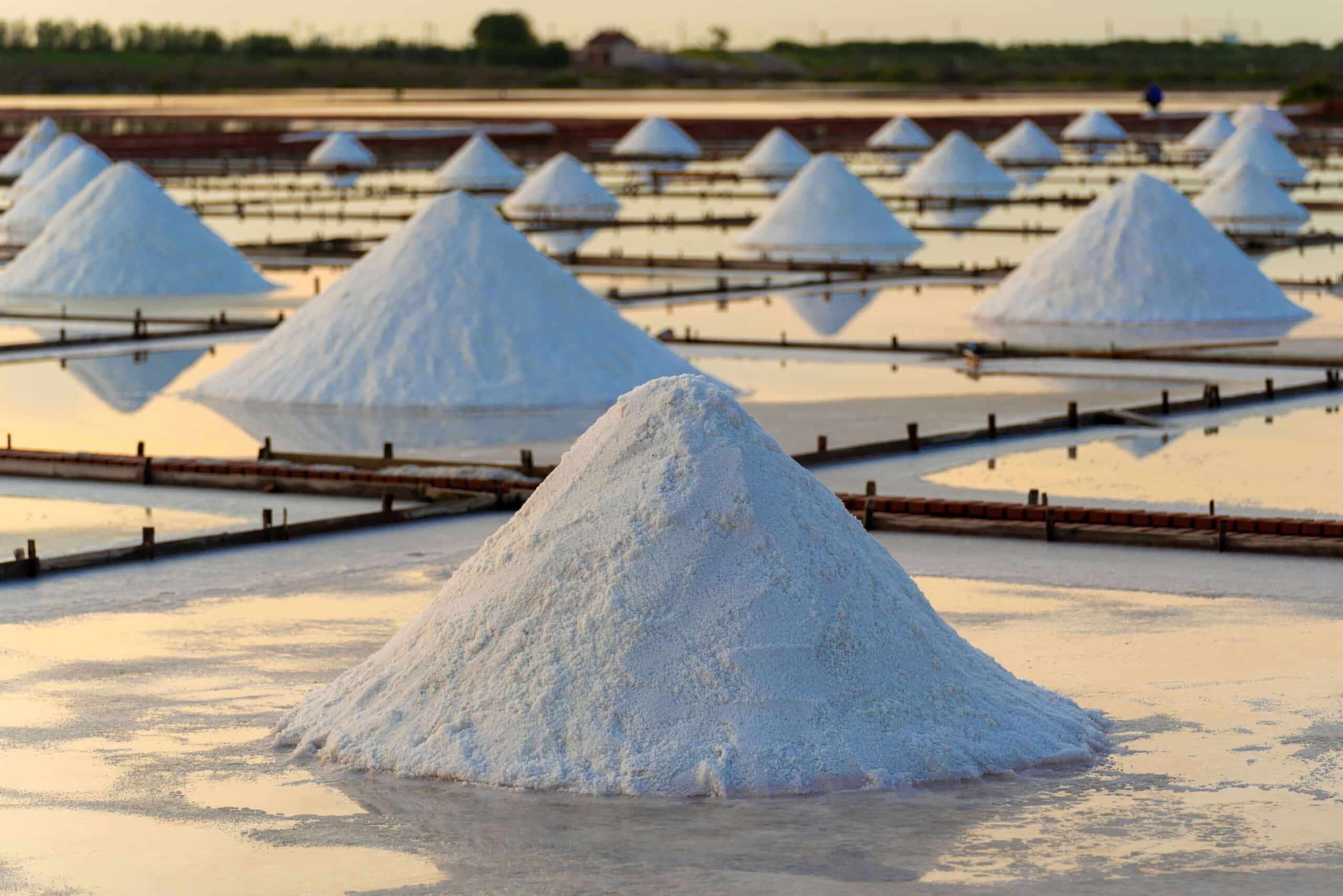
The ocean is a vast expanse of salty water, but did you know that not all the planet’s oceans and seas share the same level of salinity? Some areas are much saltier than others, and these variations are not random. They result from a delicate balance between evaporation, freshwater inputs, temperature, local geography, and marine exchanges.
Where does the salt in seawater come from?
Contrary to what one might think, the salt primarily comes from the continents, but also from hydrothermal sources on the seabed. For millions of years, rivers have eroded rocks, carrying minerals with them, including sodium and chloride. When they reach the seas and oceans, these elements accumulate. Water evaporates, but the salts remain, gradually concentrating salinity.
On average, seawater contains 35 grams of salt per liter, or 35 parts per thousand (ppt). Yet, this value is only a global average and varies widely from region to region.
Some seas are much saltier than others
All of the planet’s oceans contain salt, but their salinity varies strongly by region. Some zones reach levels well above the global average of 35 ppt, while others are markedly lower.
Among the saltiest areas is the Mediterranean Sea, where concentration can climb to 39 ppt, or nearly 40 ppt in the eastern basin. The tropical Atlantic, particularly between 15° and 30° latitude in both hemispheres, also exhibits elevated levels, sometimes exceeding 37 ppt. These zones are often located in hot, arid regions near major deserts such as the Sahara or the Australian desert.
Conversely, some seas display surprisingly low salinity. This is the case for the Baltic Sea, which sometimes falls below 8 ppt, or certain near-Arctic and near-Antarctic regions, which hover around 30 to 34 ppt. These areas are often found in humid or polar climates and receive substantial freshwater inputs.
Where do these salinity differences come from?
Two major mechanisms regulate the salinity of the oceans: evaporation, which concentrates salt, and the addition of freshwater, which dilutes it.
-
Evaporation occurs in hot, sunlit areas where water evaporates faster than precipitation can replace it. This process leaves behind the dissolved salts, making the water saltier. This explains the high salinities observed in the Mediterranean or in the subtropical zones of the Atlantic.
-
The input of freshwater, on the other hand, reduces salinity. This can come from precipitation, river runoff, or melting ice. For example, the Baltic Sea receives water from hundreds of rivers and is poorly connected to the Atlantic Ocean: its salt remains diluted. At the poles, ice melt and the formation of sea ice (which releases salt into the underlying water) also modify the salinity balance.
Thus, each marine zone reflects a balance between evaporation and dilution. These differences profoundly influence ocean circulation, water density, and even certain ecosystems.
Salinity, a driver of ocean currents
Salinity does not only alter the taste of water: it has a fundamental impact on ocean dynamics. Saltier water is denser than fresh water. When it is cold, its density increases even further, causing it to sink toward the depths.
This phenomenon gives rise to deep ocean currents, essential for the global distribution of heat and nutrients. These slow, yet powerful currents influence the world’s climate over the long term.
Another interesting phenomenon is the halocline, a transitional layer between two bodies of water with different salinities. It acts as a physical and acoustic barrier, as it disrupts the propagation of sound waves. Military submarines exploit these layers to hide from sonar, playing a game of hide-and-seek in these zones of contrast.
Source: The Baltic Sea in numbers – The Baltic Sea (itameri.fi)
Article prepared with the help of AI · Our method
