
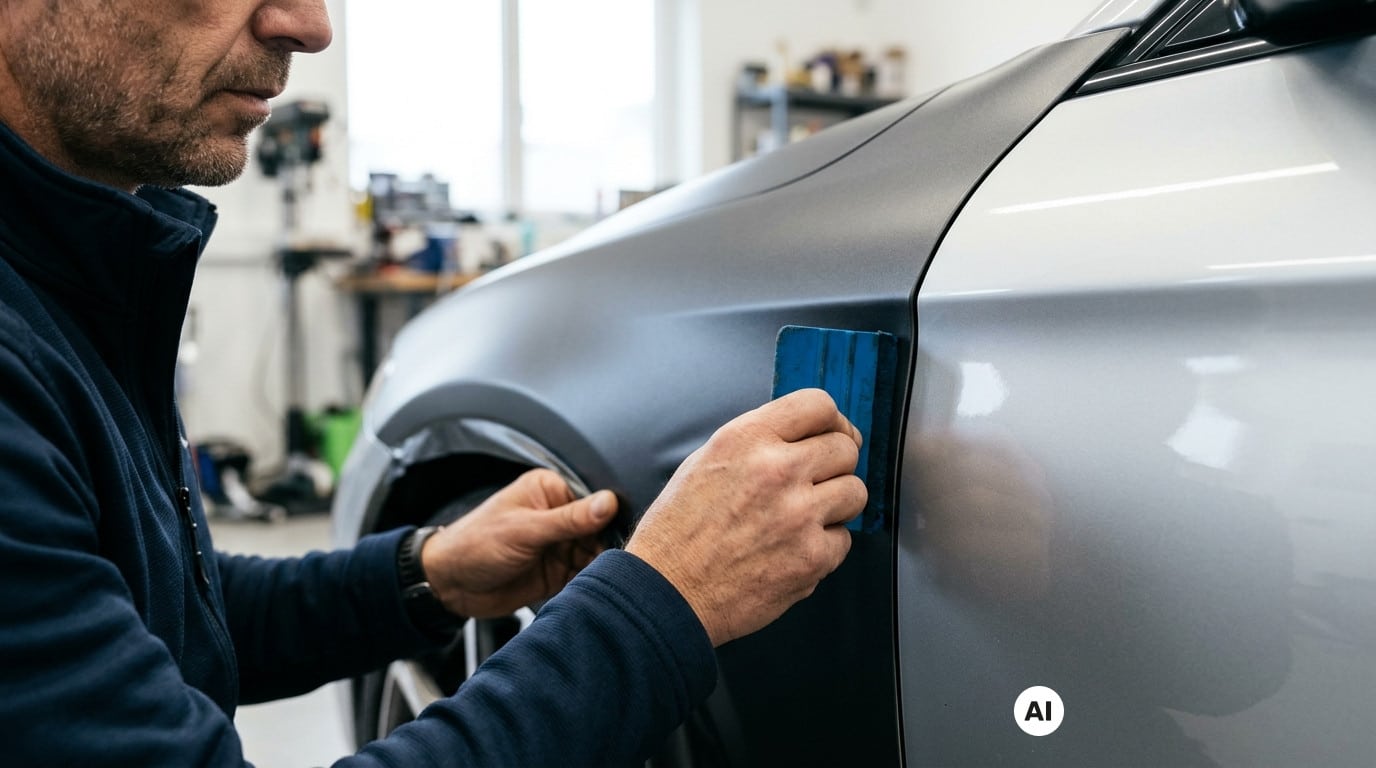
Covering a car with an adhesive film can alter its appearance without repainting. This technique, known as covering, is sometimes presented as more environmentally friendly than a repaint. Yet the absence of spraying during application is not by itself proof of a better environmental balance. graphics.averydennison.com
A rigorous comparison must take into account the manufacture of materials, the preparation of the bodywork, energy consumption, emissions, service life, and waste treatment.
Two processes that require a suitable surface
The covering consists of applying an adhesive film onto the vehicle’s body. Some films are PVC-based; other formulations exist depending on the products. The surface must be clean and compatible with the adhesive. A paint that adheres poorly can peel off when the film is removed: the process is therefore not without risk for the existing coating. graphics.averydennison.com
The application may require local heating to follow the vehicle’s contours and to stabilize certain areas. Calling the operation entirely “cold” would be inaccurate.
Repainting also requires surface preparation adapted to the state of the bodywork. This may involve cleaning, sanding, repairs and the application of several products. It is not always necessary to completely remove the old paint.
Paint: emissions and energy consumption to consider
Automotive painting work uses primers, paints, varnishes and cleaning products. Some contain solvents likely to release volatile organic compounds during preparation, application and drying. Water-based formulations can also contain a fraction of solvents.
Fume cabinets provide ventilation and capture tailored to the work. It is nevertheless important to distinguish paint particulates, captured by certain filters, from solvent vapors: their treatment does not necessarily rely on the same devices.
Drying can be accelerated by heating, which consumes energy. This heating is not automatic: some work can dry at room temperature in a suitably ventilated area. The balance sheet therefore depends on the products and equipment used by the workshop.
Covering: an impact that goes beyond the installation
Covering uses a plastic film, an adhesive and, depending on the finish, inks or additional coatings. Their manufacture and end of life must be included in the comparison.
Recycling presents a particular challenge. Avery Dennison acknowledges that assemblies combining films, adhesives, pigments and inks are difficult to recycle with current technologies. A removed film should not automatically be regarded as recyclable material.
The service life also matters. It varies depending on the product, surface exposure and maintenance conditions. An advertised duration for a vertical application cannot be transposed without caution to the hood or the roof.
To compare, define the same need
A color change, the correction of a few scratches, and the repair of corroded bodywork are different interventions.
For a localized defect, it is relevant to compare a targeted repair with other available solutions, rather than assuming that a full covering is necessary. Covering does not straighten a dent or treat corrosion. Surface defects may remain visible or compromise the film’s adhesion.
An environmental comparison should thus be based on the same surface area, a comparable expected result and the same service life, including any repairs or replacements.
Can we designate a greener solution?
The sources presented do not allow establishing that covering is systematically preferable to painting, nor the reverse. To conclude, a life cycle analysis accounting for the actual products used and workshop practices would be required.
When the paint still serves its function and the change is purely aesthetic, keeping it avoids the additional impacts of a new coating. When intervention is necessary, limiting work to the affected surface and seeking a durable solution are more robust decision criteria than a broad promise of an “eco-friendly” process.
Article prepared with the help of AI · Our method
