
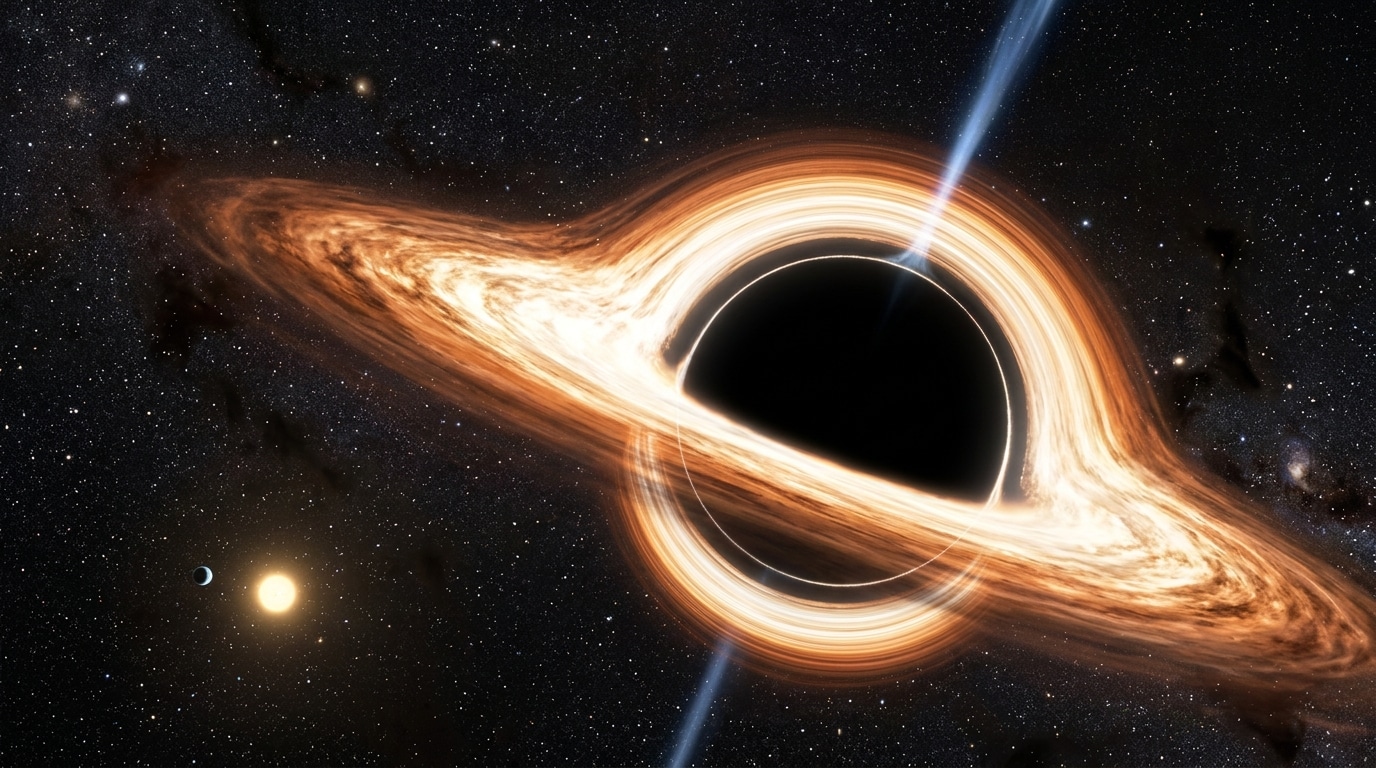
TON 618 is a quasar extremely distant, located near the boundary between the constellations Canes Venatici (the Hunting Dogs) and Coma Berenices (the Hair of Berenice). Its central black hole ranks among the most massive known, with estimates ranging from 40.7 to 66 billion solar masses, depending on the estimation method used. These values are indirect and divergent. In 2025, a more direct measurement, of 36 billion solar masses, was published for another black hole—the one at the center of the Cosmic Horseshoe—so the ranking remains unsettled.
A quasar cataloged in 1957, identified in 1970
TON 618 first appears in a 1957 survey of faint blue stars conducted at the Tonantzintla Observatory in Mexico. The Mexican astronomers Braulio Iriarte and Enrique Chavira record it as number 618 in the Tonantzintla catalog. At that time, the object is not recognized as a quasar: this class of objects would only be identified in 1963.
We must wait until 1970: a radio survey carried out in Bologna detects a radio emission, a sign of a quasar. Marie-Hélène Ulrich subsequently obtains spectra at the McDonald Observatory, which reveal a very high redshift (z = 2.219). For its redshift, the light takes about 10.8 billion years to reach us: the object is therefore very distant and very luminous.
TON 618 is a “radio-loud” quasar, meaning it emits strong radio waves. Like all quasars, it corresponds to the active nucleus of a galaxy: a supermassive black hole fed by a disk of very hot gas, whose radiation outshines the host galaxy. Its luminosity exceeds that of about 140 trillion Suns.
Between 40.7 and 66 billion solar masses
Directly weighing a black hole so distant is not possible. Astronomers infer its mass from the velocity of the surrounding gas: they measure the width of emission lines in the spectrum and estimate the size of the gas region from the quasar’s luminosity.
A study by Shemmer and colleagues (2004), based on the Hβ line, yields about 66 billion solar masses. In 2019, Ge and colleagues revisit the same data using another spectral line, that of ionized carbon (C IV), and find slower gas motion, hence a smaller mass: 40.7 billion solar masses. The two figures remain indirect estimates, and the discrepancy arises from the method used, not from a new observation of the object.
To give a sense of scale, the central black hole of the Milky Way, Sagittarius A*, weighs around 4 million solar masses. In the lower range, TON 618 is about 10,000 times more massive; in the upper range, more than 15,000 times.
A record that is hard to settle
In August 2025, a team led by Carlos Melo-Carneiro published in the Monthly Notices of the Royal Astronomical Society a measurement of the black hole at the center of the Cosmic Horseshoe, a giant galaxy located about five billion light-years away. Its mass is about 36 billion solar masses (36.3 according to some sources), with a detection at 5 sigma.
This measurement combines two methods: the gravitational lensing effect and the motion of stars at the galaxy’s center, which move at nearly 400 km/s. This black hole is quiet: it does not power a quasar, unlike TON 618.
The figures for TON 618 and the Cosmic Horseshoe are thus not directly comparable. One author, from the University of Portsmouth, summarizes: most other mass measurements are indirect and highly uncertain, and “we do not really know which one is bigger.” Depending on the estimate used for TON 618 (40.7 or 66 billion solar masses), the Cosmic Horseshoe is either barely behind or clearly lighter. The title of the most massive remains open.
Sources :
- Unveiling a 36 billion solar mass black hole at the centre of the Cosmic Horseshoe – Melo-Carneiro et al., MNRAS, 2025 (University of Portsmouth)
- University of Portsmouth helps discover most massive black hole ever – University of Portsmouth, August 7, 2025
- Giant Einstein ring reveals one of the Universe’s biggest black holes – Royal Astronomical Society (ScienceDaily)
- The Blueshift of the C IV Broad Emission Line in QSOs – Ge, Zhao, Bian & Green, 2019
- Shemmer, O., Netzer, H., Maiolino, R. et al. (2004), The Astrophysical Journal, 614, 547
- TON 618 – Wikipedia
Article prepared with the aid of an AI · Our method
