
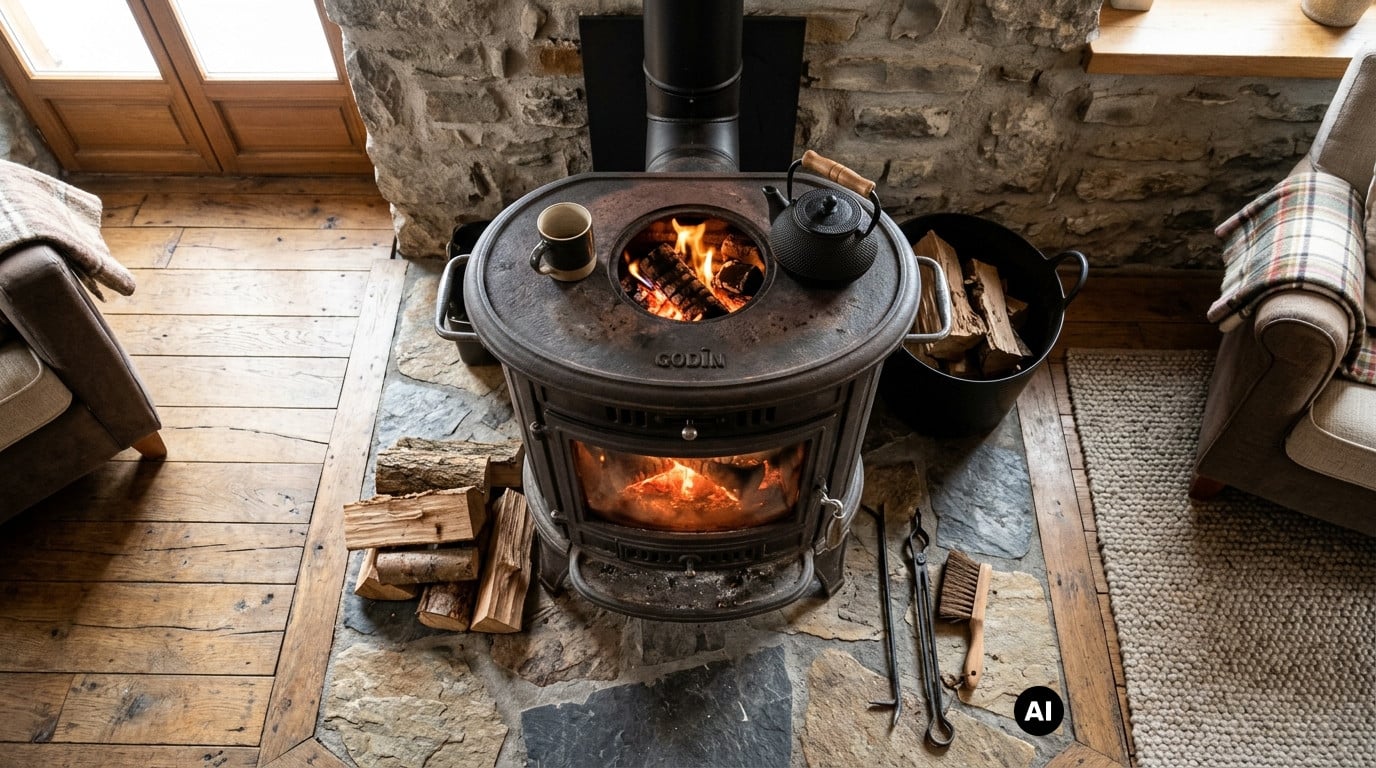
A wood stove that sings a peculiar melody and a glass that turns black in only a few hours: this scenario is familiar to many homes equipped with a stove or insert, even if they don’t fully understand why. People often blame the appliance, sometimes the chimney, rarely the real culprit. Because these symptoms, as irritating as they are dirty, almost always point to the same origin: wood that isn’t as dry as you think.
The good news is that there is a simple way to check this detail before adding another log to the fire. You just need to know how to read correctly the numbers displayed by your measuring device, because a fairly common pitfall could easily distort the diagnosis.
The signs that betray wood still damp
Even before pulling out any measuring tool, the wood itself sends fairly clear signals. The characteristic hiss that comes from a burning log reveals water turning into steam under heat. This sound, often accompanied by small crackles, is not merely incidental: it means that part of the fire’s energy is spent evaporating this residual moisture rather than heating the room.
The glass that gradually darkens is another hard-to-ignore clue. This dark deposit corresponds to residues of incomplete combustion that cling to the cold glass. Properly dry wood produces a brighter flame, and leaves the glass relatively clean from one use to the next. Conversely, a sluggish burn that struggles to ignite should raise a red flag immediately.
Why wood moisture affects combustion and the sooting of the stove
The mechanism is, essentially, quite logical once it is spelled out. A log saturated with water must first release this moisture as steam before it can actually burn. This step consumes a non-negligible portion of the heat produced, which explains why damp wood heats less effectively than dry wood of the same volume. The ADEME even recommends using wood with a moisture content not exceeding 20%, a threshold that guarantees combustion is sufficiently efficient to limit energy losses.
Beyond heating performance, this imperfect combustion generates more residues that deposit on the glass, in the flue, and inside the appliance itself. This very phenomenon explains the accelerated sooting observed with wood that is too humid. A stove that fouls up regularly demands more frequent maintenance, and the overall efficiency of the installation suffers in the long run.
How to correctly measure moisture content with a moisture meter
To move beyond mere intuition and obtain a reliable measurement, the moisture meter remains the reference tool. But the reliability of the result depends largely on where you take the measurement.
The most relevant method is to split the log and measure the moisture at the core of the wood, not on its bark or outer surface, which dry out more quickly and give a misleading picture of reality. It’s at this precise spot that the water still trapped in the wood fibers hides.
There is, however, a technical detail that many users overlook and that can sow confusion. Many moisture meters display a result based on the dry mass of the wood, whereas the ADEME’s recommendation for the 20% threshold is based on the gross mass. Concretely, a 20% rate calculated on gross mass corresponds to a value of 25% when expressed on dry mass, the scale used by many commercial devices.
In other words, if the moisture meter reads 25%, that does not necessarily mean the wood is out of bounds: it may very well meet the recommended threshold, provided you know the scale used by your device. This detail changes everything in interpreting the result, and it’s worth checking the manual before condemning a batch of logs a little too quickly.
Best practices for drying and storing wood effectively
Once the diagnosis is made, the question of drying remains. Wood needs time and proper conditions to naturally shed its moisture and reach that famous recommended threshold. Proper storage planned from the start greatly facilitates this step and helps avoid nasty surprises when lighting the stove.
Source: How to heat with wood properly? (librairie.ademe.fr)
Article prepared with the help of AI · Our method
