
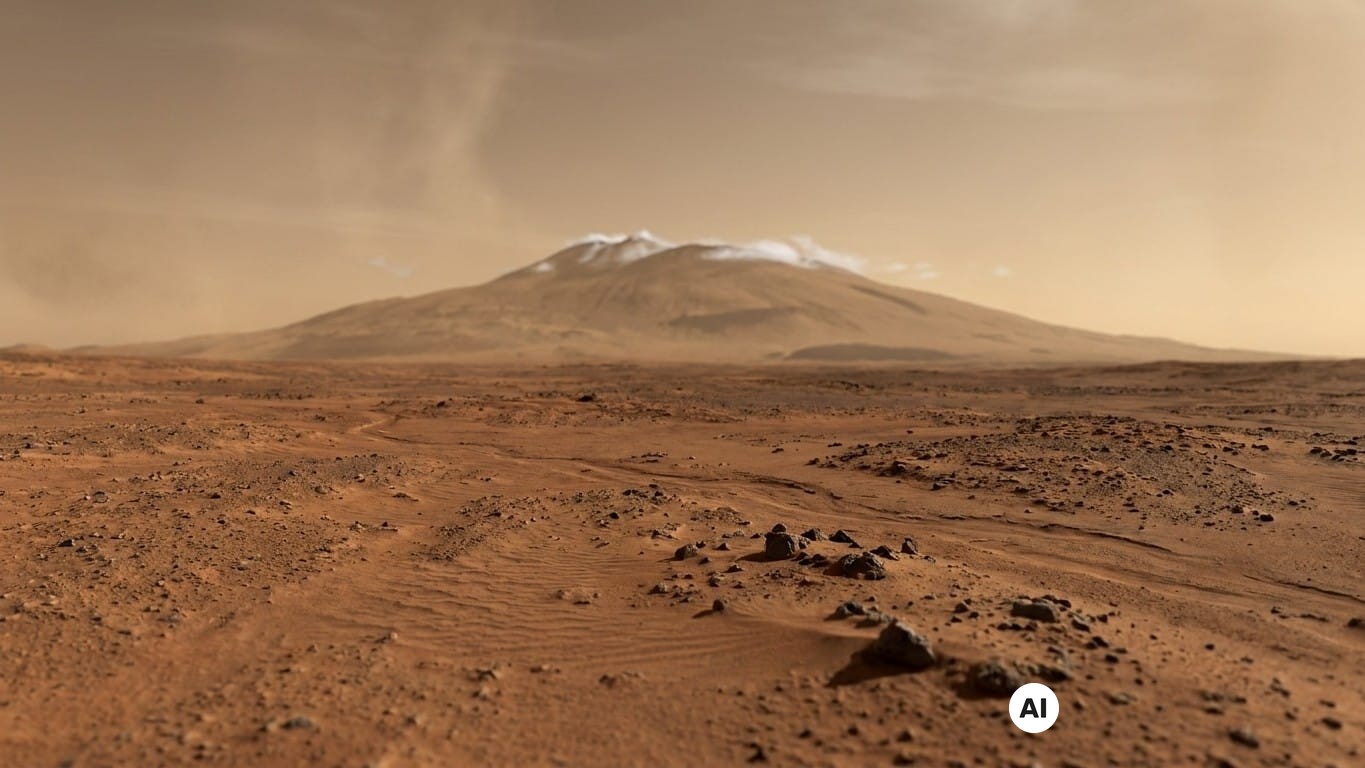
21,229 meters. That is almost three times the height of Mount Everest. Olympus Mons, the colossal volcano on Mars, towers above every other known feature in the solar system, yet no probe has ever approached its sides up close. The absolute height record belongs to a world we have not yet visited.
A Giant That Dwarfs All Terrestrial Records
Rising to about 21,229 meters above the Martian reference level, Olympus Mons stands as the tallest feature known in the solar system. To put this into perspective: Everest peaks at 8,849 meters. Olympus Mons rises roughly 21 kilometers above the global Martian datum, and in places it dominates its immediate surroundings by as much as 26 kilometers. On Earth, Everest reaches about 8.8 kilometers above sea level, while the planet’s tallest volcano, Chile’s Nevados Ojos del Salado, barely exceeds 6.8 kilometers.
Olympus Mons covers an area of roughly 300,000 square kilometers, about the size of Italy or the Philippines. If you set this volcano over France, it would cover more than half of the country. It stretches about 648 kilometers across its base, and its average flank slope does not exceed five degrees, creating a dizzying paradox: a mountain three times higher than Everest, yet with such gentle slopes that a hiker halfway up might not even realize they are climbing. Because of its size and its relatively mild inclines, a person standing on the Martian surface would be unable to perceive the volcano’s full profile, even from afar. One could be on Olympus Mons and not even know it.
Why Mars Was Able to Create This Geological Giant
The extraordinary scale of Olympus Mons can be explained by Mars lacking mobile tectonic plates. Unlike Earth, the Martian crust stays fixed over a hotspot, allowing a volcano to accumulate lava indefinitely in the same spot. On Earth, plate movements creep a volcano over hot spots, producing chains of islands like Hawaii. On Mars, nothing moves. Lava piles up, layer after layer, for billions of years.
Mars’s weaker gravity reduces the crustal stresses, permitting a larger buildup of lava before any collapse occurs. The absence of mobile tectonics lets a mantle hotspot remain in place for extremely long periods. And the relatively low erosion on Mars helps preserve the structure for very long timescales. The result: Martian volcanoes generally live much longer than their Earthly counterparts, Olympus Mons itself surviving for nearly 4 billion years.
At the summit, six nested calderas form an irregular depression measuring about 60 by 80 kilometers, dipping up to 3.2 kilometers deep. Each caldera corresponds to a collapse after the magma chamber shank drained, recording multiple eruptive episodes fossilized in the rock. The enormous magma chamber that fed Olympus Mons could be around 80 kilometers in diameter.
Noticed from Earth Long Before It Was Understood
The volcano’s first name was Nix Olympica, “the snows of Olympus.” It was given by Giovanni Schiaparelli, who noted a white spot at this location in the 19th century and suspected perpetual snows. The high albedo observed from Earth is actually caused not by snow, but by CO₂ ice clouds clinging to its summit—a misinterpretation that persisted for nearly a century.
It was only with the arrival of the Mariner 9 spacecraft in orbit around Mars in 1971 that the volcanic nature of this structure could be recognized. Mariner 9 reached Mars while the planet was shrouded in a global dust storm: the peaks of the major edifices of the Tharsis plateau gradually emerged from the dust, revealing their height. A moment of revelation almost cinematic: the first objects to pierce the storm were precisely the tallest ones. Physics, as an involuntary spoiler.
A Dormant Volcano, Maybe Not Quite Dead
Astronomers estimate that Olympus Mons’s last major eruption occurred about 25 million years ago, which is fairly recent in the geological history of Mars. But “dormant” does not mean “dead.” A finding presented at the Europlanet Science Congress in 2024 highlighted the presence of a vast magmatic plume beneath the Tharsis volcanic region, spanning more than 1,600 kilometers in width and located about 1,100 kilometers beneath the surface. Data indicate that the Olympus Mons region is rising rather than sinking, contrary to expectations. Marsquakes recorded by NASA’s InSight lander testify to ongoing geological processes.
To date, no probe has been able to land near Olympus Mons due to the challenges posed by the rugged terrain. In March 2024, NASA’s Mars Odyssey orbiter captured an unprecedented image of Olympus Mons, offering scientists an unprecedented view of the volcano and enabling the study of different layers of the Martian atmosphere, including clouds and dust. In the same year, researchers detected frost traces on the summit of Olympus Mons, equivalent to the water content of 60 Olympic-sized swimming pools, a discovery that renewed interest in the volcano. Water, in some form or other, at the roof of the solar system. It’s hard not to see this as an invitation to explore further.
Sources: alamyimages.fr | Olympus Mons: The highest summit in the Solar System makes Everest look like a small fry (dailygeekshow.com)
Article prepared with the aid of AI · Our method
