
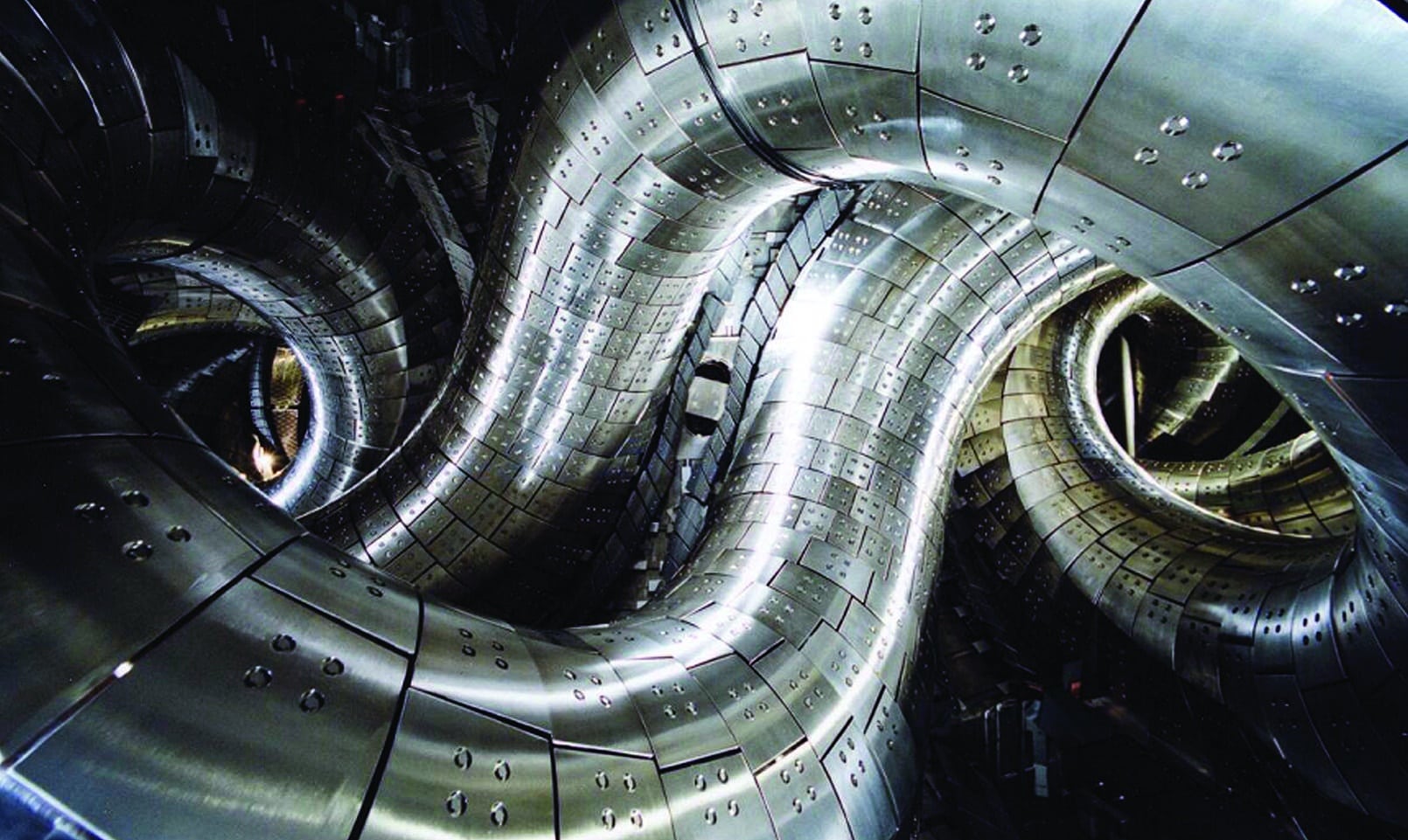
The quest to master nuclear fusion, this clean, nearly unlimited energy source with no long-term radioactive waste, has moved a major step forward. The stellarator Wendelstein 7-X, an experimental reactor installed in Germany, has shattered several world records by demonstrating its ability to maintain an ultra-hot and stable plasma longer than ever before. This success marks a crucial advance toward the goal of producing viable fusion energy at an industrial scale, capable one day of replacing our polluting fossil energy sources.
Nuclear fusion: a clean-energy dream for decades
Nuclear fusion is the reaction that powers our Sun and the stars. It involves fusing light hydrogen nuclei to form heavier nuclei, such as helium, releasing a huge amount of energy. Unlike the fission used in current power plants, fusion produces virtually no long‑lived radioactive waste and does not carry the risk of major nuclear accidents.
Yet reproducing these incredibly extreme conditions on Earth remains a colossal challenge. For fusion to start, the fuel must be heated to about 150 million degrees and confined long enough for the reactions to become self-sustaining. Until now, experimental reactors consumed more energy than they produced.
Stellarators vs Tokamaks: two approaches to confining the plasma
To confine the plasma at these temperatures, two major reactor types are being developed: tokamaks and stellarators. Tokamaks, simpler, use a strong electric current inside the plasma to generate a magnetic field capable of confining it. But this method is difficult to stabilize over long durations, which limits performance.
Stellarators, by contrast, use a complex set of external magnets arranged in a helical shape to keep the plasma stable without relying on an internal current. This system is more challenging to design but promises better stability for prolonged operation. The Wendelstein 7-X is, to date, the most advanced of these stellarators.
A record experimental campaign for Wendelstein 7-X
During recent experiments conducted at the Max Planck Institute for Plasma Physics (IPP) in Greifswald, Germany, the international team behind Wendelstein 7-X exceeded all expectations. The reactor set several world records, notably in the duration for which the plasma remained hot and stable, a fundamental criterion.
The “triple product” — a combined measure of the plasma density, its temperature, and the energy confinement time — reached values comparable to those achieved by the best tokamaks. The triple product is crucial because it measures the efficiency of the reaction: one must surpass a certain threshold (the Lawson criterion) for fusion to become self-sustaining, producing more energy than it consumes.
Thomas Klinger, the operations director of Wendelstein 7-X, called this new record a “formidable achievement” and an “important step toward a stellarator capable of functioning as a power plant.” It is proof that this technology has a promising future.
How did they pull off this masterstroke?
This advance rests on a major technical innovation: a new fuel-injection system. Researchers used an injector developed by the Oak Ridge National Laboratory, which fired about 90 frozen hydrogen pellets into the plasma at velocities close to that of a bullet.
At the same time, the plasma was heated by powerful microwave pulses, reaching a temperature of 30 million degrees Celsius. This clockwork-like operation enabled maintaining for 43 seconds a record triple product, an unprecedented duration for a discharge of such length.
This prolonged confinement of the plasma is essential, because the longer it stays hot and stable, the more energy the fusion reaction produces. The campaign also set another record: an energy exchange of 1.8 gigajoules over six minutes, compared with 1.3 gigajoules in 2023, slightly surpassing the best value achieved by the Chinese EAST tokamak.
Towards commercial fusion energy: a near future?
These results demonstrate that the stellarator is a serious candidate to become the key technology for future fusion power plants. Its ability to keep the plasma stable without an internal current is a huge advantage for continuous commercial operation.
Robert Wolf, head of heating and optimization for Wendelstein 7-X, notes that this achievement is also the fruit of exemplary international collaboration, strengthening confidence in the long-term feasibility of nuclear fusion.
Of course, the path ahead remains long. The next step will be to surpass the Lawson yield threshold and produce more energy than the reactor consumes. Then will come the challenges of constructing large-scale, durable, and economically viable facilities.
But every record broken, every technical advance brings humanity closer to a source of clean, nearly unlimited and safe energy. In a world grappling with the climate crisis, these advances carry hope for a sustainable energy future.
Source : Wendelstein 7-X sets new performance records in fusion research [UPDATE] (ipp.mpg.de)
Article préparé avec l’aide d’une IA · Notre méthode
