
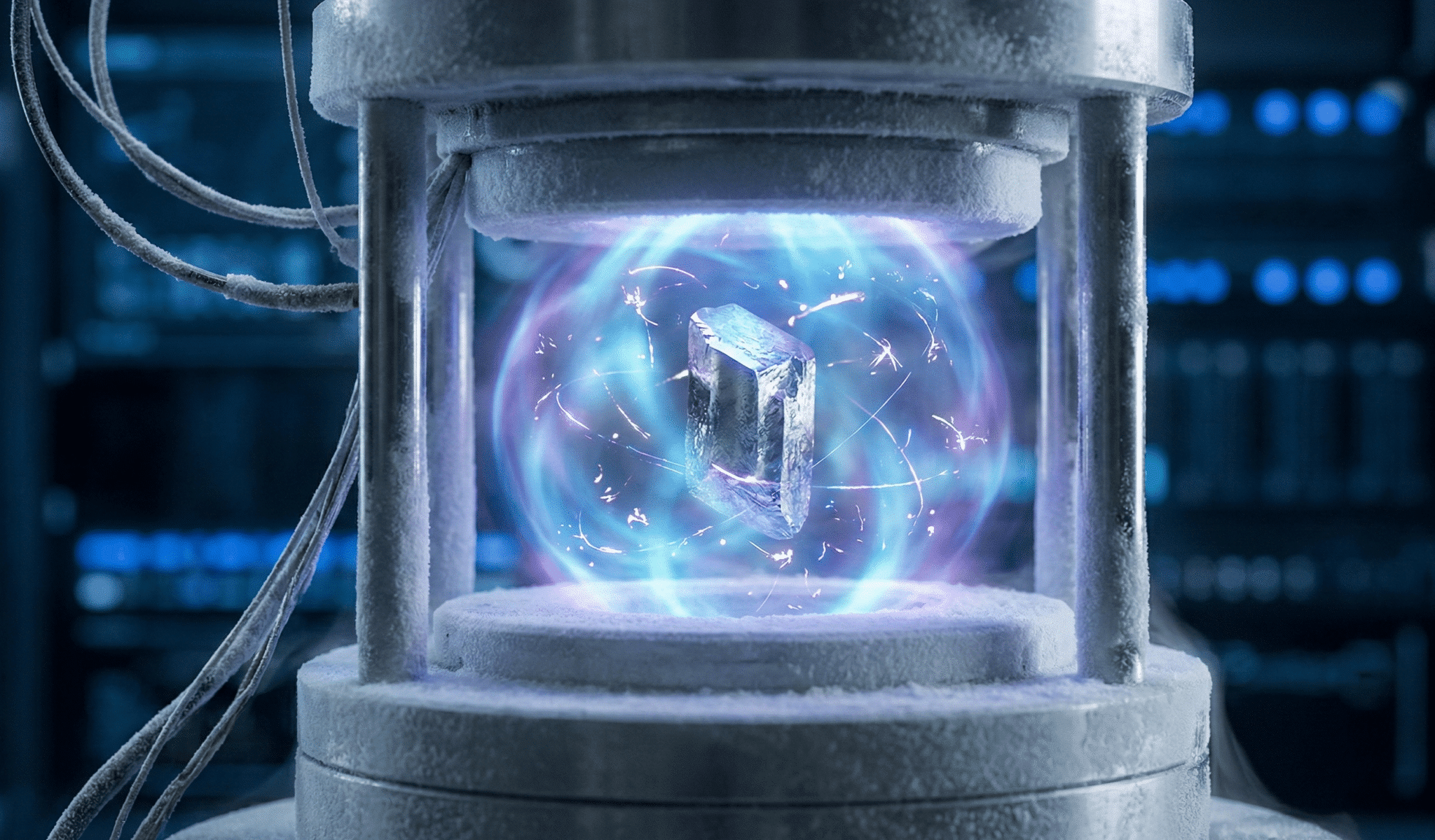
In quantum physics, there are theoretical boundaries once thought insurmountable. One of them has just fallen. An international team of researchers observed the emergence of a quantum state of matter where every physics textbook claimed it could not exist. This discovery, realized in a material cooled to near absolute zero, compels scientists to rewrite the rules governing electron behavior and opens the door to a new era for future computing.
The Forbidden Marriage of Chaos and Order
To grasp the magnitude of this discovery published in Nature Physics, one must imagine two concepts that were long believed incompatible: quantum criticality and topology.
On one side, quantum criticality represents a state of pure chaos. When a material is cooled to extremely low temperatures, it becomes unstable, oscillating between different phases. The individual particles (like electrons) lose their identity and merge into a kind of collective wave “soup.” This is the quantum fog.
On the other hand, topology embodies order and structure. It is a geometry that protects the properties of particles, much like a knot in a rope remains a knot even as the rope is shaken.
Until now, the consensus was clear: you cannot have both at once. Topological order requires well-defined particles, whereas quantum criticality destroys precisely these definitions. It is as if one tried to build a Lego structure (topology) from flowing liquid water (criticality).
The Electron That Spins Without a Magnet
Yet, this is exactly what the team led by Silke Bühler-Paschen (TU Wien) and Qimiao Si (Rice University) observed in a complex material composed of cerium, ruthenium, and tin (CeRu₄Sn₆).
To prove the impossible, they cooled this strange metal to near absolute zero and passed an electric current through it. They then witnessed a startling phenomenon: the Hall effect. Normally, to bend the path of electrons (the Hall effect), a strong magnetic field must be applied. In this experiment, no magnet was present.
The electrons bent their own way, guided solely by an intrinsic property of the material. This was an irrefutable signature that topology (order) endured and thrived at the very heart of quantum criticality (chaos). Contrary to expectations, quantum fluctuations did not erase the order; they stabilized it.
The “Holy Grail” for Quantum Computers?
Why is this theoretical breakthrough a game-changer for the tech industry? Because it addresses one of the biggest challenges in quantum computing: fragility.
Current quantum computers are extremely sensitive to disturbances. This new state of matter offers the best of both worlds:
-
Sensitivity (enabled by quantum criticality) to detect and process information.
-
Stability (enabled by topology) to protect information from errors.
As physicist Qimiao Si explains, “our work shows that powerful quantum effects can combine to create something entirely new.” This isn’t merely a lab curiosity; it could form the building block for electronic components with extraordinary efficiency or sensors with unparalleled precision. Physics has just opened a new door, and we have merely begun to pry it open.
Source: Quantum Physics: New State of Matter Discovered (tuwien.at)
Article prepared with the help of AI · Our method
