
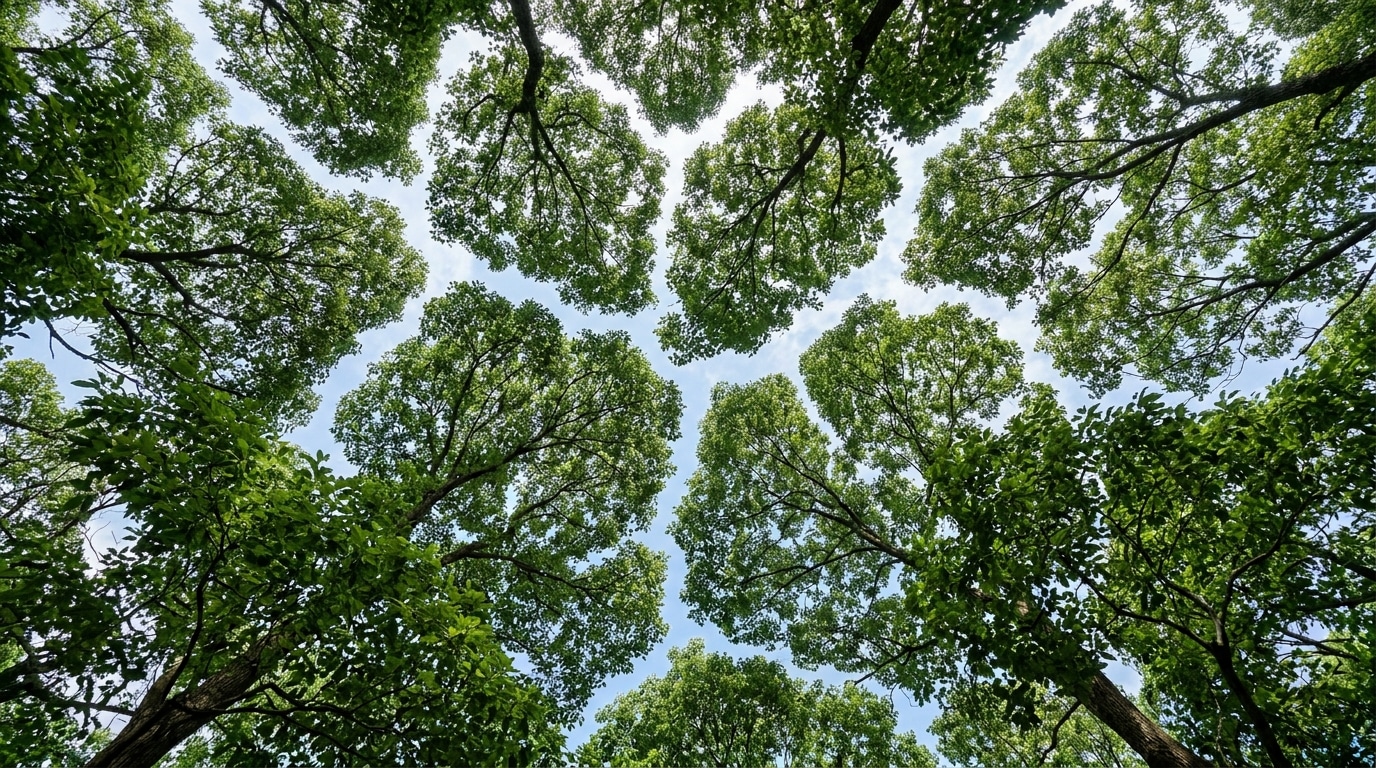
Look up in certain forests: between the treetops, corridors of blue sky wind their way, as if the trees refuse to touch each other. Botanists refer to this as “crown shyness.” The camphor tree of Borneo, which grows notably in Malaysia, is the most studied example. The cause remains debated: branches rubbing in the wind, the neighbor’s shadow, or a barrier against parasites. Researchers today believe there is not a single explanation.
A phenomenon known since the 1920s
In some forests, the crowns of neighboring trees stop growing before they meet. From below, the foliage forms a puzzle of pieces separated by thin gaps, with no overlap. Scientists have debated this phenomenon since the 1920s. The English term “crown shyness” refers to the work of forester Lane-Poole, cited in 1955 by researcher Jacobs, who studied eucalypts in Australia. The French translation, “timidity of the tops,” is more recent.
The emblematic species is the camphor tree of Borneo, Dryobalanops aromatica. This can be seen, for example, at the Malaysian Forest Research Institute, where the gaps clearly separate the canopies. In 1977, the Malaysian forester Francis Ng described it among the large Asian trees in the Dipterocarpaceae family. In 1981, Francis Hallé and Francis Ng also illustrated a form of shyness inside a single crown, between branches of a single tree.
The phenomenon is also observed in France, for instance on stone pines at the Villa Thuret, Cap d’Antibes. Other species display it as well: eucalyptus, twisted pine (Pinus contorta), black mangrove. There are no precise figures required for how many species are involved or how wide the gaps are: it varies from forest to forest.
The wind hypothesis: branches damaged by rubbing
The most well-supported explanation is mechanical. In wind-exposed forests, flexible branches sway and collide. These repeated impacts damage buds and young shoots at the tips. Growth then slows and stops at the point of contact, without any signal needing to travel between trees.
This idea goes back to the 1950s: a 1955 study on eucalyptus in northeastern Australia already concluded that abrasion killed terminal shoots. In 1984, biologist Francis Putz and his team reinforced this finding on black mangroves of Costa Rica. If two canopies are prevented from colliding artificially, they eventually fill the gap that separated them.
A 2021 study in Annals of Botany by researchers from Wageningen University and the University of Oxford refined the pattern in three dimensions. LiDAR laser scans were conducted in Guyana in 2017, on 14 pairs of trees chosen from more than a hundred. The researchers measured how much the surfaces of two neighboring crowns interlock. This interlocking is more pronounced when the trees are tall: the correlation is positive (R² = 0.48).
Light, parasites: clues that add to the wind
Wind does not explain everything. Francis Ng had proposed that the branch tips slow their growth when they approach the neighboring foliage, because they are shaded. In extension, one hypothesis suggests that plants possess photoreceptors capable of detecting a neighbor. The link between these photoreceptors and the crown’s shape has not been demonstrated experimentally.
Another possibility concerns the health of the trees. The gaps allow light to reach the understory. Francis Putz suggests they might also hinder the progress of lianas, non-flying insects, and certain pathogens from one crown to another. This idea remains speculative: it has not been proven.
As the mechanisms vary from forest to forest and from species to species, experts acknowledge that several causes can produce the same pattern. The gaps between the crowns thus are not the signature of a single strategy.
Sources :
- Crown shyness – Wikipedia
- Mechanical Abrasion and Intercrown Spacing – Putz, Parker & Archibald, American Midland Naturalist, 1984 (Smithsonian)
- Understanding crown shyness from a 3-D perspective – van der Zee, Lau & Shenkin, Annals of Botany, 2021 (PMC)
- Tree crowns avoid colliding in 3D – Botany One
- Some trees may ‘social distance’ to avoid disease – National Geographic
- Crown shyness: are trees social distancing too? – Natural History Museum
- Timidité des couronnes – Université de Montpellier (HAL)
Article prepared with the help of AI · Our method
