
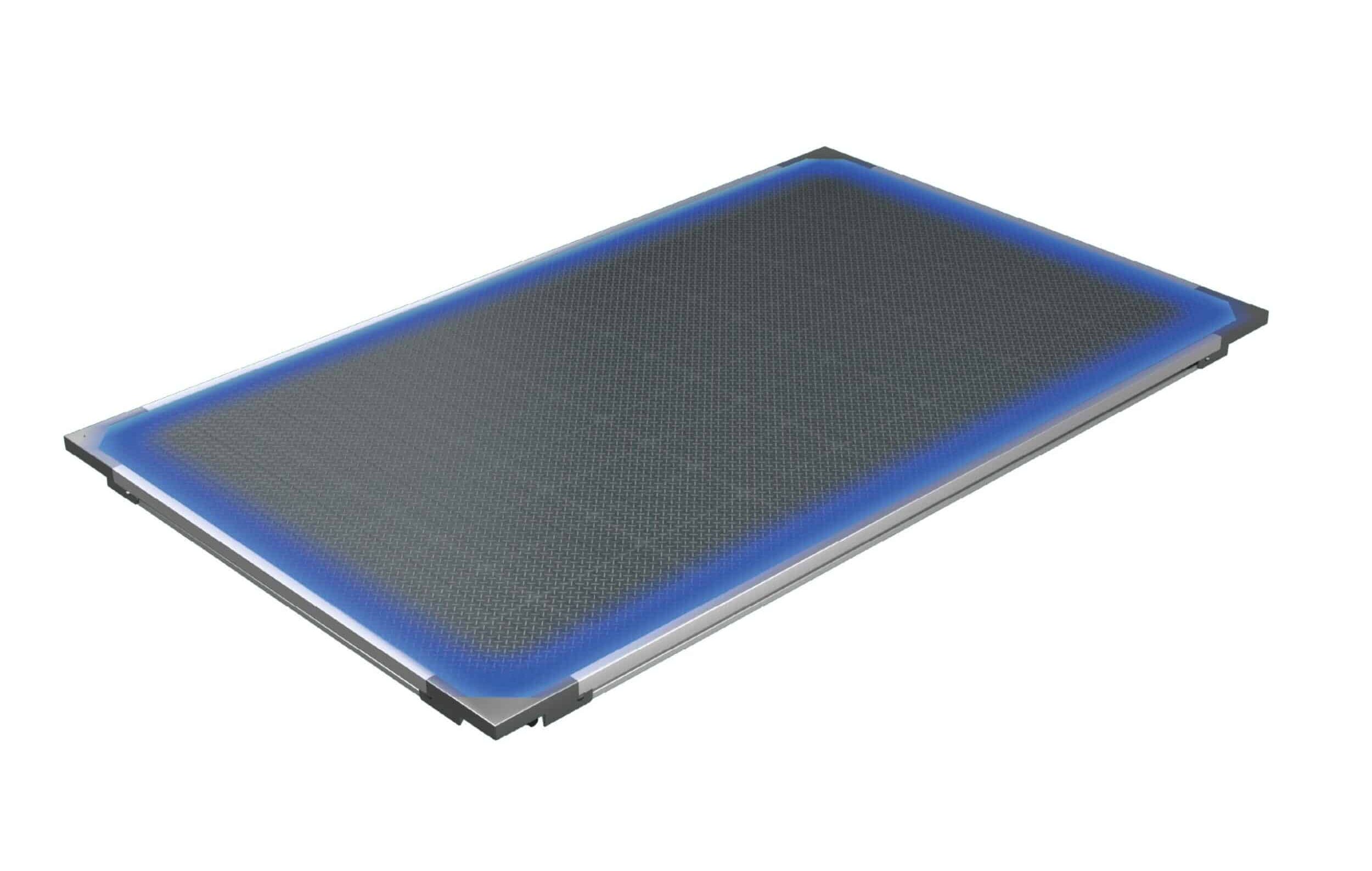
A Chinese company has recently introduced a new product to the European market: the Harmony-F Solar Flooring. This is a photovoltaic pavement system distinguished by its mechanical robustness and high energy performance. What should one know about this technology? What are its advantages?
A system designed for pedestrian zones
Founded in 2009, the Chinese company Arctech is typically best known for its industrial solar trackers. These are motorized, intelligent support structures built for large-scale photovoltaic parks. In a press release issued on May 6, 2026, the company announced plans to diversify its European catalog with a new product: the Harmony-F Solar Flooring. The concept involves photovoltaic tiles, a floor covering intended for sidewalks, walkways and other outdoor spaces such as building façades. The goal is clear: to help convert pedestrian areas into sources of green energy.
« This off-grid solution is designed to generate renewable energy on walkable surfaces such as sidewalks, walkways and building façades. », reads the press release.
The system incorporates solar cells of the TOPCon (Tunnel Oxide Passivated Contact) type. According to Arctech, this technology offers higher conversion efficiency and less degradation over time compared with the conventional Passivated Emitter and Rear Cell (PERC) cells. In addition, TOPCon cells more effectively capture diffuse radiation, which is a real asset since the tiles laid flat on the ground sit within urban spaces that naturally experience shading.
Tiles able to withstand extreme conditions
Installing solar tiles directly on the ground obviously demands exceptional durability. The Harmony-F system can support maximum loads of up to two tonnes. It therefore endures heavy pedestrian traffic as well as the passage of light vehicles. In terms of hardness, the surface reaches Mohs hardness level 7, granting extreme resistance to scratching and abrasion.
Moreover, the flooring is non-slip (JGJ/T 331-2014 standard) for enhanced pedestrian safety and carries an IP67 rating, providing total protection against dust and temporary immersion. Finally, the tiles remain , thereby resisting severe frosts and intense heat waves.
What about performance?
Not surprisingly, the Harmony-F units were designed to fit the constraints of urban furniture. The tiles measure 1200 × 600 × 45 mm and weigh 28 kg each. In terms of performance, each tile can deliver up to 110 Wp (peak watts). Also worth noting is the top protective layer, whose treatment yields light transmittance above 85%, thereby maximizing the exposure of the underlying cells. It should also be highlighted that TOPCon cells offer 3–5% higher efficiencies than PERC cells. Furthermore, the system supports a maximum DC voltage of 1500 V, simplifying connections to large networks or hybrid systems.
With this launch, Arctech targets municipalities and European eco-district projects potentially interested in local, clean energy production, all while avoiding the need for additional ground space or rooftop modifications.
Source : Arctech debuts TOPCon photovoltaic pavement solution (pv-magazine.com)
Article prepared with the help of AI · Our method
