
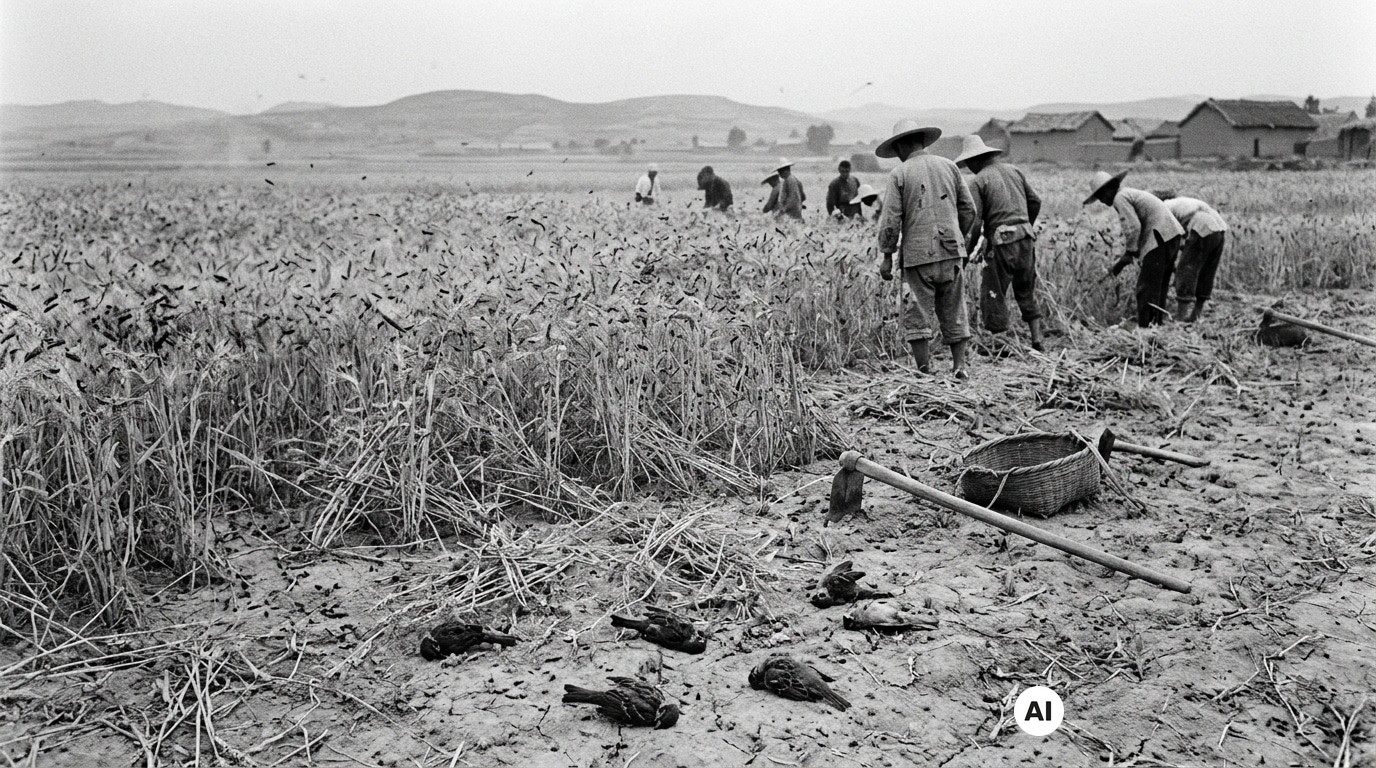
People often imagine that famine is primarily a matter of climate: drought, flood, a late frost that ruins the fields. Yet one of the largest food disasters in human history cannot be explained solely by weather or poor harvests. It partly originates in a political decision, carried out with formidable discipline, aimed at an adversary weighing barely 30 grams: the Eurasian tree sparrow. In 1958, China declared war on this small bird. Three years later, tens of millions of people died of hunger. For a long time, the link between these two facts remained within the realm of hypothesis advanced by environmental historians. Today, it has been quantified, and the result is dizzying.
A Political Order Against a 30-Gram Sparrow
How could an entire country decide to exterminate a species? Yet that is what happened. The reasoning seemed indisputable on paper: sparrows peck grain in the fields, thus they reduce harvests, so their disappearance should logically free up more food for humans. A simple, appealing equation, and catastrophically false. The problem is that this arithmetic ignored the functioning of an ecosystem. A study published in 2025 quantified the scale of the disaster: nearly 20% of the collapse of agricultural production during this period could be attributed to this single decision. Not drought, not a reckless agricultural policy, but the deliberate disappearance of a bird.
The Four Pests Campaign or How to Decree the Death of a Species
In 1958, China launched the famous Four Pests Campaign. The stated objective: to improve farming and public health by eradicating four designated enemies — flies, mosquitoes, rats, and sparrows. For the latter, the method was terrifyingly effective. Rather than killing them one by one, the population was mobilized to prevent them from landing. Millions of people pounded on pots, waved banners, and produced a continuous din to keep the birds in flight. Exhausted, unable to rest, the sparrows fell to the ground, dead from exhaustion.
One anecdote alone encapsulates the scale of the operation. At the Polish embassy, where sparrows had taken refuge, the diplomats refused to participate in the hunt. No matter: drums resounded uninterrupted for two days around the building. After this sonic siege, the Poles had to use shovels to clear the corpses of birds that littered the pavement. In total, it is estimated that nearly two billion sparrows were eliminated.
The Biological Error No One Dared Correct in Time
Here’s the crux of the tragedy. Yes, the adult sparrow does eat grain. But the essential point is overlooked: to feed their nestlings, they deliver a substantial amount of insects. The sparrow is not only a consumer of cereals; it is also a formidable predator of pests that ravage crops. By removing it, China did not gain grain: it removed a key component of the natural regulation system of the fields.
The consequences did not take long to manifest. Deprived of their principal winged foe, the insects, particularly locusts, flourished without restraint. The fields, now unguarded, were left to the pests. Some scientists had warned about this ecological role, but their cautions were dismissed. It would take until 1960 for the logic to prevail again: the sparrow was discreetly removed from the list of pests, often replaced by the bug. The comparison between the official posters of 1958 and those of 1960 testifies to this silent reversal. Too late.
What the 2025 Figure Reveals About the Food Chain
How to measure the impact of a bird disappeared over sixty years ago when there was no census of sparrow populations at the time? Researchers demonstrated ingenuity. Failing direct data, they used an indirect indicator: a habitat suitability score, i.e., a measure of each region’s capacity to host sparrows. By cross-referencing these data with newly digitized agricultural and demographic statistics, a clear pattern emerged.
The results are telling. Where sparrows were most prevalent before their eradication, harvest losses were the most severe: about 5.3% for rice and up to 8.7% for wheat. A methodological detail strengthens the robustness of this conclusion: before the campaign, a region’s sparrow suitability had no relationship with its agricultural productivity. It was the disappearance of the birds that tipped the balance. In other words, the sparrow was what scholars call a keystone species, a quiet but essential link in the food chain.
When a Poor Harvest Becomes a Mass Famine
A drop in yields, even a substantial one, does not inevitably lead to a catastrophe. What turned an agricultural deficit into tragedy were the state-imposed food requisitions. Stockpiles were drawn down without accounting for actual losses, leaving campaigns stripped of their food. In the areas where sparrows were most abundant, mortality rose by nearly 9.6%, which alone accounts for about two million additional deaths.
These two million victims constitute only a fraction of the total tally of the Great Famine of 1959-1961, which claimed between 16 and 45 million lives depending on the source. But this figure carries a major symbolic weight: it isolates for the first time the portion of responsibility directly attributable to the disappearance of a single animal species.
The tale of the Chinese sparrow is not merely a past curiosity. It reminds us, with unusually blunt force, that every species occupies a place in an invisible balance whose value we rarely appreciate before breaking it. At a time when biodiversity is retreating worldwide, this lesson more than half a century old lands with a haunting resonance. How many quiet guardians of our ecosystems do we still overlook today, until their absence is painfully felt?
Source: Campaigning for Extinction: Eradication of Sparrows and the Great Famine in China – The Institute for Climate (climate.uchicago.edu)
Article prepared with the help of AI · Our method
