
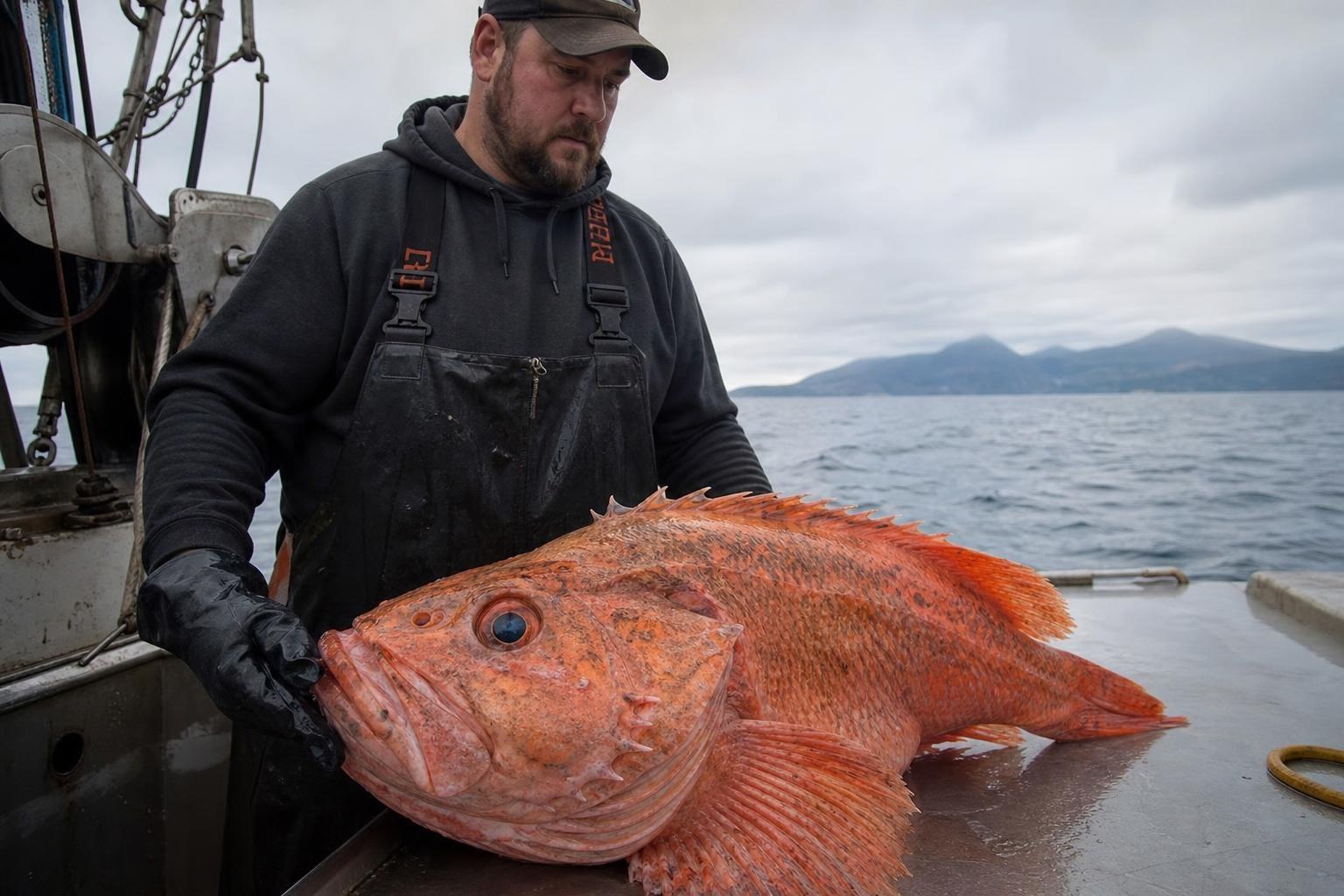
The hook sank, the line trembled, and a fish surfaced with the kind of age that makes time feel rubbery. In cold northern waters, a rockfish lived through two centuries, drifting through winters so long they remade the sea. Someone lifted it from the deep, and the calendar suddenly stretched, reminding us that human maps, treaties, and borders are just interruptions in older, quieter timelines.
“Imagine being a creature that remembers no war, no treaty, no flag,” one observer mused. “Only pressure, temperature, and the slow clock of the ocean.”
How do you count two centuries of fish life?
A fish this old keeps its biography in bone, not ink, and scientists read it like a tree. Hidden inside the skull sit the otoliths, ear stones that lay down rings year by year, whispering a ledger of seasons, diets, and growth. When specialists section those stones and count bands, they turn guesswork into measure, translating mineral circles into years that feel almost impossible.
Age in rockfish is easy to overestimate with size, because a big body does not always mean elder. Deep, cold water slows metabolism; scarcity stretches childhood; and at depth, survival is patience made flesh. The method is gritty and careful—thin slices, microscopes, multiple readers—because a claim like “two hundred” asks for evidence that can stand weight.
Born into a world before our paperwork
This fish entered life before new maps were stamped and new laws took hold. It grew while empires traded territories, while shorelines learned new names, while a purchase price was inked and sealed. Far offshore, none of that mattered; the fish rode currents, hunted plankton and shrimp, dodged predators whose patience matched its own. “The sea tracks a different calendar,” an old deckhand once said. “And it doesn’t ask for our permission.”
To feel the stretch of that era, consider what two centuries contains:
- Steam gave way to diesel, telegraph to fiber, wooden schooners to sonar and satellite-fed charts.
Why some fish live this long
Rockfish are masters of the slow lane: late maturity, episodic recruitment, and the kind of longevity that buffers bad years with very good ones. Many species in the genus Sebastes evolve for depth and cold, where less light and steady temperatures favor a strategy of waiting rather than racing. They invest in survival, not speed; in resilience, not sprint.
That strategy cuts both ways. When we fish them hard, recovery takes decades, not seasons. A population can slip quietly toward thinness while the surface still looks full. The math is forgiving for a while—until suddenly it isn’t.
Science written in rings and riddles
Scientists do more than count rings; they validate with chemistry and statistics, cross-checking age against known signals like bomb-era isotopes or radiometric clocks. Each test is a question to the otolith: Are these lines true years, or the stutter of a stress event? The best results line up like a chorus, each method singing the same note.
That is how a claim like “over two centuries” moves from bar talk to paper, from amazement to evidence. “You think you know time,” a lab tech once remarked, “and then a fish shows you a different unit.”
Ethics at the end of the line
A catch like this is a mirror, asking what it means to take a life that took two hundred years to grow. Some call it a stroke of luck, others a loss that can’t be repaid. Both feelings can be true. The data it offers inform policy, but the weight of its years asks for more than tables and thresholds.
Sensible management is not mystery. It looks like depth-based closures, conservative quotas, selective gear, and sanctuaries where elders keep their slow watch. It looks like humility in the face of lifespans that dwarf our attention.
What a 205-year fish teaches
Longevity is not a parlor trick; it is a library of adaptations that may help populations ride shifting oceans. Old females in some rockfish species produce more—and higher-quality—offspring, a compounding benefit that keeps years of poor recruitment from turning into collapse. Protecting the oldest is not an ornament; it is infrastructure for tomorrow.
There is also the climate angle. As temperatures creep and oxygen slides, the calculus of slow growth and late maturity may change, stressing a life strategy tuned to colder, steadier baselines. The elders have survived many swings, but even patience has limits.
The long now beneath the hull
Hold the image: a scarlet flank, spines like careful calligraphy, eyes reflecting a light they did not evolve to greet. The deck smells of salt, the winch ticks down, and someone holds a being older than any grandparent they have ever known. “Two centuries waiting, five minutes on the surface,” a voice might say, “and most of us only notice the photograph.”
Maybe that is the task the deep keeps handing us: to meet age with awe, to match patience with policy, to translate long lives into choices that last longer than the day’s catch. The fish did its part—two hundred years of quiet practice. The rest is up to our shorter, noisier kind.
