
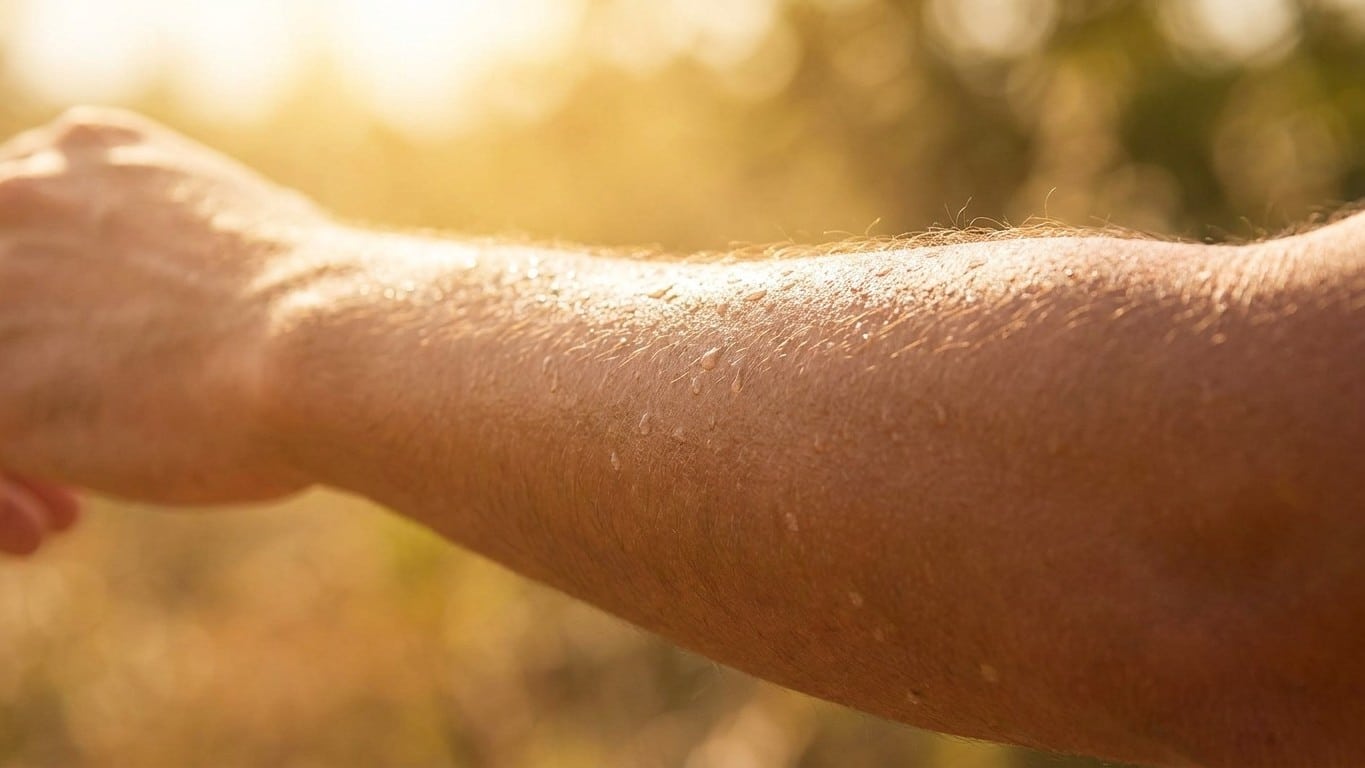
Thirty-five degrees in the shade. The first day of a heatwave: it’s a blow, breathless, sweat sticking. Two weeks later, the same temperature is endured without drama. The same thermometer, the same sun. A different body.
This isn’t just a feeling. These adaptations occur over 7 to 14 days of regular heat exposure, although some changes can continue to develop over several weeks. The phenomenon has a name: thermal acclimatization. And it rests on precise physiological mechanisms, measurable, documented by decades of research in sports medicine and environmental physiology.
What Really Changes in the Body
The first lever, and probably the most dramatic, concerns the blood itself. Repeated exposure to heat stress over 7 to 14 days triggers several physiological adaptations: the blood plasma volume increases, improving blood circulation and promoting heat loss. This rise accounts for 10 to 12% of the plasma volume, which maintains central blood volume, stroke volume, and sweating capacity. Put plainly, your heart no longer has to work as hard to supply both the muscles and the skin: it has more liquid fuel at its disposal.
Sweating, too, becomes more refined. The sweat adaptation is shown by a shortening of the delay between the start of effort and the onset of sweating, with sweat production becoming more abundant but less mineral-concentrated: you lose less salt, but more water, which must be balanced by drinking. This detail deserves emphasis: at the start of summer, you lose a lot of salt in your sweat, which explains cramps and quick fatigue. Acclimatization increases the number of active sweat glands and promotes the reabsorption of mineral ions like sodium, chloride, and potassium by the sweat glands, thereby limiting their loss in sweat.
Acclimatization can boost the amount of sweat produced to nearly three times the quantity observed without acclimatization. Three times. It marks the difference between an undersized cooling system and industrial-grade air conditioning.
The Timeline of the Transformation
In the best-case scenario, 75 to 80% of physiological adaptations occur during the first 4 to 7 days of daily heat exposure. Heart rate drops after 4 to 5 days, body temperature after 7 days. It is not linear: early victories are swift, while the final refinements take longer.
After 7 days, most adaptations are in place, with an optimal duration of 2 weeks to optimize sweating adaptations and performance during exercise. Professionals have understood this well. Tennis players contesting the first Grand Slam of the year in Australia routinely plan an acclimatization period to avoid wilting on court upon arrival. For the Tokyo Olympics, athletes prepared with 10 days of daily heat exposure.
The recommended protocol is progressive. Over a span of 7 to 14 days, one gradually transitions from moderate activity for 15 minutes per day, enough to stimulate sweating, to 1 to 2 hours of intense activity. The goal isn’t to suffer but to maintain a sufficient thermal stress to trigger adaptations without overloading the body.
Acclimatization Wanes as Fast as It Gains
Here is the lesser-known downside of the phenomenon. Researchers estimate losses of about 2 to 3% of the benefits per day without exposure to heat. During this window just after a period of acclimatization, the benefits quickly return when exposure resumes. A vacation return home to a hot country after two weeks in an air-conditioned office? Acclimatization begins to fade after about a week away from heat. After a month absent, most individuals’ heat tolerance returns to baseline.
This cycle explains a universal experience: the first heatwave weekend of summer is always the worst. The body hasn’t had time to adjust. We emerge directly from a winter spent indoors with heating, without a gradual thermal transition. Acclimatization refers to the process by which the body gradually adapts to a hot environment in order to better tolerate physical effort under these conditions, with a sequence of physiological adaptations that enable more effective regulation of body temperature and reduce the risk of heat-related illness.
What This Means for Everyone, Not Just Athletes
Acclimatization isn’t reserved for marathon runners. Anyone who is exposed daily to outdoor heat benefits from the same process. A construction worker, a bicycle courier, a gardener. On average, 7 to 14 days of exposure to hot weather are enough to achieve meaningful adaptations, according to Santé Publique France.
But some profiles acclimate less well or more slowly. Certain conditions like diabetes and cardiovascular diseases, as well as medications such as beta-blockers and diuretics, disrupt thermoregulation. Older individuals are particularly vulnerable because they show higher instances of dehydration and age-related loss of heat-shock proteins. Children, meanwhile, are at risk due to a higher surface-area-to-mass ratio and lower sweat production.
The good news is captured in a single figure. The physiological changes favored by acclimatization include increased sweating, expansion of plasma volume, improved cardiovascular performance, better hydro-electrolyte balance, and a decrease in the energetic cost of effort. An acclimatized body spends less energy to perform the same work in the heat. This gain in efficiency, achieved after two weeks of progressive exposure, remains one of the fastest physiological adaptations the adult human body can accomplish, which stands in clear contrast to altitude adaptation, which requires several additional weeks for comparable benefits.
Sources: Santé. Exercising in hot weather: what are the risks for the body? (mon-sejour-en-montagne.com) | Heat and athletic performance: how far can your body go? (ma-sante.news)
Article prepared with the help of AI · Our method
